
Heavily rotated Arsenal swat aside Napoli

As predicted, Arsenal arrived in Naples with a heavily rotated side with 4 changes from the weekends game with Chelsea – Mikel Merino, Viktor Gyokeres, Eberechi Eze and Piero Hincapie all coming into the starting XI.

In a hostile stadium, against a Napoli team with plenty of experience and attacking quality, the changes made little difference. Mikel Arteta’s side were simply better.

The final score was only 1-0, thanks to Martin Ødegaard’s superb strike in the 75th minute, but the scoreboard was doing Napoli a considerable favour. Arsenal had chances to put this game beyond doubt long before the captain finally found the net.

And that is perhaps the most encouraging part of the evening.

This wasn’t Arsenal at full strength desperately hanging on for a famous away victory. This was a rotated Arsenal side controlling a Champions League match in Naples as though it were a routine Saturday afternoon fixture.

There was no great sense of Arsenal needing time to settle. The ball was moved around with the usual patience, Napoli were pushed backwards and the Gunners repeatedly found spaces between and around the home side’s midfield.

The only thing missing was the finish.

Arsenal created enough opportunities to have been comfortably ahead before half-time, with Mikel Merino among those unable to convert. The second half followed much the same pattern: Arsenal continued to dictate, while Napoli struggled to turn possession into anything remotely resembling sustained pressure.

For all the talk beforehand about the difficulty of playing in Naples, Arsenal made the occasion look surprisingly ordinary.

That is not an insult to Napoli. It is a compliment to Arsenal.

Perhaps the biggest takeaway is what the performance says about the squad – Arteta made significant changes, yet the structure remained.

The pressing remained. The control remained. The defensive discipline remained. Most importantly, the expectation that Arsenal would dominate the ball and territory remained. This is what squad development is supposed to look like.

You don’t build a team capable of competing for major honours simply by having eleven excellent players. You build a squad in which the standards don’t collapse when you rotate three, four or five positions.

Against Napoli, Arsenal looked like a team with depth rather than a team forced to compromise because of it. And then there was the captain.

Martin Ødegaard has started this season looking like a man determined to remind everyone exactly how good he is.

He has now scored four goals in five games, and this one was arguably the best of the lot. After Arsenal worked the ball into a dangerous position, Ødegaard found the space outside the box and produced a superb first-time strike that flew away from the goalkeeper and in off the post.

It was the sort of goal that had been threatening to arrive all evening.

The Norwegian was also central to almost everything Arsenal did well, creating six chances and completing five passes that broke Napoli’s defensive line.

There was something particularly pleasing about seeing the captain take responsibility when Arsenal needed someone to turn dominance into a result.

There will be complaints that Arsenal should have scored more. And some have complained that we will not achieve anything this season without a new striker. That is unfair. We heard the same last season and won the league.

The big misses against Napoli were by Bukayo Saka, Merino and Hincapie. Having a better striker on the pitch would not have seen these guys snap up their fairly easy chances. And these fans seem to have a mythical striker who is tall, strong, quick and can score, whilst pressing and being involved in the build up. He does not exist.

There should also be considerable credit for the other side of the equation – Napoli managed just one second-half shot. One.

Arsenal didn’t merely prevent Napoli from scoring. They largely prevented Napoli from playing. And that is the bit that should worry Arsenal’s Champions League opponents.

You can survive a team that creates one or two chances. You can hope they miss them. But when Arsenal can produce 26 shots and around 4.1 expected goals while conceding roughly 0.3 xG, and do so with a significantly altered XI, it starts to look rather more serious.

The scoreline says narrow victory.

The performance says something else entirely.

If there is one criticism, it is obvious.

Arsenal should have killed the game.

There were enough opportunities to turn this into a 2-0 or 3-0 victory, and the longer you leave an opponent alive in a Champions League away game, the more opportunity you give them to produce one moment of nonsense.

Thankfully, Napoli never found it.

And Arsenal’s ability to remain calm despite failing to convert their superiority was itself encouraging.

They didn’t panic.

They didn’t start forcing everything.

They kept playing their football.

Eventually, the goal came.

The Champions League is about surviving difficult nights, but it is also about making difficult nights look less difficult than they actually are.

Arsenal did that in Naples.

The result will go down as three points.

The performance may prove more significant.

If this is what a heavily rotated Arsenal side can produce away from home in Europe, the rest of the squad should be feeling rather confident about their chances of getting plenty of football this season.

And Arsenal’s European rivals should probably be feeling rather less confident.

DJ
Mikel Arteta needs to stop chasing Champions League perfection

There is a temptation, when you are Arsenal and you have finally established yourself among Europe’s elite, to treat every Champions League game as a statement.

Every point matters. Every position matters. Every home game must be won.

But Mikel Arteta should resist that temptation this season.

If Arsenal are serious about finally winning the Champions League, the priority during the league phase should not be finishing inside the top eight.

It should be qualifying – and arriving in the knockout stages with a fresh squad.

PSG have already provided Arteta his blueprint.

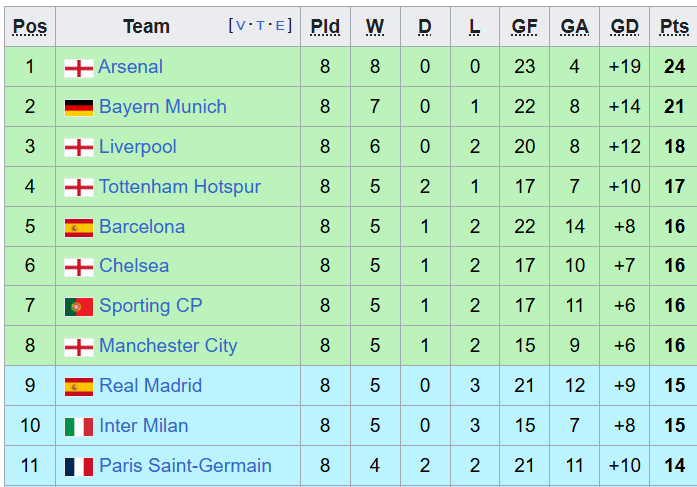
Over the last two seasons, PSG have demonstrated something that should fundamentally change how Arsenal approach the competition. In 2024/25, PSG finished 15th in the league phase, winning four, drawing one and losing three. That put them in the play-offs. They went on to win the Champions League.

A year later, PSG finished 11th. Again, they had to navigate the knockout play-offs. Again they won the Champions League. That is not a coincidence worth ignoring.

The new Champions League format gives clubs more room for strategic thinking. The top eight qualify automatically for the last 16, while teams finishing ninth to 24th have to go through a two-legged play-off. Of course, finishing in the top eight is an advantage. Nobody would deliberately choose extra matches. But there is a danger in treating it as essential.

The difference between finishing, say, sixth and 11th could require a handful of additional points. Those points might come at the cost of playing Bukayo Saka, Martin Ødegaard, Declan Rice or Gabriel every three days when the Premier League is entering its winter period. And that is where Arteta needs to think differently.

Arsenal do not need to win the league phase. They need to survive it.

There should be a much greater willingness to rotate.

If Arsenal have already accumulated enough points to make qualification highly likely, why risk a key starter in a dead-rubber Champions League fixture? Why not give valuable minutes to squad players? Why not protect the players who will ultimately be required to beat Europe’s best sides in March, April and May?

The objective should be to maximise the condition of the squad for the knockout rounds – not maximise Arsenal’s position in a league table in November.

PSG’s recent European campaigns are the perfect evidence.

Their 2024/25 league phase looked remarkably ordinary. They finished 15th and appeared to be in genuine danger of elimination. Yet once the knockout phase began, they beat Brest, survived Liverpool, edged Aston Villa and Arsenal, and demolished Inter 5-0 in the final. Then they did it again.

In 2025/26, Paris finished 11th, meaning another play-off was required. They subsequently eliminated Monaco, Chelsea, Liverpool and Bayern Munich before beating Arsenal on penalties in the final.

The lesson isn’t that league-phase results don’t matter. It is that they matter less than what happens afterwards.

UEFA’s own technical analysis of PSG’s 2024/25 triumph highlighted their pressing, energy and fluidity as crucial to their success. Those qualities are much easier to produce when your best players arrive at the business end of the season physically fresh. That should be the Arsenal model.

Take the Premier League seriously. Take every Champions League game seriously. But don’t confuse seriousness with playing the strongest possible XI every time.

Arteta has spent years building a squad capable of competing on multiple fronts. This is the season to trust it.

If Arsenal need eight points from their final three league-phase matches to qualify, take the eight points.

If five will probably be enough, don’t chase seven at all costs.

And if finishing eighth rather than 12th means throwing a tired Saka into another 90 minutes in December, perhaps the trade-off isn’t worth it.

Because the Champions League is not won in the league phase.

It is won when the games become two-legged, the margins become tiny and the pressure becomes enormous.

PSG have shown Arsenal that you can arrive there from outside the top eight.

Now Arteta needs to decide whether Arsenal want to win the league phase — or win the Champions League.

Keenos

5 Arsenal obsessions rival fans need to get over

Mikel Arteta out of his technical area

There is nothing that winds up opposing fans more than Mikel Arteta daring to stand outside his technical area.

You literally have Aston Villa and Newcastle fans boasting about “only watching Arsenal to count how often Arteta is outside of his technical area”.

How said must your lives be that rather than enjoying a Sunday roast with your family, you are hate watching Arsenal. But not only are you hate watching, you are only really concerned with a man standing outside his technical area – something every manager does. These are grown men spending their Sunday’s doing this. Hard drives need checking I think…

Set Piece FC

Last season it was “Set Piece FC. Arsenal are so boring”.

12 months on almost every Premier League club now has a set piece coach. Those fans that once criticised Arsenal are now celebrating how a dedicated set piece coach has changed their team both defends and attacks set pieces.

The best bit is we are 3 games in and have yet to score from a corner. I wonder if Sky will be putting up their “goals from set pieces” anytime soon? #JoviarOut

Southern Softies

For decades, we were labelled Southern Sofites. Could not handle teams playing physical against us. Rough us up and collapse.

We now have a team of 6ft+ physical specimens. And all of a sudden being a little bit more physical is seen as a negative?

I am sure opponents preferred it when we had diminutive playmakers like Cesc Fabregas, Tomas Rosicky and Samir Nasri. Players who their teams could dominate physically.

When Arsenal were being physically dominated by the likes of Chelsea, pundits put it down as our “opponents wanting it more”. Now we want it more, those same pundits and fans want the game to become non-connect.

PGMOL champions

We won the title, without resorting to sugar daddy spending and collecting financial charges on the way.

I always respected the way Jurgen Klopp’s Liverpool won the league (Arnie Slott’s only title was won on Klopp’s work). They were a well run club, had a brilliant manager, and every aspect of the club moved in one. they showed that you could compete, and beat, Man City without having a dodgy Russian billionaire buy you, or become a sports washing project for a Middle East oil nation.

Arsenal have replicated what Liverpool did, and deserve credit. But that creates an issue.

Many fans, including Arsenal, hid behind Man City and Chelsea’s financial wealth for the reason their team was not winning. Now that Arsenal have won, that excuse is gone and they can not handle it.

Rather than just accept that Arsenal are well run, and their club is not, they do mental gymnastics to try and diminish Arsenal’s achievements. The truth is, they should be holding their own team team higher level, then talking about PGMOL title as a coping mechanism.

North London Forever

You’ll Never Walk Alone is an American show tune from the 1945 Rodgers and Hammerstein musical Carousel.
I’m Forever Blowing Bubbles is a popular American song written in 1918, released in late 1919.

North London Forever was one mans ode to his home town, Angel. It was never written about Arsenal. It was adopted by fans as a club anthem. And it has more association with Arsenal Football Club then the many American song’s that other clubs sing.et for some reason opposing fans get their knickers in a twist over it.

Yes, we were founded in South London. But we moved to Highbury in 1913. That is 113 years ago. Since then we have had two World Wars and one World Cup.

The irony is, Louis Dunford could have been singing about any white working class area throughout the UK. If opponents stripped away the connection to Arsenal, they would quickly recognise there own deprived areas in his words. It is a brilliant anthem.

Keenos