
Category Archives: Arsenal

Same Old Arsenal

A comfortable victory. First 3 points of the season in the bag. Our £65m striker scores his first of the season.

Pre-game, a lot of the talk was about the lack of new forward at the club. In the pub chats, I stood strong on my opinion – anyone that comes in must be better than Kai Havertz, and as of yet no striker has moved clubs who I would have taken above Germany’s first choice.

As Havertz rose to head in our opener, I felt vindicated in sticking by my guns.

My thought was that had we signed Dominic Solanke, Ivan Toney, Ollie Watkins or Benjamin Sesko and they scored that goal, we would all be saying “what a difference a proper striker makes.”

Havertz goal was a delightful header. A proper strikers goal. Something that Olivier Giroud would have been proud of. And he has the added benefit of his all round game being superior to others who are simply just goal scorers.

I get why some fans would have been a little negative when seeing the starting XI. It contained no new players, with Riccardo Calafiori on the bench. But this is where we are with the squad right now.

Last season we pushed Manchester City all the way. So there is no need to fix something that is not broken.

It is always clubs lower down the table that make a huge number of signings. Those at the top, with world class squads, tend not to see a huge turnover in players. And those that come in need to be better than the players they are replacing.

Would Dominic Solanke at £65m or Julian Alvarez at £80m be an improvement on Havertz and Gabriel Jesus? I would say no. Meanwhile, Calafiori is a step up on Jakub Kiwior, and Mikel Merino is a better option centrally than Emile Smith Rowe.

In years gone past, we have started slowly as new players needed to get to grips with playing with each other. The advantage of signing so few was that everyone already knew their roles, and had the connections.

We saw Ben White and Bukayo Saka renew their relationship on the right – whoever the new England manager is needs to make amends with White. We have Oleksandr Zinchenko coming in off the left to make an extra man in midfield. Thomas Parety operating as a one man defensive midfielder. Gabriel Martinelli an outlet on the left. It was very much “same old Arsenal”.

It was interesting to see Zinchenko going off after 60 minutes to be replaced by Jurrien Timber rather than Calafiori.

The feeling is that Calafiori has joined to be a “Ben White” of the left and will eventually be our first choice left back. But with Timber and Zinchenko we have options to play more progressive full backs on either flank.

The sub was not an indication that Timber is ahead of Calafiori in the pecking order, but that different players will be used for different situations.

There will be games where we want to go White left, and either Timber or Zinchenko right. And other games where it will be Timber right, and Calafiori left.

One comment I heard in the ground which hit a note was about how Arteta wanted to “reduce the minutes” of players.

A criticism of Arteta is that he trusts very few, and he does not overly trust his squad. Whilst this is justified, it is also because some of the squad players (such as Smith Rowe and Nelson) are not good enough.

This season we will see Timber and White share minutes on the right, Zinchenko and Calafiori share minutes on the left. Partey, Merino, Declan Rice and Jorginho share minutes in those two midfield position. Leandro Trossard and Martinelli rotate on the left and Havertz and Jesus rotate up top.

It is only William Saliba, Gabriel, Bukayo Saka and Martin Odegaard who will all Start when fit”.

On the later two, you simply do not rest your best players. How often did Lionel Messi, Mo Salah, Cristiano Ronaldo et al get rested or rotated at their peak? The answer is rarely.

When you have special talents like Odegaard and Saka, you play them. And the more they play the more their bodies adapt to playing.

So we have the first win of the season on the board. We now have a week off until Aston Villa next weekend. And then before we know it we are on the cusp of the first international break of the season.

Enjoy your Sunday!

Keenos
Why have the top 3 English sides only made 2 new signings between them?

On the eve of the start of the new season, The Arsenal have made just one new senior signing – Riccardo Calafiori. That increases to two if you include the David Raya deal being made permenant.

Understandably, some Arsenal fans have got their knickers in a twist with our transfer business this summer. And I do get it.

In recent years, we have seen a lot of new players come into the club, with over £500m spent in the last 3 seasons on 19 new players. So it feels a bit underwhelming that we have spent just £65m on two players, one of which was with us last year.

But the lack of new players is indicative of where we are as a club and where Mikel Arteta is with his squad. Clubs competing for big honours tend not to make a lot of signings.

Lets look at this summer so far:

Liverpool: 0 new signings
Manchester City: 1
Arsenal: 2
Brentford: 2
Fulham: 3
Crystal Palace: 3
Everton: 4
Manchester United: 4
Tottenham: 4
Wolves: 4
Leicester City: 5
Newcastle United: 5
Bournemouth: 6
Brighton: 6
Ipswich: 6
Nottingham Forest: 6
Aston Villa: 8
West Ham United: 8
Chelsea: 9
Southampton: 12

Liverpool have yet to make a signing. Manchester City have made one. Whilst Arsenal have signed 2.

Of the 3 players that have joined, one was at their club last season (Raya) and one was already owned by the clubs group (Savinho).

And this not just in the Premier League – Real Madrid have also only made two signings this summer; Kylian Mbappe and Endrick.

So why are top clubs doing very little business?

Smaller pool of top players

It is fairly simple logic, but the better you are, the less players exist that would improve you. And those players that would improve you tend to already be at top clubs.

Take the striker situation at Arsenal.

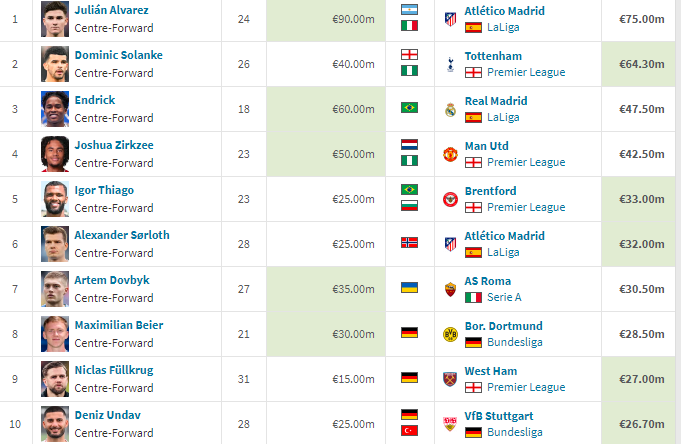
Yes, we are in the market for a new striker, but how many strikers in world football would actually be a better option than Kai Havertz and Gabriel Jesus?

Of the 10 most expensive forwards to move this summer, I would not have taken any of them above the two we have.

Some will make the case for Julian Alvazrez, but he is just a less proven Gabriel Jesus at the same age. And has gone for huge money. Endrick meanwhile is clearly a talent, but again completely unproven.

He could become the next Neymar, he also could be the next Alexandre Pato or Gabriel Barbosa.

When inferior strikers like Dominic Solanke are moving for £65m, then you begin to understand why Arsenal have not made a move. And why Manchester City are going into the new season without a striker to cover Erling Haaland.

As we continue to improve, the pool of players that would improve us shrinks. And we should only be spending to improve the squad. Not spending for the sake of spending.

Less urgent to improve

Not only is the pool of potential transfer targets smaller the better you perform, the need to make large improvements also reduces.

The saying “you stand still in football, you go backwards” is true. But when you are in and around the top of the tree, there is a less need to make drastic improvement’s and make big steps forward. You only need to make a couple of tweaks here and there.

Sir Alex Ferguson always lived by the philosophy of making just a couple of big transfers a season that would improve your first team. In turn, the 2 players they replace become squad members, and therefore improve the squad depth.

This summer, we would be looking to make 2 or 3 new signings who would come in and improve the starting XI. That would in turn improve the squad.

Calafiori is already through the door, and Mikel Merino is imminent. The 3rd signing will be a forward, if one comes available that actually improves us. Beyond that we do not need to do any business.

We are good with the defence we now have. Further forward in midfield we are well set with Declan Rice, Thomas Partey, Jorginho and Merino. Further investment will happen next season when Partey and Jorginho depart.

if we get a new striker, Gabriel Jesus then becomes the 4th option on the wing. If we get a new top winger, we might see Gabriel Martinelli operate as the 3rd striker. We probably do not need to by both a winger and striker this summer.

Moving forward, it will be 2 or 3 new signings a year. And that is something fans will have to get used to!

Final thoughts

When assessing our transfer window, I always look at the players that have joined other clubs and ask my question “would I have wanted them at Arsenal”. With my superior brain power, I also take into account whether I would have wanted them at that transfer fee and wages, and if they would have actually have joined us.

So yes, I would have like Kylian Mbappe at Arsenal. But that deal was never going to happen. But I would not have wanted julian Alvarez or Dominic Solanke. Nor would i have wanted us to sign Pedro Neto or Joao Neves. Amodou Onana would have been nice, but only if Partey had departed. He has not.

When you look at the top transfers across world football, who would you actually have wanted us to sign? Realistically we were never spending £50m on Michael Olise as backup to Bukayo Saka. Douglas Luiz is in the same boat as Onana. Dani Olmo is no where near as good as Martin Odegaard.

Consider this team:

Vlachodimos
Mazraoui Yoro Kilman Maatsen
Nevez Onana
Neto Alvarez Diaby
Solanke

That is the 11 most expensive players transferred this summer by position – excluding the lads that joined Arsenal. The cost nearly £500m to buy combined. How many make our strongest XI? And how many would our strongest XI beat them buy?

Now I am not saying here we do not need to buy anyone. It is more that we are in a new future where we need to expect only a couple of new signings a year. and we as fans need to get used to that.

That endorphin hit of new transfer will happen less often. But those players will buy will be of a higher quality. Players that will improve us.

What we do not need to be doing is spending £150m a summer on players that do not improve us. That are not better than what we have.

Tomorrow we face Wolves. We do not need those negative Nancie’s from the 2010s to refund their voice. We do not need “Spend some fucking money” heard. Because remember, those fools do not care who we buy, they only care about how much we spend.

Keenos

How not to run a football club – The story of Chelsea FC

In 10-years time someone far better at writing than me is going to release a book. Its title will be How not to run a football club – The story of Chelsea FC.

As Chelsea’s disorganized spending continues, as does the comments surrounding “does PSR not matter to them”. The simple answer is yes, it does matter. However those running the club are now having to juggle so many balls that when one collapses, it will probably lead to the collapse of the entire club.

Amortisation

Regular readers of the blog will know that amortisation is not a loophole found by Chelsea, but a common accounting procedure that all clubs have followed for decades. It is nothing new.

At the time of writing, Chelsea have pent £160milion this summer. Amoritised over 5-years, that equals an increase in expenditure of £32m. The deal for Joao Felix will take their summer spending to around £220m. And increased outlay of £44m a year.

That is an additional £44m in revenue Chelsea have to find to balance the books. They will do this by either selling players for above their book value, selling tangible assets, increasing sponsorship income, increasing revenue from European football, or increasing revenue from the TV deal.

Those last 3 will be almost impossible for Chelsea as they are tied with performances in the league, which are declining.

In fact, Chelsea will have to find more new revenue to cover the less of not being in Europe, and a reduction in sponsorship deals linked to European football.

That leaves just selling players and selling assets.

Selling players

As well all know, selling an academy player equates to 100% book profit. This means that the entire transfer fee can be used as a positive in the accounts.

Meanwhile, if you sell a player who still has an un-amortised transfer fee on the books (their book value mentioned above), any incoming fee most firstly offset the remaining fee, with the remaining being booked as profit.

Ian Maatsen, Lewis Hall and Omari Hutchison have all departed the club this summer. All had a book value of £0m, meaning Chelsea would bank 100% profit (50% of the Hutchinson deal was reportedly aid to Arsenal). Add in Conor Gallagher, they should expect to bank around £111m. More than enough to cover the £44m increase in spending.

The issue with relying on selling academy players is you can only sell them once.

Whilst the amortised fee goes across 5-years, the sale of a player goes into a single year.

In 2025/26, Chelsea will still need to find £44m to cover their 2024/25 spending. On top of that they will need to generate revenue to cover any expenditure in the summer of 2025, AND they still need to find the funds to cover previous years.

In 2023/24, Chelsea spent £400m. The year before it was £538m.

That means over the last 3-years, Chelsea would have increased their amorisation by around £230m a year.

Of course, they have then reduced their amorisation with the likes of Kai Havertz, Kalidou Koulibaly, Antonio Rüdiger, Jorginho, Michy Batshuayi, Timo Werner, Hakim Ziyech and N’Golo Kante departing.

My estimation is those players that have left would have wiped off around £80m a year in amoritesed transfers. That still leaves Chelsea needing to find £150m a year in additional revenue to break even.

Last season, they banked around £90m in pure profit from selling Mason Mount, Ruben Loftus-Cheek and Ethan Ampadu. A further £54m was banked by selling Havertz, Kovacic, Pulisic and Mendy, although the sale of Koulibaly cost them £8m giving them around a net £46m.

So player sales raised them around £144m in book profit, which allowed them to balance the books and stay with Profit and Sustainability Rules.

But they are now in a position where they need to keep selling players and generating book profit.

The £111m raised so far this season gets them close to covering the last 3 years increase in amorisation costs, and expect the likes of Trevor Chalobahto depart to help further close the gap. But having sold Mount, Gallagher, Chalobah, Loftus-Cheek and others, the academy is beginning to look a little dry.

Levi Colwill is really the only bankable asset still at the club, and will likely be sold next season. And if Chelsea can not raise over £150m in book profit from player sales, then they are in big trouble!

Selling assets

To help balance the books last season, Chelsea sold their training ground and a hotel to themselves to help generate revenue and balance the books. But you can only sell an asset once.

As Barcelona have found out, when you begin selling off the crown jewels without dealing with the elephant in the room (too much expenditure), then the issues simple return the next season. And this time you have less tangible assets to sell.

Chelsea still have “levers” the can pull, as Barcelona called them. They could “sell” future TV revenue to bring in immediate income like Barcelona did. They can also sell the ground (although not the pitch), which might bring in £400m, but will sot Chelsea in rent over the long term.

Like with selling players, eventually you run out of items that will make you a profit. And then you are in deep trouble.

Buying players

Such is Chelsea’s problems, they are now being forced to buy players they do not want to ensure players get sold.

Chelsea do not want Joao Felix, but without them buying him Atletico Madrid can not afford Conor Gallagher.

Gallagher generates about £35m in immediate profit, whilst Felix will cost the club around £10m a year.

Whilst they will be able to use the net £25m to balance the books this season, they are saddling themselves with a further £10m then need to find for the 4-years after. It is clearly not a smart deal for them long term.

Chelsea will need to keep doing these deals to sweeten transfers for outgoing players. They will be forced to overpay for players they do not want, to finance sales for players that are superior than those incoming.

Final thoughts

My thoughts on Chelsea’s spending has never really been about the risk / reward.

Yes, they are taking huge risks by relying on selling £100m+ worth of “book value” talent each year to balance the books. It is not easy, but as they have shown it is not impossible.

The issue is that, from the outside, they are signing players without a clear plan. For example they have signed 8 (I think) goal keepers since Todd Bohely et al came in. And they are already looking to sell players signed just 12 or 18 months ago.

And each summer, they get weaker. Those departing are better than those coming in. And each transfer they are just lumbering themselves with more debt in the future.

Most Chelsea fans with a brain reading this would have already shown concern about how their club is being run.

43 players in your first team squad is clearly not sustainable. And once you begin selling those players for a book loss rather than profit, things will quickly snowball.

In 1 or 2 summers time, Chelsea will find themselves needing to raise £200m in book profit to balance the books, but find themselves with very few stars that will raise them any significant profit. And at that point their only get out will be administration and relegation.

Back in the mid-late 00s, most of us were on forums saying “what will happen when Roman leaves”. We are now finding out. And the implosion will be on a grander scale than Leeds!

Fan will come to the comments of this blog and boast about European titles, Premier League titles and more, but most fans will not care about what the club has achieved in the past if they have no future. Most fans in our comments will simply find a new club or a new sport. And Chelsea will be back to “Save the Bridge” and beginning the match going fans for a handout just like the 80s and 90s.

It will be glorious.

Keenos