I often get accused of being a bit blaise when we lose a game. Whilst I am more than happy to analyse the defeat and criticise where needed, my ultimate view is “that’s football”.
When we lose to West Ham and Fulham, I was disappointed. But I refused to join the pile on. I have always said that football is a game of incredible highs and incredible lows, and being an Arsenal fan I have experienced a lot more highs than low.
The very nature of football means you will get those get those disappointing results against the likes of West Ham and Fulham, but in turn you will be rewarded with the last two brilliant weekends of football we have had.
Liverpool at the Emirates last Sunday was a fantastic day at the football. One of the best atmospheres I have experienced and celebrations continued way into the night.
7-days later we took the short trip to the London Olympic Stadium to face West Ham, a team we had lost to twice this season. We left the ground about 20 minutes after most West Ham fans, off to celebrate a 6-0 win in Hackney Wick.
Those last two results are why we go football. Why we stick with the team through supposed bad times. And those poor results make weeks like the one we have just had even sweeter.
Yes, I get some will say “but why can we not demand to beat Fulham and West Ham over Christmas, and also demand we win against Liverpool and West Ham away”. And I do get this. But that also creates an unreasonable bar of expectation. No team wins every game they should. And when you lose against a West Ham, a Wolves or Brentford, it is just football.
What always makes our game great in comparison to other sports is football is a lot less predictable. You get more “upsets” than you do in NBA, in NFL or in cricket or rugby. It is why even just winning a 4-fold accumulator is so tough in football (whereas you could win a 3-fold every weekend during the 6 Nations!).
I would never want football to become dull where teams win every game they should, and suffer a defeat in every game that they should lose. It would make the sport very boring, very quickly (see Euro or World Cup qualifying as the example).
There really is no need to analyse how we performed Sunday. We turned up. Scored 6 goals, then took over Hackney Wick. What a day.
I am still in pain today after my celebrations on Sunday. I can take those defeats against Fulham and West Ham to have the cloud 9 feeling over the last week. On to Burnley next!
(4-3-3) David Raya; Ben White, William Saliba, Gabriel Magalhães, Jakob Kiwior; Martin Ødegaard (c), Declan Rice, Kai Havertz; Bukayo Saka, Leandro Trossard, Gabriel Martinelli.
Scorers: William Saliba (32 mins), Bukayo Saka (41 mins, 63 mins), Gabriel (44 mins), Leandro Trossard (45+2 mins), Declan Rice (65 mins)
Arsenal Possession Percentage: 71%
Referee: Craig Pawson
Assistant Referees: Marc Perry, Steve Meredith
Fourth Official: Graham Scott
VAR Team at Stockley Park: VAR John Brooks; AVAR Lee Betts
Attendance: c.62,000
As is the case with every match the boys play these days, it becomes imperative that three points are in the bag come the final whistle, to keep the pressure up on Manchester City, who currently reside in second place in the Premiership table.
With regards to injuries, Oleksandr Zinchenko is currently nursing a calf problem, whilst Gabriel Jesus, who missed the Liverpool match last week with a knee injury, are hopefully fit for today’s game. Additionally, it is hoped that Bukayo Saka will be fit despite hobbling off the pitch during the last match.
Of course, all three will be assessed by our medical team as to their fitness and availablity prior to the white-hot London derby against West Ham United at the London Stadium this afternoon.
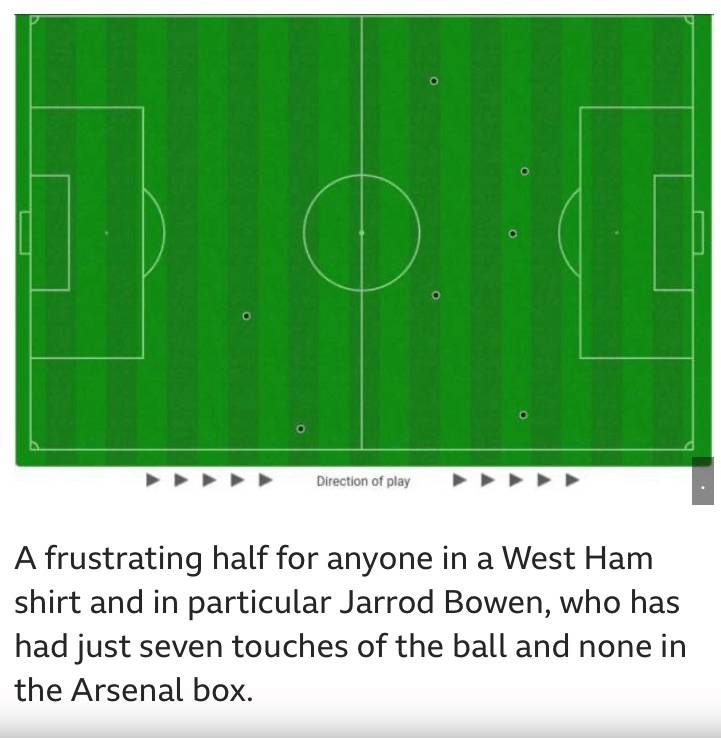
Within three minutes of the start, Declan Rice got his first touch of the ball on his return to his old club and it was greeted by some boos and catcalls from the home fans, which is rather puerile, to say the least; a minute later, the home side had the first attempt on goal, when Jarrod Bowen broke clear of our defence as he chased a ball down through the middle of the pitch, but the linesman’s flag was quickly raised for offside.
After a period of pressure on the West Ham goal, Edson Álvarez slid in rather wildly on Bukayo Saka, and in doing so, received the first yellow card of the game, which was richly deserved.
We pressurised their goal consistently and constantly for the next ten minutes or so, before West Ham came back at us with a couple of very good chances which we managed to clear well.
The best chance of the match so far came as early as the twenty-fourth minute when Gabriel Martinelli sent a great ball in from the right wing, Kai Havertz wisely ducked out of the way and Leandro Trossard connected perfectly with the volley, but goalie Alphonse Areola tipped the strike over the crossbar.
Just eight minutes later, we opened the scoring when Declan Rice’s corner came into the penalty area and William Saliba headed it into the net perfectly.
We then stepped up the pressure, and six minutes later, Bukayo Saka ran through on goal but was taken down by Alphonse Areola inside the penalty area; a penalty was given and Bukayo Saka scored his fiftieth goal for the club.
Our domination of the match was there for all to see and literally on half time, we grabbed our third goal when Declan Rice curled the ball into the penalty area from a free-kick and Gabriel managed to get away from the West Ham defenders to head the ball into into the net from close range; not satisfied with that, two minutes into injury time, captain Martin Ødegaard burst through the middle, slipped the ball to Leandro Trossard, who curled a fine finish into the far corner of the net to go into the break four goals up!
As soon as the second half started, we were straight on the attack but fortunately for the West Ham defence, Leandro Trossard’s shot flew high over the crossbar.
The second half was starting to be a rerun of the first, as shot after shot rained down on the West Ham goal, with the home side looking all at sea. On the hour, there was a good chance for us to add a fifth goal as Bukayo Saka ran across the area and was eventually able to find the space to shoot but Alphonse Areola saved.
Four minutes later, we inevitably scored the fifth goal when Martin Ødegaard fed Bukayo Saka beautifully, who cut inside and had the whole goal to aim for and he simply drove a shot beyond goalie Alphonse Areola’s left-hand side. Two minutes later, West Ham old boy Declan Rice thumped an unstoppable drive from some distance into the back of the net to rub even more salt into the wounds of the Hammers; understandly, his celebrations were low-key out of respect for his former club, but of course, our fans went wild!
A few minutes later, David Raya had a rare bit of work to do as he caught Mohammed Kudus’ cross which easily came his way, which was rare, because he has had so little to do in this one-sided match.
It looked like Bukayo Saka was going to grab our seventh, but the goalie made a spirited save, and with twelve minutes of the game remaining, our sixteen-year-old midfielder Ethan Nwaneri came on the pitch for the closing stages along with Cédric Soares, who replaced Ben White and Gabriel Martinelli.
The rest of the match was pure game management on our part, and as the final whistle was blown, the sense of relief that the game was over for them was etched on the West Ham players’ faces and was there for all to see. Nobody could possibly predict this annhiliation of West Ham United this afternoon, but having done so, our players ran over to our fans to drink in the applause and cheers for their work here in East London today.
A superb day at the office for the boys, and our biggest Premier League away win as well. We ruthlessly dismantled West Ham United here at the London Stadium this afternoon, and in doing so, firmly cemented our title credentials for this season.
We stay in third place but are now behind second-placed Manchester City only on goals scored, which is a fantastic achevement. Everyone played well, everyone was totally professional as one would expect an Arsenal side to be. Our next game is Burnley at Turf Moor next Saturday afternoon, and a win there keeps us in the hunt for the Premiership trophy. Well done, chaps!
Remember everyone, keep the faith, get behind the team and the manager, as this season is going to be crucial for our future success in all competitions. Stick with the winners. Our next match: Burnley at Turf Moor on Saturday, 17th February at 3.00pm (Premier League). Be there, if you can. Victoria Concordia Crescit.
Steve
Too Dearly Loved To Be Forgotten: Arsenal v Racing Club de Paris 1930-1962 by Steve Ingless (Rangemore Publications, ISBN 978-1-5272-0135-4) is now available on Amazon
🔴⚪️GIVEAWAY TIME⚪️🔴
We are giving away one of our new Declan Rice passport covers. To be in with a chance of winning:
If Carlsberg did Saturday’s, then yesterday was not a good for The Arsenal.
It started with two late-ish goals for Erling Haaland as Manchester City overcame a stubborn Everton 2-1 and finished with Tottenham scoring a 96 minutes to beat Brighton 2-1. In between, Liverpool were pegged back to 1-1 before romping home 3-1.
With all 3 teams playing at home, a trio of victories was expected, so we can not get too disappointed with the results that transpired and ultimately we need to focus on ourselves.
As Saturday’s went, mine was actually fairly decent. The highlight being a cheeky visit to Palm Bay in Debden which sent me into a food coma! Today it is a short trip on the Central Line to what is now my “local club” in West Ham.
A lack of trains in East and North London will mean today is a bit of a nightmare for many to get too. No Elizabeth Line and no C2C Line is a headache for those coming in from East, and no London Overground means those from Islington will have to go into London to come back out.
Luckily for me, the Central Line is running. It will be a quick trip into Stratford, trek across the park for a few pre-game beers in Hackney Wick. Then onto the London Olympic Stadium to watch football.
We have already been beaten twice by the Mockney Essex Boys this season, and have now not won in 3 outings.
The League Cup was one of the worst performances I have seen from us in a long time, whilst the home defeat between Christmas and New Year was won of those that we win 9 times out of 10.
That game still grates a little. We dominated play and should have scored 3 or 4. Meanwhile, their opener came when the ball clearly went out of play. But we move on.
Win today and we are back level on points with Manchester City, and just 2 points behind Liverpool. We will also increase that gap on 4th.
A quick final thought on yesterday’s games.
Tottenham beat Brighton 2-1 with that 96th minute winner. Fans and players celebrated like anyone would scoring with the last kick. It will be interesting to see if the media spend the next week condemning the scenes at White Hart Lane. Or will the lack of noise just prove once more that it is only Arsenal that are not allowed to celebrate victories (alternative theory: it will show Tottenham are a small club that are not newsworthy).
Hopefully today we will be celebrating the night away in Stratford. Although a little bit of me dies everytime I go to the athletics stadium, remembering how much I used to love a visit to Upton Park.
Enjoy the game today from wherever you are watching from.