
I love rugby. Or to add more accuracy; I love the England Rugby Team.
Blame my step-granddad for my love of egg chasing. He was a dyed-in-the-will Glaswegian. A Teddy Bears. A bluenose. Me being a proud Englishman, we bonded over our English/Scottish rivalry as I grew up (I also inherited a mild support for Ranger and a hatred of Celtic from him).
Some of my earliest memories are from the early-mid 90s. A pre-teen Keenos, in a pub on the Lower Clapton Road, watching England beat Scotland in the 6 Nations.
I tell you this to justify why I was watching England lose to Ireland at Twickenham at the weekend. A shocking loss which the English Football Team would’ve been “proud” of (incidentally, I much prefer watching England play cricket and rugby over football).
As I was watching the game, I got reminded of an article I read a couple of years ago by Sir Clive Woodward in the Daily Mail.
The jist of it was simple. That the constant stream of people in and out of rows, up and down the stairs, to get a pint or go for a piss, had become a huge distraction away from the game. The full column is below:
I seemed to touch on a very raw nerve the other day when I mentioned how irritating the constant procession of fans to and from the bars and lavatories at Twickenham is getting during the game.
It has got out of control recently and is fast becoming a real issue.
I’ve seen it with my own eyes and have heard many friends and regular England supporters complain constantly about it.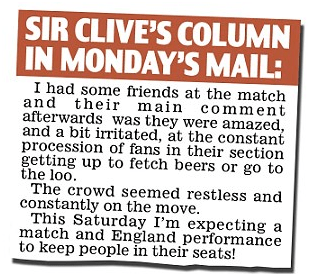
Rugby fans have a well-deserved reputation for enjoying pints and hospitality before and after the game and long may that remain the case.
It is a traditional part of the big day out, meeting friends before and the big post-match inquest over a few drinks afterwards.
But surely in between the game itself must take centre stage.
Currently, the stream of people replenishing drinks, carrying trays of beers to friends, buying and fetching hot food and answering calls of nature is off the charts.
And pity the people having to stand up like a game of musical chairs as they make way for those who seemingly can’t sit still for more than five minutes.
This is beginning to detract seriously from the enjoyment of those who have paid very good money — well in excess of £100 per ticket in many cases — to watch a game that they are only seeing dribs and drabs of because of this tide of humanity.
Guys — and girls — it’s only an hour and 20 minutes with a 15-minute half-time break for essential calls of nature. Surely we can manage that? You wouldn’t think of behaving like this at a theatre or cinema.
I would seriously think about shutting the drinks outlets 10-15 minutes before kick-off and not opening them again until the final whistle is blown. Take a drink to your seat by all means — you might have a hip flask of your own as well — but that’s your lot for the duration of the game
Twickenham is not primarily a public bar, it’s a wonderful ground where rugby must come first, second and third and where members of the public of all ages must feel completely comfortable and welcome.
After I touched on this in Monday’s column, Aly Prowse, a diehard England fan from Somerset, wrote to me. She is a member of the official England supporter club.
The RFU has become very commercial and has proved itself to be a money-making machine. Twickenham’s revenue through beer and food sales has benefited the Rugby Football Union, but in the rush to cash in they need to be careful here.
The RFU committee members would never countenance such behaviour where they sit, or in the Royal Box where the VIP guests are catered for, so why encourage it elsewhere in the ground?
Let’s make sure that those England fans, and visiting fans, who have dug deep to travel and support their teams, get full value for that loyalty and commitment.
Match day at Twickenham should always be a pleasure, not a chore.
Now I have no issue with people liking a drink. I myself am partial to a lager or 8 at the football. I have missed entire halves before because I was having a pint, having a chat.
But perhaps when it comes to drinking, football does have it right?
By not allowing fans to drink in-front of the pitch, it means that there is not a constant flow of people going to an from the bar for 90 minutes, like there is in rugby.
It was noticeable against Ireland on Saturday. Streams of people constant going up the stairs empty handed, then returning with 4 pints. It meant the crowd was restless. The constant getting up and down for others a distraction.
At cricket, you drink all day in the sun. But it is customary to not leave your seat until after an over. And stewards will stop you returning to your seat until between overs. It stops the constant flow of people in and out of the stands that you see at rugby. Stops distractions.
I have often been one who has said “get the atmosphere back at football. Let us drink, smoke, stand and swear”. But having watch the rugby Saturday, would drinking in-front of the pitch make much of a difference? Or would it just create a constant annoyance for everyone bar the person who has gone to get themselves a pint.
Perhaps, when it comes to drinking at football, you are best off keeping it to the concourse.
Keenos
Follow @KeenosAFC





