Transfers are often driven by circumstances, but the dominoes falling at the right time to trigger a deal.
Take Thierry Henry.
Arguably Arsenal’s best player of all time, and certainly in my life time, only joined The Arsenal due to the departure of Nicolas Anelka.
The transfer of Henry to Arsenal was confirmed on 3 August 1999, with Anelka departure to Real Madrid announced a day later. The Anelka deal also saw Davor Suker move in the other direction.
Henry was actually Arsene Wenger’s 2nd choice to replace Anelka – their international teammate David Trezequet was top of the list.
How different the landscape of Arsenal could have been had Anelka stayed, or Monaco accepted the offer for Trezeguet.
Despite recent talk that Granit Xhaka’s departure from Arsenal has stalled, he is still expected to join Bayer Leverkusen. He is due to be replaced by a combination of Kai Havertz (when we want to set up normally) and Declan Rice (when we want to be a bit more defensive).
In the majority of our games next season, we will go into them with a midfield of Rice behind Havertz and Martin Odegaard. They will be backed up by Thomas Partey, Jorginho, Fabio Vieira and Emile Smith Rowe.
In games where we look to go more defensive, Partey and Rice will probably start together with Havertz sacrificed.
In recent weeks, we have been linked with the likes of Moises Caicedo, Romeo Lavia and, more recently, Real Madrid’s Aurelien Tchouameni. But all those links come with a caveat: “lined up to replace Thomas Partey”.
With the two new acquisitions, our midfield is currently filled. And that means it will be one in, one out moving forward. We will only recruit someone else if Partey is sold. And that brings a huge what if?
What if Partey is not sold? Well he then stays, then we do not make any more signings.
But what that means is our targets are currently in an Arsenal purgatory.
Take Romeo Lavia as the example.
Currently at relegated Southampton, he is clearly highly interested in joining Arsenal. But he knows he has to wait until Partey leaves before he gets his move. How long does he wait for Arsenal for before beginning to talk to other clubs?
Well that point seems to be this week as his representatives opened talks with Liverpool.
If Liverpool move quickly, they could secure the services of Lavia before Arsenal have resolved Partey’s future.
The narrative will be that Edu’s dilly-dallying led to us missing out on Lavia. But the truth is we were unable to make a concrete move for him until Partey’s departure was close to being confirmed.
To miss out on Lavia is certainly not a disaster, but will be frustrating.
At just 19-years-old. he has all the attributes needed to play in conjunction with Declan Rice when we go more defensive. He will also not have the expectation to play week in week out at a top club.
The fear Edu and the team will have is the longer Partey does not move on for, the more targets will go elsewhere.
Lavia could end up at Liverpool, Chelsea could sign Caicedo and Barcelona could find the cash to sign Martin Zubimendi.
It could get to a point where our main “Partey replacement” targets have secured moves elsewhere and are no longer on the market. What then are our options?
Well we could just move to the next one on the list. But how far down do we keep going? We could enter the loan market, or we could take the risk and leave ourselves with only Declan Rice and Jorginho.
It will be frustrating to lose out on Partey replacements whilst we await his future to be resolved. And it will be equally furstrating to miss out on a potential £40million transfer because an adequete repalcement can not be found.
Finally it will be frustating if we sign someone we do not really want.
It is not an easy puzzle to solve for Edu and the team.
Ideally, Partey’s future will be resolved sooner rather than later and we can move onto signing his replacemnt before they are snapped up elsewhere.
Jurrien Timber looks set to be the final piece in Mikel Arteta’s jigsaw this summer.
Following on from last year, Arsenal have looked to move quickly in the transfer market, with the majority of transfer business done before players return for pre-season.
You can only see someone else following Timber, Declan Rice and Kai Havertz through the door if there is an exit (Romeo Lavia replacing Thomas Partey the obvious one).
Havertz and Rice need no introduction, but who actually is Jurrien Timber?
Timber is a 22-year-old defender from Ajax who made his debut for the Dutch side at the age of just 18.
Predominantly a central defender for Ajax, he is expected to play as an inverted right back for Arsenal, mirroring Oleksandr Zinchenko on the left hand side.
I would be very surprised if he replaces Ben White straight away at right back, and imagine his acquisition will allow the Englishman to be William Saliba’s cover at centre back. Takehiro Tomiyasu will then likely be shift to left back to cover Zinchenko with Kieran Tierney out the door.
Whilst he played centreback for Ajax, he was often given the freedom to drift wide or push high when Ajax were in position.
Timber’s ability on the ball and passing meant that he is often heavily involved in the build up play, always offering an option for his team mate on the ball. Pushing Timber wide or forward allowed them to overload opponents in certain positions.
He certainly does not look out of place when on the ball, in the middle of the park. If you did not know better, you would think you were watching a midfielder playing at centreback, not a defender pushing into midfield.
Timber is a very intelligant player, and fantastic at breaking through an opponents high press. He is agile and light footed, and can change direction with a quick drop of the shoulder. Almost Jack Wilshere like.
This means that at one point he can look closed in, then with a swivel of his hips he has done a 180 and opened up the other side of the pitch. This then gives him the space to pass into and launch an attack, or get his head down and run into.
Timber is comfortably the defender when it comes to passing in Holland. He has also shown his ability on both the Champions League and Europa League stages in recent seasons.
For Ajax last season, he averaged 80 passes a game at a 92% completion rate. In the Europa League he averaged over 100 passes a game, with 93% completed. In the Champions League, he completed 94% of all his passes (across 6 group stage games).
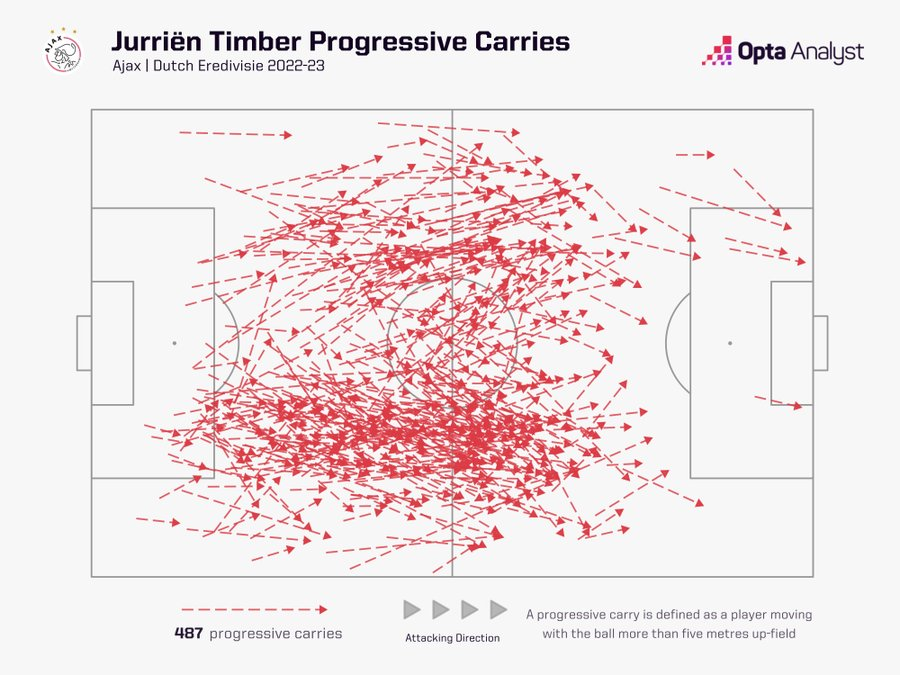
Timber is also not a sideways passer. He ranks high amongst centre backs across Europe when it comes to forward passes and runs (progressive carries).
Timber is one of the players who is not rapid, but has that initial burst that creates space for himself. Again, not to dissimilar to Wilshere. This means that when he does drop that shoulder, he can quickly find himself with enough time and space to get his head up and make the right decision.
This initial burst also makes him a very good one on one defender.
A third comparison to Wilshere is in the way he likes to draw defenders in before changing the direction of play.
This helps himself, and Ajax, to combat a high press as it means an attacker is than committed in the challenge and is therefore out of position as the ball moves forward into the next phase of play.
Given his technique and ability to find space, it is actually a surprise he has found himself as a centreback, especially when you take into account he is only 5′ 10″. But then I guess this is the Dutch total football way.
The final string to his passing bow is the fact that his left foot is nearly as strong as his right. This will make him a perfect candidate to play as that inverted centre back as he can keep both sides of the pitch open – one of the issues when Tierney played in the inverted role is his lack of right foot meant all of his passes were only ever going from left to right.
When you are as good as Timber is on the ball, there can be a tendancy to try and make something happen everytime. Also looking for that Hollywood ball or that lung bursting run forward. David Luiz comes to mind. But Timber is sensible with his skills.
He recognises when is the time and place for the expansive play, but that also often the shorter, safer pass is the better one.
Timber’s ability allows him to comfortably drift into space left by others, regardless on where on the pitch he finds himself.
Like Arsenal, Ajax play with a single pivot 6.
Edson Alvarez likes to drop deep between his centrebacks. When Alvarez’s marker follows him to press, Timber feels the space further forward.
Arsenal play a different version of this, with Zinchenko filling the space left by Thomas Partey from a wider position rather than Gabriel or William Saliba stepping forward.
With Rice incoming, you can already picture him dropping between the central dfenders, and then Zinchenko and / or Timber filling that space from a wide position. It will almost give us a narrow 2-3 defensive line instead of a 4-1.
When playing further outwide, expect Timber to be playing one-twos with Rice (or Partey) to break the press.
His ability on the ball allows him to play that one touch pass into midfield, and his initial burst of pace will see him get ahead of the opposite winger trying to press him. He will then have the option of Martin Odegaard inside, or Bukayo Saka outside to continue the attack. Thus ensuring Arsenal’s attackers are not doubled up on.
White already does this for Arsenal, meaning that Timber can easily slot in and replace him at right back when required.
If you are thinking “all you have spoken about is his ability on the ball”, then you are right. And that is because his passing and awareness when his team are in possession is his strength. But this does not automatically mean he is a bad defender.
Timber is an an solid, calm and confident defender. His reading of the game and tactical intelligence more than makes up for his vertical deficiencies.
Whilst Timber is not the tallest, his ability to read the game and positioning often enables himself to incerpt the pass rather than compete physically for the ball. Like a prime Fabio Cannavaro.
That initial burst of pace, and his long limb allow him to get between the ball and his opponent and nick it away. It also means that he can quickly cover the space in behind him if a forward does get the jump ahead.
If the opponent does receive the ball ahead of him, Timber is one who tends to close off the space, jockey and force them away from the danger area, rather than lunge in and try and win the ball as quickly as he can.
For Holland, Timber has averaged 2.5 intereceptions a game over this seasons World Cup qualifiers. This compared to 0.8 per game for Virgil van Dijk, who much prefers the physical battle.
This will, of course, raise concerns as to whether he has the physicaly attributes to play in the Premier League. Something labelled at his former teammate Lisandro Martinez. This should not be a concern as it is expected Timber will play more as a right back, with White being the option for centreback if Saliba is out.
Physically, Timber reminds me a lot of Bacary Sagna.
However, it is not all roses and sunshine. Playing to his strengths can lead to his weakenesses.
The initial burst of pace in the challenge and determination to be first to the ball can lead him to over commit.
If he does not get to the ball first, he can be found off balance and easily rolled. This gives the attacker the advantage and time to get away from him. You can picture Erling Haaland (or an a prime Didier Drogba) pining themselves against him, and then rolling him as he tries to come round the side to get the ball first.
When he does decide to tackle an opponent, he goes in for it 100%. Strong and committed. This can result in the challenge being deemed reckless and the result is often a free kick against him.
One area that Timber can certainly improve is his aerial prowess.
Timber is not able to compete with the biggest of strikers, and also lacks the black artas that someone like Martinez has to make up for it. Sometimes it feels like he gives up on challenging the ball in the air, and focuses on what he is going to do when the ball is back on the ground.
He certainly needs to learn that an aerial duel is not always about winning the ball, but also about disrupting your opponent so they can not win it cleanly.
Hopefully this weakness should not be exposed as much when playing right back. Gone are the days Andy Carroll pinging himself to a full back and looking for those long cross field balls.
If Timber was being signed as a central defender, you would be concerned. But all of his weakenesses in defence are Ben White’s strengths (Timber could learn a lot from White about the dark arts of a physical duel).
Arteta loves players who are comfortable on the ball no matter when on the pitch they are. His philosophy is about passing it into space, trusting a team mate will be in that space, and then that team mate having the technique to transition the ball into the next box of space.
If you cut the pitch into quarters, Timber can dominate the defensive right hand side of the quarter in same way Zinchenko does on the left.
The only question left for Arteta is whether he can play both Zinchenko and Timber as inverted full backs at the same time, or whether for balance one will need to sacrifice their natural instincts and stay wider.
When he arrived as a skinny kid from the Campeonato Brasileiro Série D, no one could have predicted the impact he would have.
2 July 2019 we announced the signing of Gabriel Teodoro Martinelli Silva. Barely legal, he was playing in the fourth division of the Brazilian football league system. Martinelli was not even on the radar of his national team, failing to play at any level for Brazil prior to joining The Arsenal.
The youth team of that time included the likes of Bukayo Saka, Eddie Nketiah, Emile Smith Rowe, Reiss Nelson, Folarin Balogun and Xavier Amaechi.
We had such a wide array of young, English, attacking talent in our academy that I just did not understand why we were bringing in someone from Brazil.
I did, however, state:
“If the club considered Martinelli as already better than Nketiah and Nelson, I would understand it more. He would be coming in to the 1st squad, able to contribute straight away.”
And as it turned out, the skinny kid from Brazil would quickly become part of Unai Emery’s first team squad.
Martinelli’s impressive pre-season and quality in training encouraged Emery that he would be ready for immediate first-team integration.
It was testiment to his attitude that from the day he joined, he listened, learned, and worked hard. 4-years on he is still continually praised for the way he applies himself in training, and it is that which has turned him from unknown from Brazil to one of the best left wingers in the world.
A little more than a month after signing, Martinelli made his debut – coming on in the 84th minute as a substitute for Henrikh Mkhitaryan against Newcastle.
In just his second game for the club, ands his first start, he would score twice against Championship side Nottingham Forest in the League Cup.
His performance received praise from Emery, who said: “He’s hungry to have that opportunity to help us, he is very humble, he fights. I told him to have some patience for his opportunity to do like he was doing. He did that. He deserved it”
A week after, he would get another 2-goals in the Europa League against Standard Liege. What was exciting is how different his goals were.
He was showing he had the strikers instinct with goals from within the 6-yard box. He was beating men and curling them in from the edge of the box. And rising high despite his slight frame to head them in.
4 goals in his first 3 games would turn into 7 from 7 as he continued to take advantage of playing in the Europa League and League Cup.
When we failed to make Champions League football, I mentioned that one benefit could be that the lower tier would give opportunities to some of our talented youngsters.
It was the Europa League in 2019 that saw both Martinelli and Saka display their talents in the Arsenal shirt. Neither looked back (and a year later the Europa League gave Smith Rowe his chance!).
After a brace against Liverpool in the League Cup, Liverpool manager Jürgen Klopp labelled him the “talent of the century”.
No longer was he a skinny kid from Brazil signed to play in our academy. He was now of the most exciting young attacking talents on the planet.
Martinelli would become the first Arsenal teenager to reach double figures since Nicolas Anelka. He would finish the season with 10 goals from 26 games.
Despite only having joined a year earlier, Martinelli would sign a new 5-year deal in 2020. Testiment to his position in Arsenal’s first team squad. Then disaster struck.
As football began to prepare for its return following the Covid break, Martinelli sustained a knee injury in training that would rule him out until the end of 2020.
Martinelli would undergo surgery to repair a lesion in the cartilage of his knee. At such a young age, this sort of injury could have changed the path of his career.
At the FA Cup final in 2020, you could not help but feel sorry for him as he hobbled around Wembley on his crutches. His first season with the club ended early through injury and future potentially in doubt.
Hi return to the Arsenal first team squad took time.
Mikel Arteta clearly understood the impact rushing a young a player back from injury could have on their long term fitness. The manager resisted the urge to “sling him straight back in” even though there was plenty of noise from fans calling for him to start.
This led some sections of the fanbase to criticise Arteta, claiming he did not understand the talent Martinelli had. The truth is Mikel was just protecting Martinelli. And a couple of minor set-backs during recovery would prove Arteta right.
Come 2021/22, with a full pres-season under his belt, Martinelli looked fighter, stronger and quicker.
He has clearly worked extremely hard on the training ground and in the gym, ensuring that he was physically ready to become a top Premier League player.
Martinelli would start 21 times in the Premier League, scoring 6, assisting 6.
On the opposite wing was Saka. He had kicked on to the next level scoring 11 and assisting 7. It was felt by many that Martinelli was the level below, and that we perhpas needed to be looking at an upgrade.
The summer of 2022 felt like a bit of a crossroads for Martinelli, Arteta and Arsenal.
Do we continue progressing this young brazilian talent, now 21. Or do we go out into the market and sign a top, top left winger and have Martinelli as 2nd choice.
We did look who was out there. Talk of Raphina and a big money move for Ukranian starlet Mykhailo Mudryk. In the end no deals got over the line and we would start 2022/23 with Martinelli as our first choice left winger.
Martinelli would take his game up a level, showing the benefits once again of working hard and listening in training. He would quickly become one of the best left wingers in England.
In January, talk of Mudryk raised its head again. Like many, I scratched my head as to why we were looking to spend so much on him. In Martinelli we had someone who I felt was putting in better, more consistent performances at a higher level.
Mudryk went to Chelsea, Arsenal signed Leandro Trossard, and Martinelli would finish the season with 15 league goals from the left wing.
This summer there has been zero talk of us signing another left winger. Martinelli is now someone who could start for any time in the Premier League, including Manchester City.
Transfermarkt value Martinelli as the 5th most expensive left winger in the world.
Vinicius Junior, Phil Foden, Rafael Leao and Khvicha Kvaratskhelia are the 4 ranked above him. Martinelli is younger than them all.
Marcus Rashford, Luis Diaz, Jack Grealish, Kingsley Coman and Neymar round out the top 10.
Martinelli is probably unlucky that he plays in the same era as Vinicius Junior and Neymar. Their presence in the Brazilian national team has seen him win just 6 caps for his country. If he was English he would probably be closing in on 30 caps.
And it is probably only his two compatriots that are better than Martinelli.
I certainly would not want to replace him with Leao, Kvaratskhelia , Rashford or Diaz. They are all probably at the same level alongside Martinelli as “next best”.
Signed for £6m, it would probably take a bid north of £100m to pry him from Arsenal (it will not happen).
Taking into account what he has already contributed, looking forward to what he could achieve in the future, and that price tag, I think Martinelli is the best Arsenal signing in 20-years.
The last player we plucked from no-where, paying pennies, who went on to become a key fixture in our first team was Kolo Toure.
Toure was signed from Ivorian side ASEC Mimosas for just £150k in 2002. He would become a regular in our invincible side and play 326 times for That Arsenal.
Before Toure, we are probably looking at Freddie Ljungberg as the next one plucked from obscurity to become a superstar.
Martinelli now needs to back up last season, build on his 15 goals and 5 assists. I see no reason why he can not finish next season with 20 goals and 10 assists in all competitions from that left wing. He is that good.
Our best signing in the last 20 years. Martinelli could become one of Arsenal’s greatest signings of all tiem.



 She Wore A Yellow Ribbon