Match Report: Arsenal 4 – 0 Newcastle

Arsenal (0) 4 Newcastle United (0) 0
Premier League
Emirates Stadium, Drayton Park, London N5 1BU
Sunday, 16th February 2020. Kick-off time: 4.30pm

(4-2-3-1) Bernd Leno; Hector Bellerin, Shkodran Mustafi, David Luiz, Bukayo Saka; Dani Ceballos, Granit Xhaka; Nicolas Pépé, Mesut Özil, Pierre-Emerick Aubameyang; Eddie Nketiah.
Substitutes: Sokratis Papastathopoulos, Alexandre Lacazette, Lucas Torreira, Emiliano Martínez, Joe Willock, Sead Kolašinac, Gabriel Martinelli.
Scorers: Pierre-Emerick Aubameyang (54 mins), Nicolas Pépé (56 mins), Mesut Özil (89 mins), Alexandre Lacazette (94 mins)
Yellow Cards: Granit Xhaka, Bukayo Saka
Arsenal Possession Percentage: 67%
Referee: Lee Mason
Attendance: circa 60,000

For our first competitive match in eighteen days, we welcome old adversaries Newcastle United, who are a place below us in the Premier League table at the time of writing, but unfortunately share the same points as us; both sides desperately need a victory at The Emirates this afternoon, which by rights, should lead to a fiercely competitive match. The big news of the day is that young and exciting Eddie Nketiah has earned a place in the starting eleven ahead of Alexandre Lacazette; could this surprising decision be a glimpse of the future?

A wild and thunderous beginning to the match which saw Granit Xhaka picking up the first booking of the game with less than ten minutes on the clock due to a reckless challenge; however, as a team, we started to push the ball around fairly confidently and were unlucky not to open the scoring when an impressive attack broke down in the Magpies’ penalty area. Incredibly, goalie Bernd Leno pulled off a miraculous save when a shot from Sean Longstaff ricocheted off Dani Ceballos’ leg which was destined for the back of our net, when somehow our goalkeeper twisted himself around to turn the ball around the post for a corner. A close shave indeed. Despite the team struggling to gain rhythm and control in the first quarter of the game, Bukayo Saka was unlucky not to score after twenty minutes when a looping shot from outside the box narrowly missed the opponents’ goal. Worryingly, Newcastle United seemed to catch us cold with fast smash’n’grab tactics, and it has to be said that it was some kind of miracle that many of their attacks did not end up with the visitors taking the lead. Pierre-Emerick Aubameyang claimed our first shot on target just after the half-hour mark when a Mesut Özil inch-perfect pass found our Gabon striker just inside the box, but his left-footed shot was easily saved by Martin Dúbravka in the visitors’ goal. Now we started to wake up, with a series of intelligent movements both on and off the ball; it was one of these attacks on the visitors’ goal that led to a superb shot from Eddie Nketiah that by rights, on any other day, would have been a goal had it not been for an excellent save from the Magpies’ goalie, who just before half-time also athletically tipped a Nicolas Pépé free-kick over the bar.

Half-time came and went, with the second half starting pretty much as the first one ended, with Arsenal gaining control and passing the ball around looking for a way through the Magpies’ midfield. Eddie Nketiah hit the crossbar from close range after some sterling work by Nicolas Pépé on the byline, jinking in and out of defenders seemingly at will. At last, after fifty-four minutes, a Nicolas Pépé cross into the visitors’ area found the head of Pierre-Emerick Aubameyang, who wasted no time in opening the scoring for us, and incredibly, just two minutes’ later, Bukayo Saka twisted and turned two Newcastle defenders inside out on the left wing, then passed the ball low and true for Nicolas Pépé, who scored our second goal of the day with his sweet left foot. Fortunately for us, Ciaran Clark missed an open goal just after the hour mark, and we somehow appeared to just reboot and start again with hardly a blink. Pierre-Emerick Aubameyang bounced the ball off the crossbar after a Mesut Özil assist, and by now, our confidence became obvious to all and sundry as the match wore on. Allan Saint-Maximin hit the post with an clever shot with a quarter of an hour remaining, and although we were shaken, we were certainly not stirred. After Bukayo Saka pointlessly received a yellow card for an unfortunate collision, Lucas Torreira replaced Dani Ceballos with ten minutes of the match remaining, and so with the game ebbing away, Eddie Nketiah was substituted for Alexandre Lacazette; seeing fresh legs on the pitch, the team were off and running again. Literally, with a minute to go on the clock, Nicolas Pépé managed to pass a simple ball to Alexandre Lacazette, who, as he was falling down, got the ball to the advancing Mesut Özil, who easily put the ball into the back of the net for our third of the match (and his first goal for ten months as well). Joe Willock replaced goalscorer Mesut Özil in injury time, and despite the massive advantage, we still came forward looking for more goals to be added to our tally; and we did! Alexandre Lacazette got our fourth and final goal from close range in the fourth minute of injury time to make it a satisfying afternoon’s work for everyone involved with Arsenal Football Club.

Well, just how good was that win today? Overall, we played very well, and there were so many good things to take away from this match. Just how impressive was Bukayo Saka out on the left? It was great to see Nicolas Pépé becoming the player that we all know he can be, and Mesut Özil played like a man possessed at times, spraying passes hither and thither. There couldn’t have been an Arsenal fan in the stadium who wanted to run on the pitch and give Alexandre Lacazette a hug of relief  when he scored the winner in injury time. We needed this victory so much after everything the fans, players and this club has been through in the past few months. Let us savour the win, and hope it gives us renewed confidence for the rest of the season, starting with the Europa League game at Olympiacos on Thursday. At last. Remember everyone, keep the faith, get behind the team and the manager, as this season is going to be crucial for our future success in all competitions. Stick with the winners. Our next match: Olympiacos at Georgios Karaiskakis Stadium, Piraeus, Greece on Thursday 20th February at 8.00pm (Europa League). Be there, if you can. Victoria Concordia Crescit.

Steve

Too Dearly Loved To Be Forgotten: Arsenal v Racing Club de Paris 1930-1962 by Steve Ingless (Rangemore Publications, ISBN 978-1-5272-0135-4) is now available on Amazon.
Pre-season commercial tours key to Arsenal’s future success

The outbreak of coronavirus has led some Premier League clubs to review their pre-season plans for 2020.

It had been predicted that Arsenal were due to play in China in 2020 as part of one of the many different international pre-season tournaments that happen. These plans will now be in doubt.

This has led some fans to comment about their disdain for these sort of pre-season tours, which are on the face of it are driven by the appearance fees clubs get paid.

Gone are the days of Arsene Wenger taking his squad to an Austrian mountain for pre-season training with a few games against the local fisherman.

Money-spinning international tours are often used to highlight the greed in football, the commercialism. That managers complain about fixture congestion whilst they are “forced” to take their players to Sydney, Shanghai and LA in pre-season; clocking up thousands of air miles.

Being negative about pre-season tours in Singapore, New York and Dubai is surely just an outdated view held by people who do not really understand?

Pre-season is a major money-spinner.

Promoters, who must be match agent-licensed by Fifa, pay clubs a fee – often US$1 million or more per game for major teams.

In 2019/20 Arsenal played 3 International Champions Cup games in American which they would have expected to earn around $3million for.

As Arsenal fans we often moan about the clubs poor commercial income, lagging behind Manchester United, Liverpool and even Tottenham these days. Is it then not hypocritical to complain about poor commercial income, whilst also complaining about being paid millions to take the team to America, Thailand or Dublin.

How many millions did Arsenal miss out on going to Austria whilst Manchester United were going to China, Thailand and Australia in the 90s?

The big money from the pre-season tours, however, is not that initial fee but what comes from it. The increased brand awareness.

Playing games abroad is the quickest way for a side to get a foothold in that city or country. Off the back of these tours, clubs can sign new commercial deals with regional companies. These deals can prove very lucrative.

In 2018, Manchester United generated £275million in commercial income, Arsenal’s was just £107million.

The difference is not just because of the major deals – kit manufacture, shirt sponsor, sleeve sponsor, naming rights – but also the smaller deals.

Manchester United’s commercial income dwarfs Arsenal’s despite them having not sold the naming rights to Old Trafford.

Their “global partners” site shows them having 24 global partners, from betting to pillows, tyres to wine. They have an additional 9 regional partners including an Official Soft Drink Partner of Manchester United for China, Official Nutritional Supplements Partner of Manchester United for Japan, Official Soft Drinks Partner of Manchester United for Nigeria and Official Pharmaceutical Partner of Manchester United for Korea and Vietnam.

On top of these, they also have 14 financial partners and 14 media partners. They have an Official Broadcast Partner of Manchester United in Mauritius and an Official Financial Services Affinity Partner of Manchester United for Serbia, amongst others.

The Manchester United brand has been on a global tour for over 20 years. Building relationships, selling themselves. This commercial income is built off the back of pre-season tours.

Brand Finance research showed that 42% of Chinese fans bought brands that sponsor their favourite club. It is huge business.

Arsenal have been behind the ball game when it comes to taking the side abroad. Remaining in Austria allowed the likes of Chelsea to overtake us as a global brand.

If Arsenal are to close the commercial revenue gap, they need to build their brand stronger abroad. This means more tours to China, Thailand, Singapore and America. Without these tours we will continue to fall behind.

We also need to accept that football is a global game. Playing abroad gives fans of Arsenal in those countries a chance to see their team play. And through their passion the fan base will grow, and with it the commercial income.

The facilities and hotels Arsenal will stay, train and play in are world class.

It will be 5 star hotels, modern training facilities and perfect pitches. This isn’t Arsenal taking the team to Bangkok, staying in a back packers hotel off the Khao San Road, and playing on a mud pitch. The Rajamangala Stadium is a 65,000 arena renovated in 2019.

The facilities Arsenal use in America, Australia or Singapore will be better than those used in Austria.

Ultimately, these tours are not a new thing – we all remember the stories of Ray Parlour in Hong Kong. That was back in 1995.

If you stand still in football, you go backwards. Pre-season tours thousands of miles away from London are key to a successful future for Arsenal. Without them we will fall further behind.

Keenos

Goal Scoring – It’s an old mans game

Yesterday I discussed about how being the wrong side of 30 does not suddenly stop Pierre-Emerick Aubameyang by being a top class striker.

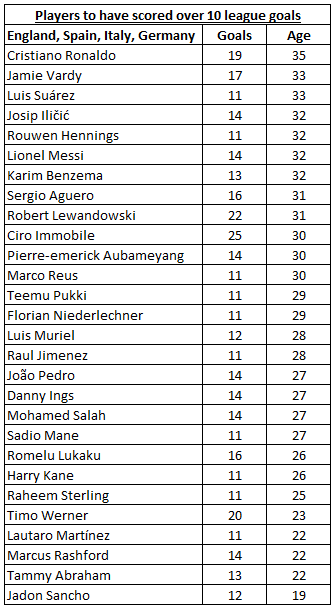
A look around the top scorers of Europe tells a story of the “old men of football” outperforming the youngsters:

The top two in England – 33-yeard-old Jamie Vardy and the eternal Sergio Aguero – are both older than Aubameyang – with the Arsenal striker 3rd on the list.

Over in Italy, Ciro Immobile tops the list – he turns 30 at the end of this month. Cristiano Ronaldo at 35 is 2nd, with Romelu Lukaku 3rd. At 26-years old he is one of the youngest on the long list.

La Liga is topped by Lionel Messi (32), Karim Benzema (32) and Luis Suarez (33). no other played has scored over 10 goals.

Germany bucks the trend; with 2 of the 3 top scorers being under 30 – although 31-year-old Robert Lewandowski still tops the charts. He is backed up by Timo Werner (23) and Jadon Sancho (19).

Of the 28 players to have scored over 10 goals in Europe’s top 4 leagues (Premier League, La Liga, Serie A & Bundesliga), 12 are over 30 and just 5 under 24-years-old.

If Arsenal do decide to let Aubameyang (and Alexandre Lacazette) leave this summer, they have to be looking at bringing in a proven goal scorer. Not take a risk on someone from Portugal, Holland or France. The above list would be the starting point.

You would want the Aubameyang replacement to be no older than 27 years-old. That way Arsenal get least at 3 seasons out of him before we are in the same situation as we are now.

16 players are over 27-years old, leaving us just 12 players.

Mo Salah, Sadio Mane, Harry Kane, Raheem Sterling, Marcus Rashford and Tammy Abraham are all playing for Premier League rivals. We can draw a line through them.

You can also remove Jadon Sancho as he is not a striker – I would not be upset to see him on our left wing next season.

Joao Pedro and Danny Ings are in the same sort of boat as each other. Having a good season, but are either Arsenal quality? No.

Romelu Lukaku only joined Inter Milan in the summer so he is unlikely to leave.

That leaves Lautaro Martinez and Timo Werner.

Werner is the stand out name on the list. Just 23-years-old, he already has 100 senior goals. He has been linked to Chelsea and Liverpool already. If he comes on the market, any top side after a striker will be after him.

If Arsenal do decide to cash in on Aubameyang and Lacazette, Werner must be top of the list. But I imagine Chelsea and Manchester United are thinking the same for next summer.

As for Martinez, I know nothing about him.

The reality is there is not a lot of quality proven goal scorers in world football that have youth on their side.

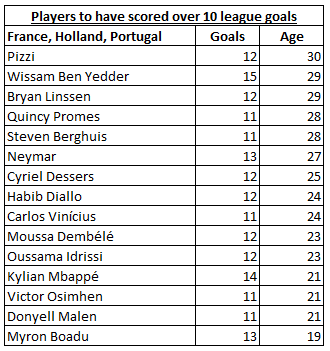
One option would be to look outside the top 4 leagues, and instead focus on Holland, France and Portugal:

The obvious one of Kylian Mbappe aside, there is also not much outside of the top 4 leagues.

Would you rather Aubameyang up top or Cyriel Dessers, Habib Diallo or Victor Osiemhan?

Moussa Dembele is the next best after Mbappe, but is he really up to Aubameyang’s level yet? Surely a better option would be to keep Aubameyang and sign Dembele as a replacement for Lacazette.

Likewise Myron Boadu is clearly a talent, but like with Gabriel Martinelli he is young and it will be a risk to have him as first choice.

I would rather keep a 31-year-old Aubameyang, backed up by Martinelli, than spend big on someone who is not really good enough.

Football is changing. Goal scoring is no longer a young mans game.

Keenos