Review of the Football Supporters (Access) Bill

On Wednesday, Justin Madders, MP for Ellesmere Port and Neston introduced the Football supporters (Access) Bill to Parliament. The crib notes of which can be read in an article in The Times titled Football should care more about its fans An interesting read, an interesting Bill, and well worth dissecting:

Football is our national sport, we invented the modern game and have the most popular league in the world, viewed by millions around the globe. I grew up playing and watching the game and loved every minute. I still play and watch when I can. I have less time and don’t move quite so quickly around the pitch, but I still enjoy it.

However, the difference between professional football now and when I was growing up is incredible. We have some of the best players from all over the world, huge media coverage of every millisecond of every Premier League game and more cash in the sport than it has ever seen before.

Mr Madders is correct, football has changed, and at the highest level, has become more about money generated rather than trophies won. In recent years Arsenal have been more interested in qualifying for the Champions League than winning an FA Cup. This season, Spurs played a 2nd string in a Champions League game which saw them get knocked out of the competition, to ensure they had a better chance of fielding a strong side at the weekend Premier League game to put them in the best place to qualify for next years Champions League.

More interested in qualifying for the Champions League than playing in the Champions League.

Despite this glamour and cash we still flatter to deceive on the international stage and the proportion of young home grown talent breaking through each year appears to be less and less. But not only are there fewer youngsters out on the pitch, there appear to be fewer in the stands as well.

With regards to the fewer youngsters out on the pitch comment, I feel this is baseless. The average age of Premier League players is currently around 26. He has more of a point when he talks about their being fewer in the stands as well.

During the 1980s a much higher proportion of match-going fans were younger (surveys suggest that about 20 per cent were aged 16 to 20) and it is no coincidence that the average age of a supporter now is in 40s. Some surveys suggest that the proportion of young people going to games is now less than 10 per cent. Cost plays a huge part in this, which is why my Bill, if it became law, would require all football clubs to provide 10 per cent of their tickets at discounted prices to people aged under 22.

Football crowds are getting too old. The average age is going up. That is undoubtable. And is a problem. A big problem is ticket prices. Back in the day, you and your mates could get together and go to a game with your pocket money. These days you need to take out a pay day loan.

But it is not all about prices. When you used to go with your mates back in the day, you could all pay on the gate, and stand together. These days you need to buy your tickets 2 months in advance, with membership cards, and you are limited to how many tickets you can get together. Gone are the days 15 of you could turn up and be together.

Another problem is season ticket waiting lists. The likes of Arsenal, Liverpool and Spurs have waiting lists a decade long. That will naturally increase the average age of crowds, as the average age of getting your 1st season ticket is a lot higher. You hear of less and less fans who have got their first season ticket at 13 these days. Because it is near impossible unless your parents are willing to put you on the list at birth – some do.

With waiting lists so long, people are less willing to also give them up as quickly. Add in people living longer, there are probably more 60+ year olds at games these days than there were in the 1980s. It is the same as housing in the UK. The average age of a house owner in the UK is also growing.

Whilst in theory, football clubs being forced to provide 10% of their tickets at discounted prices to people under 22 is a good idea, in practise it might not be workable.

Arsenal have the Young Guns Enclosure. A great idea to try and get teenagers at games, with friends, away from parents. It is not massively popular, to a point where at some games we only see 3 rows worth of ‘Young Guns’. We have created the supply, but where is the demand.

Also, Arsenal have around 44,000 season ticket holders (on this bit I reserve the right to be a little out with the numbers). Add in 3,000 away fans, and 3,000 in club level and boxes, this leaves around 10,000 on general sale. The Bill put forward by Justin Madders would end up with over half of the general sale tickets going to those under 22.

In theory, a great idea, in reality, impractical. And it is not just problems with the prices.

We need to do more to provide for younger supporters or we risk empty stadiums in 20 or 30 years time because the fans of the future have been driven away by sky-high prices. The match-going ritual was part of growing up for my generation, and I don’t want to see the next one lose out on that.

I do agree with the sentiment of the Bill, encouraging the future of football to go to games, it is the practicality I disagree with. And in an era of supply and demand, if stadiums are empty in 20 years due to younger supporters being driven away, prices will dramatically drop, availability increase, and we will see the fans flood back. Simple fluid economics of a capitalist society.

A second measure would require local authorities to consider the needs of match-going supporters when approving kick off times. This follows a number of high profile complaints after games were moved to times which made it impossible for to attend for travelling supporters using public transport. There are countless examples of matches being moved at short notice, in particular to accommodate the demands of TV, for example, when Everton and Manchester United played in the FA Cup semi-final in April. A 5.15pm start time meant that fans risked being left with no train home from Wembley.

At the other end of the scale, at the start of the season in the non-league, Eastleigh FC found their game against Barrow being moved to a 12:30pm kick off to accommodate TV. This left them with a 10 hour, 600 mile round trip. How can anyone seriously expect fans to travel to and from that game on public transport? The Bill requires councils to assess the availability of transport before a kick off time can be approved, so that travelling fans have a realistic chance of being able to get to the game.

That is particularly relevant as we approach the Christmas fixtures, when public transport options are more limited. Games are scheduled to kick off at noon on Boxing Day and 5.30pm on New Year’s Eve. This is also important for those fans who have gone to considerable expense to make travel arrangements well in advance, only to have the time changed at the last minute. And what about the shift worker who plans his time when the fixture list is released, only to find it is worthless as the season progresses?

Out of everything said by Justin Madders, MP, it is the kick off times I agree with the most.

Yes, Sky and BT pay a crazy amount for games, but it is time that the travelling fans get taken into account when it comes to scheduling. Anyone who has done away games on a regular basis will know the frustration.

A game put on a Sunday afternoon in Hull with no trains back to London. A Tuesday trip to Everton. A Monday jaunt from Bournemouth to Newcastle.

Where it becomes more frustrating is when you look at other games on TV that weekend. You will have West Ham v Watford at a favourable time. A time where if you were made to travel to Hull, you could get their and back. It is so frustrating.

Also how long it takes TV companies to decide what games they will show on TV is laughable, meaning that fans often miss out on the advanced train tickets, the cheaper travel options.

Games around Christmas and New Years do have some control, but you still end up with a trip to Southampton on New Years Day. Or this year for Arsenal fans, a trip to Bournemouth on January 3rd. The first working day of the year.

A third measure would require football clubs to set aside a proportion of transfer fees paid for the development of football facilities for local clubs and young people. This would apply only to fees paid by Premier League clubs who, during the last transfer window alone, spent £1.2 billion on players.

A levy of just 0.1 per cent could see an extra £1.2 million raised for grassroots football. I know money does go into supporting grassroots football but it is not enough. Given the cash washing around the Premier League it seems sensible to me to ensure a little of that money goes on helping secure our future players.

One in theory that makes sense, but seems to ignore that clubs already pump a lot of money into their local communities.

Last year, The Arsenal Foundation raised £1million to build pitches in London (and a few abroad). With £21m spent in the transfer market, Arsenal put in nearly 5% of all transfer spending back into grassroots.

Of course, not all of this was club money, some was raised from various initiatives. This year the Legends game against AC Milan will increase the foundation’s coffers further. Add in the players donating a days wages and the buckets going round the ground, the club clearly does a lot for the local community.

I can not speak about other clubs, but imagine they all do similar initiatives.

Add in the free work the players do, visiting schools, youth clubs, hospitals, and the hundreds of footballs, kits, bibs and cones clubs give away, the £1.2m Mr Madders is calling for is probably already being dwarfed by all the clubs.

In fact, Arsenal have nearly hit his 0.1% of transfer spending figure of £1.2m on their own.

A quick look sees Liverpool, Manchester United and Spurs all do similar work in their local communities as Arsenal. And big spenders Manchester City have transformed the Eastlands area of Manchester beyond recognition.

If the clubs aimed for 0.1%, of transfer revenue, clubs would actually have to do LESS work.

The FA has a turnover of around £350m. Maybe instead of giving away thousands of tickets to the Football Family for FA Cup games, hosting conferences in 5 star hotels, spending £1b on a national stadium, £105m on St Georges Park, The FA should have focused more on grassroots. That is their job.

It seems Mr Madders wants the Premier League to put in the work because The FA are failing to do so.

Often pitches are in poor condition with few or no changing facilities. I recently saw a local pitch used for kids’ football where the goals were smaller at one end of the pitch than the other due to vandalism. We cannot expect the superstars of tomorrow to emerge if we are not prepared to invest in them.

Some of the worlds best players have learnt their trade in carp parks, favelas, avoiding bullets and needles. A lack of facilities did not stop the likes of Alexis Sanchez, Robinho and Carlos Tevez from making it.

We often hear that our young players are too pampered. The facilities are too nice. That we do not breed fighters, street ballers, players who will do anything to make it.

Mr Madders talks about a little bit of vandalism stopping players making it. It is clearly a fallacy.

If Carlos Tevez can make it ouf of Ejército de Los Andes and Alexis Sanchez can go from barefoot poverty to global supporter, I am sure David and Harry from Chingford, Luke from Kingston-upon-Thames, Jack from Stevenage and Frank from Romford can cope with a few broken windows in the changing room.


I feel the article, and Bill that Justin Madders, is coming from the right place, and does have some merit, but it also comes from a bit of a lack of understanding of what is really going on.

Having to buy tickets 2 months in advance is as much as a problem for a 15 year old as the price. Mr Madders clearly does not know what work clubs currently do in their local communities, or the hardship many of the foreign stars who end up on plying their trade on these shores have grown up in.

I think it is a positive that the situation many fans face is being bought to light, I only wish he had have actually looked beyond the surface and delved deeper into the problems that many match day fans have.

There is a feeling he has looked at the headlines of the problems, and not the problems themselves.

I will be watching the Bill’s progress with keen interest.

Keenos

The demise of Carl Jenkinson

132

I am beginning to write this blog at half time. Arsenal are 2-0 and heading out of the League Cup. It has not been a pretty game to watch, and Arsenal have still not yet had a shot on target.

It is the performance of one player in particular that has been most worrying. That of Carl Jenkinson.

Jenkinson has been living the dream. A proper Arsenal fan from a proper Arsenal family signing for Arsenal and playing. He is doing it for every single one of us in the stands.


His career at Arsenal since joining the club in 2011 has had its ups and downs. And you just feel this down he will never recover from. We might have just seen him play his last game for Arsenal.

Signed in 2011 from Charlton having played just a handful of games for the side from Woolwich, he went from loan spells at Welling and Eastleigh to Champions League football.

19 at the time, he was a physical spicmen who needed to be moulded. At times he looked a deer in the headlights. He seemed to take one step forward, one step back.

Early indications were that he was unlikely going to be good enough to ever play week in week out for Arsenal, but he had enough ability to be part of the squad, a second choice right back, for his entire career, if he decided to go that way.

Sacrifice a top flight career to sit on the bench, but on the bench of the club he loves. Man U built success on having the likes of Wes Brown, John O’Shea and Nicky Butt. Jenkinson was in their category.

In 2012 he made his England debut. A year later scoring his first, and only goal, for Arsenal, celebrating it like a made man, like any fan would.

In 2014/15, with the big money signing of Calum Chambers, Jenkinson was loaned out to West Ham. He was fantastic. And reports of were that Arsenal rejected a  £10m bid from the Hammers.

Last season he was once more on loan at West Ham, where he suffered knee injury in January that saw him ruled out for pretty much the year. He returned to Arsenal to complete his rehab.

In October, I was in Madrid on a stag do. A few of the lads there were West Ham season ticket holders. They laid it on a plate for me.

According to them, Jenkinson was awesome in his 1st season on loan, awful during his second season. To a point that when he got injured, they were not too worried. Even a little happy. He had become a bit of a liability.

They said he would never be good enough for Arsenal.


I, like many, kept the faith. He was after all an Arsenal fan. He deserved a chance. A second chance. A third chance. He might never be good enough as a long term option at right back, but he would be good back up for Hector Bellerin.

Jenkinson got himself fit. Got himself in a position to play. And he has been given the chance. A mixture of playing League Cup games and then Hector Bellerin getting injured. And he has been awful.

It is still 2-0. This will be posted in the morning. no matter the result. And it saddens me to say, Carl Jenkinson, your time is up.

Keenos

Can Arsenal play in Antonio Conte’s 3-4-3 system?

132

Is 3-4-3 becoming en vogue?

In the process of being spanked 3-0 by Arsenal back in September, Antonio Conte made a tactical change which did not change the course of the game, but changed the course of the season. Switching from the Premier League favoured 4-2-3-1 to 3-4-3.

Chelsea still lost 3-0, but since the tactical change, have won 7 Premier League games in a row, seen the team concede just once, scoring 19 and conceding just the one. They have also gone top of the league.

3-4-3 was Conte’s favoured formation at both Italy and Juventus. Pep Guardiola occasionally played it at Barcelona and Bayern Munich. The turn around in fortunes at Chelsea under this formation are remarkable. It is incredible to think that after the defeat to Arsenal, Conte was the bookies favourite to be Next Manager Sacked.

Tactics are a bit like clothes, they come in and our of fashion.

Up until the mid 00’s, you would struggle to find a team not playing 4-4-2. Then Jose Mourinho came along and started to play 4-3-3. He won the league and suddenly 4-4-2 was dropped, with every Premier League side mirroring Mourinho’s tactics. This formation then evolved to the 4-2-3-1 that nearly every Premier League side now plays.

It is usually a case of following the best side in the league. And it extends further. Look how many times tried to copy Barcelona and Spain with their Tiki-taka football. The trick is you can only mimic a formation or tactic if you have the players to do so. Like England showed, there is no point trying to play possession based football if you do not have the players good enough to pass.

Germany and Bayern Munich under Guardiola saw a slight move away from Tiki-taka and a return slightly to the power and pace of the 90’s. This was of governed by the players he had at his disposal. Whilst Bayern did play possession based football, it was not as strict as Barcelona and they often made use of the pace and power of the likes of Robben, Muller, Lewandowksi and Ribery. Guardiola adapted his own tactics to the players he had at his disposal.

And now we come to 3-4-3.

Chelsea are already using it to good affect. We have seen Liverpool, Spurs and Manchester City all have minor spells where they switched into this formation. One thing is for certain, if Chelsea continue to be successful with the formation, more teams will follow.

Over the next 18 months, if Chelsea clean up at home and in Europe, 3-4-3 will spread like wildfire through the continent.

Without going into the tactical positives and negatives of the formation too much – there are a lot more knowledgeable and better tactical bloggers out their than me (go to The Highbury Library to read them) – the only thing I will say on it is it is a misleading formation.

By having just 3 defenders, many will think it is a more attacking formation than the 4-2-3-1 or 4-3-3 that many sides currently play. This is often incorrect.

The way Arsenal currently line up, the full backs are often pushed past the midfielders auxiliary wingers. This often leaves the side with just 2 defenders, the centre backs. So whilst in 3-4-3 you usually have 3 staying back, in 4-2-3-1 at Arsenal it is often just the 2. So do not think “3 defenders means more attacking” it does not.

A few years back now, many Arsenal fan’s were calling for the side to play with 3 at the back. This was back in the day of us having Laurent Koscielny, Per Mertesacker and Thomas Vermaelen in the squad.

The rationale was simple. We were struggling to keep clean sheets, all 3 were decent defenders with strengths, but all had their weaknesses.

You play Mertesacker in the middle of the 3 with his height, leadership and organisation skills. Either side of him you have Koscielny and Vermaelen. One naturally right sided, the other naturally left sided. Both weak positionally in defence, but both very good coming out with the ball. With Mertesacker leadership, it could have moulded, it could have worked.

Arsene Wenger stuck to 4 at the back, and probably rightly so. At the time it was when we only had those 3 as centre back options. There was no back up to them. Had one got injured, which they so often did, it would have left us relying on the likes of Bacary Sagna or Nacho Monreal as the back up centre backs. It would have meant that we would have gone to the market and signed at least another 2 centre backs.

Roll forward a few years and 3-4-3 could be back on the table.

Should Arsenal follow Chelsea and change up the formation? A lot depends on whether we have the players.

Defence

The biggest argument a few years ago against 3-4-3 was that we did not have the strength in depth to play with 3 centre backs as we only had 3 of them.

In 2016 it is a different story. Arsenal have Koscielny, Mertesacker, Shkodran Mustafi, Gabriel, Rob Holding and on loan Calum chambers.

In the current 4 set up, Mustafi and Koscielny have looked good, but they do tend to give opponents a chance. It seems very easy for a striker to find space between the two. Arsenal are 5 games without a clean sheet.

Mustafi is brilliant on the ball. He is the real deal. Twice the player of John Stones at half the cost (nearly). He would excel on the right side of the 3. The left side is a bit more problematic.

Koscielny is a right sided centre back. He is only playing on the left side as he is more versatile and senior to Mustafi. Could he do a job on the left hand side of a 3? Or should we look to purchase a left footed left book? For now Koscielny would play there.

In the middle, it is a straight choice. Gabriel with his aggression and lack of discipline. Mertesacker with his leadership, height but lack of pace.

Personally I think that Mustafi Gabriel Koscielny would be too similar. Mertesacker would give the side more balance. But it would also be about which of the 3 gels the best, which you will only discover in game situations.

For now, if everyone was fit, it would be:

Mustafi Mertesacker Koscielny

Midfield

Hector Bellerin would be the best right wing back in the world. It would not even be a debate. He has the pace, the composure in the ball, the ability to get up and down the picture. 3-4-3 would suit him down to a tee. The left hand side is a little bit of a worry.

Nacho Monreal is a left back, not a left winger, so he is out. Potentially relegated to a role of back up left sides centre back. Kieran Gibbs is a better option, and perhaps had he played as a wing back throughout his career, he might have had a more fruitful one. Going forward has always been his strength.

On the left you could also have the option of playing Alex Oxlade-Chamberlain. Even more attacking than Gibbs, less of a defender, could he develop like Victor Moses did? The major question mark over him would be whether he has the fitness to get up and down.

In the short term, Kieran Gibbs would probably come in, but it would be an area of weakness and you would like to see Arsenal target someone like Ricardo Rodriguez.

The middle two are important. Chelsea play Matic and Kante in the middle of the park. Both are hard workers who cover the ground. With them often being 2 v 3, they need to be focused on keeping the middle strong. However with 3 centre backs behind them, you do have a little space to not have to play out and out defensive midfielders.

The most natural partnership would probably be Aaron Ramsey and Granit Xhaka. Both very good central midfielder who can both defend and get forward. They would probably work well in the system, as the 3 defenders behind them would make up for any defensive frailties they might have.

In Francis Coquelin and Mohamed Elneny, you have good back up for the 1st choice pair.

Where this would leave Santi Cazorla is unknown. He would struggle in the midfield two. He just does not have the legs to cover the full back and then get back inside to the middle of the park/

Bellerin Ramsey Xhaka Gibbs

Forward

Upfront is fairly interesting. If you have been keeping up, you would realise that we still have Alex Oxlade-Chamberlain, Santi Cazorla, Mesut Ozil, Theo Walcott, Alexis Sanchez, Olivier Giroud, Danny Welbeck and Alex Iwobi at our disposal.

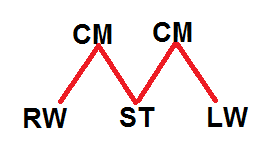
The common set up for a 3-4-3 sees the midfield and forward line make Herbet Champion’s famous M shape:

untitled

3-4-3 would mean the death of the number 10. No more Mesut Ozil. No more Santi Cazorla. So how do you fit everyone in?

Alexis Sanchez starts. You make space for him and he is capable playing in any of the front 3 positions. The question is whether you try and accommodate Mesut Ozil by pushing him out wide?

He is a talented player, and I would try everything in my power to accommodate Ozil, but when I try too, it does feel a bit too much like putting a square peg in a round hole.

The best combination would be either Walcott Giroud Sanchez or Walcott Sanchez Ox. Personally, if we were keeping the M forward line, I would go for Walcott Giroud Sanchez, with Danny Welbeck potentially coming in, either as centre forward our wide left, when he is fit.

But then that leaves Ozil no-where. Whilst I am sure this will please a lot of our boo boys who are still moaning about him, even when Arsenal won 3-1, we could maybe try a spin on the forward line to accommodate him.

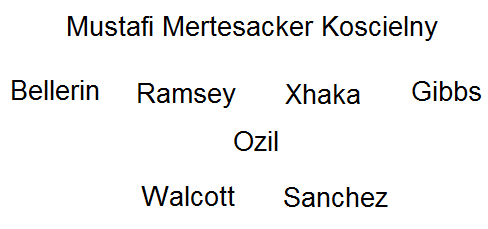
Rather than play the M we could like to play a dice like 5 formation.

cdscds

This would allow the inclusion of Ozil, given a free role to float left and right. Up top we would then play the two forwards narrower than they play in a free, with Ozil feeding them both. You would need the pair to be mobile as they will be expected to cover both the centre and drop out wide. It is for that reason that Sanchez and Walcott (or Welbeck) could be the ideal situation in my newly invented 3-4-DICE formation. An evolution on 3-4-3.

So how would Arsenal line up in Arsene Keenos’ revolutionary 3-4-Dice formation:

34dice

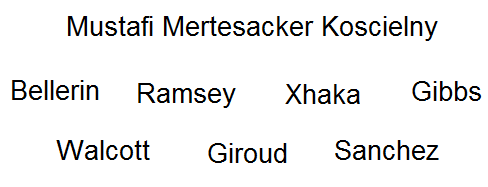
And if we went for a standard 3-4-3:

343

https://twitter.com/KeenosAFC/status/803546242546626560

Keenos