Tag Archives: Arsenal

Does football have it right when it comes to drinking??

I love rugby. Or to add more accuracy; I love the England Rugby Team.

Blame my step-granddad for my love of egg chasing. He was a dyed-in-the-will Glaswegian. A Teddy Bears. A bluenose. Me being a proud Englishman, we bonded over our English/Scottish rivalry as I grew up (I also inherited a mild support for Ranger and a hatred of Celtic from him).

Some of my earliest memories are from the early-mid 90s. A pre-teen Keenos, in a pub on the Lower Clapton Road, watching England beat Scotland in the 6 Nations.

I tell you this to justify why I was watching England lose to Ireland at Twickenham at the weekend. A shocking loss which the English Football Team would’ve been “proud” of (incidentally, I much prefer watching England play cricket and rugby over football).

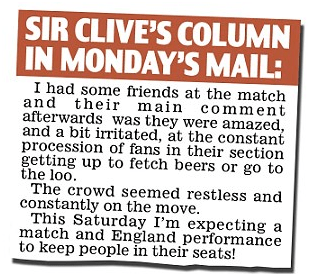
As I was watching the game, I got reminded of an article I read a couple of years ago by Sir Clive Woodward in the Daily Mail.

The jist of it was simple. That the constant stream of people in and out of rows, up and down the stairs, to get a pint or go for a piss, had become a huge distraction away from the game. The full column is below:


I seemed to touch on a very raw nerve the other day when I mentioned how irritating the constant procession of fans to and from the bars and lavatories at Twickenham is getting during the game.

It has got out of control recently and is fast becoming a real issue.

I’ve seen it with my own eyes and have heard many friends and regular England supporters complain constantly about it.
Rugby fans have a well-deserved reputation for enjoying pints and hospitality before and after the game and long may that remain the case.

It is a traditional part of the big day out, meeting friends before and the big post-match inquest over a few drinks afterwards.

But surely in between the game itself must take centre stage.

Currently, the stream of people replenishing drinks, carrying trays of beers to friends, buying and fetching hot food and answering calls of nature is off the charts.

And pity the people having to stand up like a game of musical chairs as they make way for those who seemingly can’t sit still for more than five minutes.

This is beginning to detract seriously from the enjoyment of those who have paid very good money — well in excess of £100 per ticket in many cases — to watch a game that they are only seeing dribs and drabs of because of this tide of humanity.

Guys — and girls — it’s only an hour and 20 minutes with a 15-minute half-time break for essential calls of nature. Surely we can manage that? You wouldn’t think of behaving like this at a theatre or cinema.

I would seriously think about shutting the drinks outlets 10-15 minutes before kick-off and not opening them again until the final whistle is blown. Take a drink to your seat by all means — you might have a hip flask of your own as well — but that’s your lot for the duration of the game

Twickenham is not primarily a public bar, it’s a wonderful ground where rugby must come first, second and third and where members of the public of all ages must feel completely comfortable and welcome.

After I touched on this in Monday’s column, Aly Prowse, a diehard England fan from Somerset, wrote to me. She is a member of the official England supporter club.

The RFU has become very commercial and has proved itself to be a money-making machine. Twickenham’s revenue through beer and food sales has benefited the Rugby Football Union, but in the rush to cash in they need to be careful here.

The RFU committee members would never countenance such behaviour where they sit, or in the Royal Box where the VIP guests are catered for, so why encourage it elsewhere in the ground?

Let’s make sure that those England fans, and visiting fans, who have dug deep to travel and support their teams, get full value for that loyalty and commitment.

Match day at Twickenham should always be a pleasure, not a chore.


Now I have no issue with people liking a drink. I myself am partial to a lager or 8 at the football. I have missed entire halves before because I was having a pint, having a chat.

But perhaps when it comes to drinking, football does have it right?

By not allowing fans to drink in-front of the pitch, it means that there is not a constant flow of people going to an from the bar for 90 minutes, like there is in rugby.

It was noticeable against Ireland on Saturday. Streams of people constant going up the stairs empty handed, then returning with 4 pints. It meant the crowd was restless. The constant getting up and down for others a distraction.

At cricket, you drink all day in the sun. But it is customary to not leave your seat until after an over. And stewards will stop you returning to your seat until between overs. It stops the constant flow of people in and out of the stands that you see at rugby. Stops distractions.

I have often been one who has said “get the atmosphere back at football. Let us drink, smoke, stand and swear”. But having watch the rugby Saturday, would drinking in-front of the pitch make much of a difference? Or would it just create a constant annoyance for everyone bar the person who has gone to get themselves a pint.

Perhaps, when it comes to drinking at football, you are best off keeping it to the concourse.

Keenos

Arsenal look to Germany to replace Arsene Wenger

In the 3rd part of what has become a bit of an epic mini-series in this extended break between the AC Milan game and whenever the hell we play next, we round off who should replace Arsene Wenger by looking at who would be the best option as a People Manager.

If you have already missed parts of these articles, which have been labelled “The blogging version of the Peaky Blinders” then the rest of the episode are available on Catch Up.

We started by discussing what sorts of managers there are in the world. This came from a discussion I had in the pub with some mates over the lack of real top coaches in world football at the moment. And that top sides seem to employ managers who can cope and mould the egos of players, rather than improve them.

There are clearly two types of managers in the world, the People Manager and the Head Coach.

Depending on what you believe we need, and where we sit in the football spectrum, governs who you should be demanding we go for.

For those fans who want to see us develop players, rather than simply sign the best, Leonardo Jardim comes out as number one target. A brilliant coach who has shown on multiple levels that he is ready for a job like Arsenal.

But today we look at the complete opposite to Leonardo Jardim. A man with a relatively poor club coaching record, but has proven on the international stage that he can manage and mould some of the best players in the world into a successful team.

When Raul Sanllehi said: “Ivan explained the ideas he has got for the club and the people he wants to bring in, it was impossible to turn it down” at the recent Fans Forum, that was also attended by Ivan Gazidis and Mark Gonnell, He could have been talking about this man.

Joachim Low took over as German team national manager from Jurgen Klinsmann in 2006. He inherited a side that had just made the semi-final of the World Cup. Over the next 10 years, he would nail himself to the mast as the undoubtedly the best manager in international football.

In his first international tournament, he saw his side lose the 2008 European Championship Final to a brilliant Spain side.

In 2009, he saw the Germany Under-21 team win the UEFA European Under-21 Championship. With an ageing senior side, containing the likes of Michael Ballack, he realised quickly that he needed to integrate the talented youngsters that won that tournament into his senior squad.

The likes of Thomas Muller, Mesut Ozil and Manuel Neuer.

2010 saw Germany reach another World Cup Semi Final, and 2 years later they made the European Championship Final. Then in 2016 they reached the promised land.

In 2016, Germany destroyed all as they went on to win the World Cup.  Memorably beating hosts Brazil 7-1 in the final.

Germany are favourites to win the World Cup this summer, and Low has a contract signed until 2020, but he might feel time has come this year, after 12 years in the job, to move on.

At Germany, he has not really had to improve players. He inherits top players from clubs, and has had to mould them into a formation and motivate them to success.

Managing Germany is a bit like managing a modern super club.

You do not need to overly improve your current players, you just need to get the best out of them. Get the tactics right, and keep everyone happy.

This is why Low’s poor club career is insignificant.

At club level, he never managed a top club. He clearly struggled at a lower level, to improve players. People are suited to a certain position, a certain club.

David Moyes was brilliant at Everton, but struggled when he took the step up. Likewise, Pep Guardiola has done it at Man City, Bayern Munich and Barcelona, but could he do it at Everton? Probably not.

Arsenal need to make the move forward as a super club, and Low could be the man to lead that.

When you look at the men in Arsenal’s backroom, many of whom have only recently been bought in, there is a massive Bundesliga / German link.

Sven Mislintat has recently joined the club as Head of Recruitment. Per Mertesacker is set to take over the academy.

Then you have Shad Forsythe. The American Head of performance spent 10 years working with the Germany national team and was part of the coaching set-up during their 2014 World Cup success. Low knows him, he knows Low.

Our playing side also has a German / Bundesliga feel to it.

Mesut Ozil,  Shkdoran Mustafi, Henrikh Mkhitaryan, Pierre-Emerick Aubameyang, Granit Xhaka and Sead Kolašinac have all played in Germany at some point in the career. Ozil and Mustafi have played under Low in German.

Arsenal are also heavily linked with German goalkeeper Bernd Leno as a replacement for Petr Cech.

It just feels like a natural fit for where the club is at the moment.

A bit like when Wenger joined the club in 1996, Arsenal ended up with a Gaelic feel to it on and off the pitch, Low would be coming in to a club that already has plenty of Kraut’s in the set up.

Joachim Low could be the man to get the best out of what is a very talented squad.


So who should be next Arsenal manager?

https://twitter.com/KeenosAFC/status/976003011872022529

Keenos

Barcelona man set for Arsenal move

“When Ivan explained the ideas he has got for the club and the people he wants to bring in, it was impossible to turn it down.” – Raul Sanllehi.

Arsenal’s new Head of Football Relations uttered the above words at the recent Fans Forum, that was also attended by Ivan Gazidis and Mark Gonnella.

By the time Sanllehi joined the club at the beginning of February, the overhaul of the personnel within the club promised by Ivan Gazidis early in 2017 had already begun.

The appointment of Sanllehi would not have happened overnight. Working in recruitment, the process of bringing in someone of his level takes 6 months to a year. He agreed to joined Arsenal in November 2017, but due to notice periods, could not start work until February 2018.

Arsenal probably would have started initials talks with him in early 2017, around the time Gazidis mentioned that big changes were coming at Arsenal.

Whilst Sanllehi joined after new Head of Recruitment Sven Mislintat and Contracts, Legal & Commercial Expert Huss Fahmy and Director of High Performance Darren Burgess, these names would have been mooted to the former Barcelona director during the recruitment process.

What is interesting about what Sanllehi said at the Fans Forum is the tense he used .

The people he wants to bring in indicates the future, rather than the people he wanted to bring in which would indicate the past.

Now I might be looking into it too much. A man speaking live, not in his native tongue, but this would indicate changes at Arsenal are not yet finished. And putting two and two together and getting 5, I would say he is talking about a new manager in the summer.

Yesterday I discussed the two types of manager that Arsenal could look at appointing. A People Manager or a Head Coach.

Today I look at the second of those two types of manager, the Head Coach. And one name sticks out more than any other, Barcelona born Leonardo Jardim.

Monaco manager Leonardo Jardim was born in Barcelona, Venezuela. He is a man whose reputation has grown year by year, and this summer could be the time for him to take another step up to the big time.

His CV reads of a man who has been a journey of management.

Starting A.D. Camacha in Portugal as Assistant Manager at just 27, he has moved through the divisions in Portugal until he became manager of Braga – the season after Arsenal played them in the Champions League.

A move to Greece followed, where he took Olympiacos to 10 points clear at the top of the Greek League, before the side terminated his contract with immediate affect with no reason made public.

A move back to Portugal followed where he took over at Sporting Lisbon. He coached a team full of youngsters developed at the club’s youth system to second in the league – 25 points more than the previous season.

Then came the move to Monaco.

In 2014, Jardim was appointed at AS Monaco FC manager. He led the team to the third place in Ligue 1 in his first year, repeating the feat in 2015–16. In 2015 he also led Monaco to a shock victory over Arsenal in the Champions League – beating Arsenal 3-1 in Islington.

Then, in 2016/17, he led Monaco to its first Ligue 1 title in 17 years.

A team mainly made up of previously unknown youngsters, coached to play attacking football, Monaco finished 8 points ahead of big spending PSG.

The side also reached the semi-finals in both the UEFA Champions, beating the likes of Tottenham, Borussia Dortmund and famously Manchester City. They eventually lost to Juventus in the semi-finals.

Jardim is clearly a brilliant coach. Everywhere he has been he has had to be.

He has never managed an ultra rich club who can buy up the league. Every club he has managed he has had to improve the players that are at the club. At Monaco, he did this to devastating success.

You only have to look at the likes of Benjamin Mendy, Thomas Lemar, Kylian Mbappe and Fabinho to realise how good a coach Jardim is. To realise how much he improves players.

This season, Monaco have performed admirably once more. They are best of the rest in France. Second in the league, behind PSG. But they are 17 points behind. And with vultures constantly circling, picking off the players he has developed, Jardim may well feel the time has come to make a move.

When Monaco won the league, their highest attendance was 17,135. Their lowest was 2,000.

Joining Arsenal, with our financial power and standing in the game, will clearly interest the Venezuelan. The chance to ply his trade in-front of 60,000 rather than 15,000.

And this is where Arsenal fans perhaps need to be honest with ourselves.

We are not Manchester City with their bottomless pots of cash generated from Middle-Eastern oil. Nor are we Manchester United, the super club who bring in nearly £200m more in revenue a season.

Yes, we were promised when we moved to the Emirates that we would compete with the biggest and best in Europe, but the reality is that we are still that level below – we would be even further behind had we stayed at Highbury.

That means we need to be smarter than our opponents.

Like when Wenger came in during the late 90s and revolutionised the club, the only way we can compete is through better scouting, and better coaching.

Find the next Patrick Vieira’s and Thierry Henry’s – and coach them so that they become the next Patrick Vieira and Thierry Henry.

Unlike Monaco, we do have the finances to keep the players once they become established on the world stage – like we have done with Mesut Ozil. But what we lack is the coach to take players from young with potential, to world superstar.

The best man for that job, in my opinion, is the man from Barcelona, Venezuela – Leonardo Jardim.

Keenos
