FA Cup final weekend and I do not think I have ever been so disinterested in one.
Usually, I would be buzzing for the biggest day in the English footballing calendar. Today I will not even watch it. Instead I will be in a garden centre in Harlow.
A bit of Arsenal chatter today about ceilings and floors.
Players that raise the ceiling are those that make the top end of the team better, and therefore raise the ceiling of the team. Think Declan Rice.
Meanwhile, players that raise the floor are those that come in at the bottom end of the squad, improving on those firing players. You can also raise the floor by signing “raise the ceiling” players, demoting a current starter to a back-up dancer and letting go the current squad player.
An example of this was seen last season when we signed Declan Rice. That one player raised both the ceiling and floor.
Rice was better than anything we had in midfield. But his recruitment also meant that Thomas Partey became 2nd choice, Jorginho 3rd choice and Mohamed Elneny a fringe player.
Jorginho as 3rd choice is a huge upgrade on Elneny who was previously 3rd choice. We also saw Albert Sambi Lokonga depart on loan.
If you raise the floor and ceiling at the same time, you are both improving the starting XI and improving the squad depth.
Talk is that Arsenal are looking to recruit one “ceiling” player. My bet is it will be that striker. The club will then look for 2-3 players that will raise the floor. I would imagine that will be a central midfielder and maybe another centre back.
This really shows how clear Arsenal, Edu and Mikel Arteta are thinking right now.
No longer does it feel like we are working without a plan, waiting to see who becomes available or is offered to us. We are determining our targets and going out and getting them.
Of course, it could be all for nothing as once against Manchester City will be outspending everyone.
There is already talk that they are looking to dump Matheus Nunes this summer. The former-Wolves midfielder was signed for £53m when they failed to secure Declan Rice. The fact the can discard £50m+ players like they are Uno cards highlights their financial doping.
We do not beat Manchester City by outspending them. We beat them through smarter recruitment.
Raising the ceiling and floor is good recruitment.
In other news, I see Lucas Paqueta could be in deep trouble having been charged with getting booked deliberately for “the improper purpose of affecting the betting market”. Could not happen to a nicer player at a nicer club.
West Ham got a little too big for their boots after a couple of seasons of finishing top 7, and then winning the Intertwobob Conference League thing. They then celebrated last year as they “did Arsenal out of £100m” whilst ceiling the only player that made them relevant.
Having pushed David Moyes out, they have recruited a Wolves reject. Their star midfielder is looking at a long, long ban and, with no Europe, the likes of Jarod Bowen and Mohamed Kudos might not be around much longer. I would take both at Arsenal as cover for Bukayo Saka. Their ceiling players are our raise the floor ones.
I would not be surprised if in 12-months time we are sitting here and West Ham and their god awful stadium have been relegated to the Championship.
But hey, you will always have that day you sold your star to Mikel Arteta.
A new striker is top of our list this summer. Despite us scoring more league goals in a single season than any other in our history, the forward line is an area that can be improved.
After much searching, amateur scouting and watching YouTube clips, Benjamin Sesko is the one I want for Arsenal.
Kai Havertz shows the way
I often cast my mind back to the January window in 2022 as Arsenal searched for a replacement for Pierre Emerick-Aubameyang. We were heavily linked with Dominic Calvert Lewin, Dusan Vlahovic and Alexander Isak; three strikers of a very distinct profile.
It was clear at this point that Arteta basically wanted a “more mobile Giroud” to lead his line. Someone who could work a defence with their movement, whilst also provide a physical presence in the box.
After missing out on Vlahovic, Arsenal turned down the opportunity to sign Isak in the summer and plumped for Gabriel Jesus.
Jesus was a completely different profile to the players we were previously looking at. Smaller, quicker, trickier. Although his hold up play is actually underrated.
In 2023 Arteta was focused on signing players that he thought would take us to the top 4. Jesus would be fine if we just wanted a top 4 challenge. But now we are title chasers and that means a new striker and a return to Arteta’s original plan.
In the second half of the season, due to injury and form, Kai Havertz was pushed further forward, replacing Jesus. Havertz would grab himself 8 goals and 7 assists in 13 games. This showed that a bigger, mobile, technically gifted striker is the way to go.
Sesko playing style
I have previously described Sesko as a “more mobile Dimitar Berbatov”.
Whilst he is not an out and out goal scorer or powerhouse forward in the Erling Haaland mould (who is?), he is a technically gifted player who has a great touch, great movement and a decent bit of pace.
He is not too dissimilar to Havertz, but has better instinct in the box and will be able to sniff out those goalscoring positions that Kai does not.
Age profile
In the back end of this season, Kai Havertz showed he is a genuine option as a striker for Arsenal, alongside Gabriel Jesus. That means that we no longer need to look for the “finished article” and that we could look for someone a little bit younger, a little bit rawer.
Sesko is just 20 years old (turns 21 in a week).
With the situation we are now in, we could afford to sign someone like Sesko and take our time developing. The Slovakian can play in tandem with Havertz, rather than be expected to come straight in and replace him.
A very high ceiling
Last summer, Sesko moved from Red Bull Salzburg to RB Leipzig for £20million. It was a huge step up from Austria to Germany.
Sesko started the first half of the season slowly, often coming off the bench for his new team. But as the season progressed, he established himself as their first choice striker and finished the season on a 7 game scoring streak.
14 goals in 31 Bundesliga games might not excite many, but 11 of those came in the last 16 games. Sesko proved he has that ability to step up to the next level.
The Premier League is a step up from the Bundesliga (gap not as big as Austria to Germany though). Sesko will need to continue working hard and step up again if he wants to be a regular starter for one of the best teams in Europe.
I believe he has the potential to become one of the best in Europe, and his 2nd half of the season form in Germany has shown he has the hunger to work hard on his game.
Again, with Kai Havertz at the club, we will not need Sesko to make the impact on day one. We can afford to take it slowly with Sesko and for Mikel Arteta to build him into the striker he wants.
Cost
My main concern with the links with Viktor Gyokeres was the price tag.
I was not sure paying £70m+ on a 25-year-old who was playing in the Championship 12 months ago made much sense. And as we have seen with other recent Liga Portugal imports (Darwin Nunez), the step up to England from Portugal is huge.
Isak would have been a good option this summer, but considering at Newcastle spent on him (£70m) you can not see us getting him for less than £100m. That would mean less investment elsewhere in the squad.
Finally, I was also always uncomfortable spending big on Ivan Toney considering his age.
Sesko has a £55m release clause, making him the cheapest player I have mentioned in this blog. He is also the youngest and has the highest ceiling. It is a deal that makes most sense.
And what for Kai Havertz?
When we signed Havertz, I always saw his recruitment as a utility forward. Someone who could play in multiple positions.
He has excelled up front in the second half of the season, and considering Sesko’s age and rawness, he will play a big part upfront next season.
Havertz would still remain an option playing deeper (just not with Olexsandr Zinchenko in the same team – a blog for another day) when we want to set up more attacking.
Next season we need to compete on 4 fronts. That means we need to be prepared to play 60 games. There will be more than enough to go around.
And Jesus’s future?
Some reading this might think “Jesus is gone then”. Incorrect.
Jesus joined us from Manchester City after years of being a squad player. He wanted an opportunity to show he could be a regular starter. Unfortunately, injury and form resulted in him returning to that squad role he had with Man City.
The Brazilian basically has a choice – stay at Arsenal and accept a squad role, or push for a move and hope it is “3rd time lucky” in his dream to be a regular starter.
Jesus would still have a big role to play at Arsenal.
Havertz and Sesko would be two similar style strikers. There would be games when we might want an alternative option. Someone a bit trickier and quicker. That would be Jesus. Likewise, he could be a game changer off the bench with the way he buzzes around.
Gabi is also an option on the wing.
Previously, I spoke about need a striker who could also be an option on the wing. Alternatively, we needed to target a new winger. By signing Sesko, it would free up Jesus to play on the wing.
Jesus can play both right and left wing, providing cover and competition for Bukayo Saka, Gabriel Martinelli and Leandro Trossard. I would not be unhappy if any of those 4 started out wide.
It also allows us to continue assessing our wing options.
Saka is a guaranteed starter on the right, but the left wing might need to be addressed in a years time.
Martinelli’s tough season can not be ignored, and whilst it is not an issue going into next season it is a situation to keep an eye on. Trossard also turns 30 and will have a year left come 2025.
In 12 months, if Martinelli does not return to form, I would not be surprised if we turn our focus on a new left winger, with Martinelli becoming the cover and competition. By using Jesus outside, it means we do not need to address the issue this summer and can allow Martinelli to continue his develop.
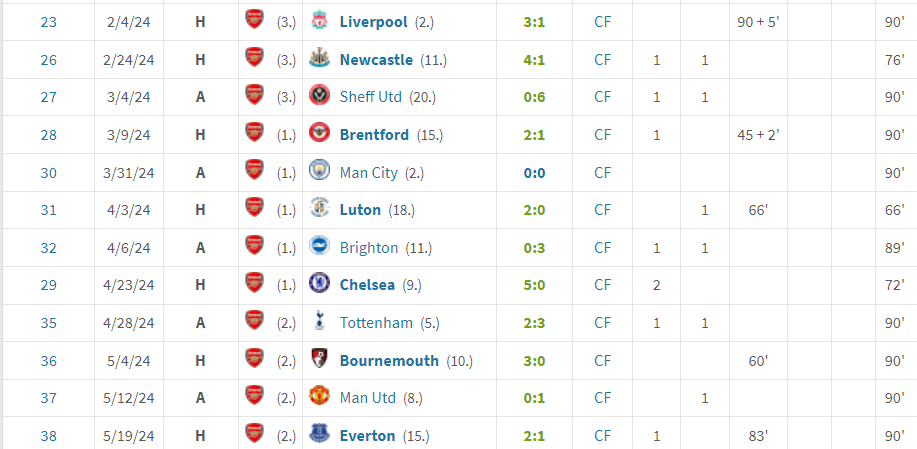
Arsenal (1) 2 Everton (1) 1 Premier League Emirates Stadium, Drayton Park, London N5 1BU Sunday, 19th May 2024. Kick-off time: 4.00pm
(4-3-3) David Raya; Gabriel Magalhães, Ben White, William Saliba, Takehiro Tomiyasu; Thomas Partey, Martin Ødegaard (c), Declan Rice; Leandro Trossard, Kai Havertz, Gabriel Martinelli. Substitutes: Aaron Ramsdale, Gabriel Jesus, Emile Smith-Rowe, Jurrien Timber, Eddie Nketiah, Jakob Kiwior, (Jorge Luiz Frello Filho) Jorginho, Fábio Vieira, Oleksandr Zinchenko.
Scorers: Takehiro Tomiyasu (41 mins), Kai Havertz (88 mins) Yellow Cards: Thomas Partey, Declan Rice, Jurrien Timber Arsenal Possession Percentage: 69%
Referee: Michael Oliver Assistant Referees: Stuart Burt, Dan Cook Fourth Official: Josh Smith VAR Team at Stockley Park: VAR Stuart Attwell; AVAR Nick Greenhalgh
Attendance: c.60,000
And so the final day of the season has arrived for us all at last. By the end of the ninety minutes we will all know whether Manchester City have fallen on their sword courtesy of West Ham United or not, and ultimately, one way or another, our fate will be sealed. But hey, what a season we have all had!
With the absence of Bukayo Saka today due to injury, there is still a fantastic party atmosphere here at the Emirates this afternoon, in which we started proceedings today for the last time this season.
In the early stages of this game, we were dominating matters with accurate passing and clever play. A superb cross by Declan Rice found the head of Takehiro Tomiyasu but it went wide of the target.
The match started to quieten down and although we had domination, the visitors still managed to sneak in and grab a half chance, which was cleared adequately by David Raya.
Martin Ødegaard slotted the ball to Declan Rice, who managed to get a left-footed shot in, which was somehow saved by Jordan Pickford, and then Gabriel Martinelli’s right-footed shot from the right side of the penalty area was saved again by the Everton goalie in the centre of the goal.
After a slight delay due to an injury to Idrissa Gueye the match continued with pressure from our team, and it has to be said that frustration appears to be creeping in, as early as the twentieth minute here.
A sublime pass from William Saliba found Kai Havertz, who did very well to hold up the ball before cutting inside to push it onto his left foot; he tried a clever reverse shot in order to try beat Jordan Pickford, but the shot was blocked by an Everton defender.
Unbelievably, Dominic Calvert-Lewin managed to hit the post with a right-footed shot, which was an incredible let-off for us at this point of the proceedings.
Just after the half-hour, both Kai Havertz and Gabriel came close to scoring, but unfortunately their shots were blocked by an alert Everton defence.
Five minutes before the break, the unthinkable happened when we went a goal down because of a free-kick by Idrissa Gueye which ricocheted from Declan Rice’s head and beat David Raya and simply flew into the top right-hand corner of the net.
A minute or so later, we scored the equaliser when our captain passed the ball to Takehiro Tomiyasu who beautifully whacked the ball into the bottom right-hand corner of the net.
During the seven minutes injury time, we continued with the pressure, with the best effort being when Martin Ødegaard passed the ball to Thomas Partey who blasted the ball over the bar. Either way, the first half finished honours even here at the Emirates.
Everton kicked off the most important second half of the season, and within a minute of the restart, we won the ball and started to put pressure on the Everton goal, culminating in a header from Kai Havertz which went just wide of Jordan Pickford’s post.
Kai Havertz was fouled by James Tarkowski who received a yellow card for his trouble, and shortly afterwards Abdoulaye Doucouré also received a yellow card for his foul on Gabriel; unfortunately, Gabriel was unable to continue as he had incurred a shoulder injury, so Oleksandr Zinchenko replaced him just before the hour mark.
A blistering shot from Dominic Calvert-Lewin was saved superbly well by David Raya and at the other end, a Jarrad Braithwaite header from Martin Ødegaard’s corner only got as far as Declan Rice, who hit a powerful shot over the Everton crossbar.
Shortly afterwards, a superb Gabriel Martinelli cross found the head of Kai Havertz, whose header bounced off the crossbar.
Emile Smith-Rowe and Jurrien Timber replaced Thomas Partey and Ben White with twenty minutes of the match remaining, and we continued trying to score a goal desperately as Leandro Trossard’s cut-back pass found Martin Ødegaard, who took a touch before shooting for goal from just outside the Everton six-yard box, but there were defenders everywhere and his effort went back into general play.
Leandro Trossard was replaced by Gabriel Jesus with twelve minutes of normal time remaining in order to grab goals, and patiently we moved forward with effort and desire.
Emile Smith-Rowe, after receiving a great cross from Gabriel Martinelli, hit the crossbar with a downward shot that bounced up and struck it with some force.
A clever shot from Gabriel Jesus was blocked by a defender that went out of play for a corner kick, and with two minutes left on the clock, we finally got the goal that we were looking for when Kai Havertz got the ball in the back of the net after a clever pass from our captain. However, there was a VAR check as it was thought there was a hand-ball from Gabriel Jesus on the build-up, but fortunately the goal was given by referee Michael Oliver.
In the five minutes injury time awarded, despite our best efforts, news came in that Manchester City had defeated West Ham United by three goals to one, and although every man did their very, very best that they could, second place in the Premiership for the season 2023-24 became our fate.
With eighty-nine points from thirty-eight matches, our boys finished just two points behind champions Manchester City. Yes, we deserved better of course, but overall we should be very proud of this season as we have progressed beyond all expectations.
We did poorly in the domestic cup competitions of course, but finishing runners-up in the Premiership and quarter-finalists in the Champions League is absolutely no disgrace. We are all so very proud of you all, and who knows what will happen next season? This could be a springboard for so much more. Well done, chaps!
Remember everyone, keep the faith, get behind the team and the manager, stick with the winners. Have a great summer everyone, see you again in August! Victoria Concordia Crescit.
Steve
Too Dearly Loved To Be Forgotten: Arsenal v Racing Club de Paris 1930-1962 by Steve Ingless (Rangemore Publications, ISBN 978-1-5272-0135-4) is now available on Amazon