It was brilliant news that Mikel Arteta has signed a new contract. Anyone that disagrees with this fact must hold some sort of grudge. Likely going back to Arteta snubbing them as a player when, as a grown man, they used to hang about the training ground begging for shirts to be signed.
So 2030. Another 4-years of challenging for titles under Super Mik Arteta. Another 4-years of trusting the process.
Arteta’s Arsenal are in the “WIN NOW” phase. The signings of Ezri Konsa and Bruno Guimaraes, two established Premier League superstars, highlight that Arteta is now building for the future. He wants glory. And it wants it this season. And next.
But this brings with it a risk.
As we have seen with Liverpool, if you do not prepare for the future you end up with a group of players all reaching the end of their peak at the same time. They will be on huge wages, which leaves you little budget to consider signing the “next big things” and what ends up happening is a few years in the wilderness whilst you rebuild a team, rather than a transition as 20-somethings take over from 30-somethings.
Manchester United have spent nearly 15-years in this wilderness following Sir Alex Ferguson’s (and theirs) last league title. It was a championship built on Rio Ferdinand, Nemanja Vidic, Michael Carrick, Robin van Persie, Wayne Rooney and Patrice Evra. The majority of which were beyond 30, and all of which were nearing the end, or at the end, of their peak.
Arteta’s job over the next 4-years is not to only win now, but also to ensure that he does not go into the 30s with an ageing squad past their best, or handover a creaking squad to the next man.
So just how would Arteta’s current Arsenal look in 2030?
Is it too early to start thinking about your Christmas jumper?
Come 2030, David Raya will be 35. As a keeper who relies on reflexes rather than his frame, he will likely be at the end of his time with us. He may not even make it through to 2030. But coming through the wings we have Tommy Setford.
Now it is notoriously difficult to come through at a top team as a goalkeeper. You just do not get the game time to develop, to make your mistakes as you grow. That is why Setford’s loan deals, and patience, are going to be important.
Come 2030, Setford would be 24. Still young for a keeper. Hopefully he would have had 3 progressive loan deals under his belt (currently at Stevenage), the last of which being either in the Premier League, Bundesliga, or other top league. If he is good enough, he will get his chance.
Jurrien Timber will still only be 29 in 2030, as will William Saliba. Riccardo Calafiori and Piero Hincapié will be just 28 and Cristhian Mosquera 26. These guys will have plenty still left in the tank. There is also Marli Salmon who will be just 21…
Gabriel Magalhães at 32 might be coming to the end of his time, but then again he has never been a defender who has relied on his pace. You could easily see him playing through till he is 34 or 35 at the highest level. Likewise, Ezri Konsa will also be 32. We do not really need to think too much about succession planning for these guys as those mentioned above will still in in their late 20s. Succession planning for the defence will probably start in 2030, not need to be done by.
In midfield, Martin Odegaard will be 31. I would not be surprised if he leave us before 2030. Maybe even next summer. Eberechi Eze (32), Mikel Merino (34) and Bruno Guimaraes (32) will likely all be either gone, or in their last season.
That will still leave us with Declan Rice (31), Martín Zubimendi (31), Myles Lewis-Skelly (24) as midfield options, with Bukayo Saka (29), Christos Tzolis (28) and Max Dowman (20) as attacking options. Despite being just 28 in 2030, I expect Noni Madueke to have departed to make way for Dowman.
Up front it is a bit more tricky. Kai Havertz will be 31 and Viktor Gyokeres 32. I would be very surprised if either are still with us in 2030.
So lets now look at 2030/31. What would be the starting XI based on players currently with us who would still have plenty to give. And where do we need to look to recruit?
Declan Rice would be the only man in our 2030/31 that would be over 30, and he would be just 31. With his footballing brain, playing a more static role, or even going back to centre back, would be an easy transition for Rice as his legs go.
Then backing the above up, we would still have the likes of Zubimendi, Salmon, Hincapie, as well as Gabriel or Konsa as an “older” option at just 32. This leaves us, in the next 4 years, to only really need to recruit a new right back, central midfielder, Odegaard replacement, left winger and two strikers.
Arteta can be in his win now phase because most of his players are all just entering their peak. There is not a huge amount of succession planning needing to be done. Much of it is already done. And the reast will happen naturally as we improve our squad year on year rather than having to buy the future.
Looking to the future, the big question now is “what will Man City’s punishment be?”. Before we get to that, Man City have until Friday 2 October to appeal. They will appeal. And their “irrefutable evidence” seems to be that money given to sponsors was from the Abu Dhabi (AD) government, and not Man City’s owners, Abu Dhabi United Group.
Mansour bin Zayed Al Nahyan is the founder of ADUG, who own 81% of Manchester City.
He is also a current vice president and deputy prime minister of the United Arab Emirates, as well as the minister of presidential court and member of the ruling family of Abu Dhabi. He is the brother of the current president of the UAE, Sheikh Mohamed bin Zayed Al Nahyan, and is married to Sheikha Manal bint Mohammed Al Maktoum, daughter of Sheikh Mohammed bin Rashid Al Maktoum, the ruler of Dubai.
Previous leaks of internal documents show that the Abu Dhabi government manages the accounts belonging to ADUG. ADUG insists it is separate from the Abu Dhabi government. This will be key, but only for some of the charges.
So what will Man City’s punishment look like?
Breaching Premier League Profitability and Sustainability regulations (2015-2018)
Manchester City have been found guilty of 114 breaches of the Premier League’s financial rules. 7 of those cover a breach of the Premier League Profitability and Sustainability regulations between 2015-2018.
Whilst the 7 charges may be the one of the smallest, they are perhaps the easiest to judge and may be in the most impactful. They are also an aspect of the case that Man City’s irrefutable evidence can not defend.
In recent years, Everton got a 10-point deduction for a PSR breach. This was reduced to 6-points on appeal as they self-reported the breach. A second breach saw them get a 2 point deduction. Nottingham Forest have also received a four-point deduction for breaching Premier League profit and sustainability rules.
So that sets the baseline for a breach at 2-10 points, with mitigating circumstances including how much they breached the rules for, whether they self-reported, and whether they cooperated with the Premier League. We can strike those last two off as we know City did not report themselves, nor did they cooperate.
The 7 breaches cover 3 seasons. You do not get multiple point deductions for multiple breaches in a season. They are batched together when the authorities consider the severity of the breach. So for the 3 seasons of PSR breaches, I would expect a point deduction of 18 to 30 points minimum (IE along the lines of Everton’s biggest punishment, and what it was reduced to on appeal).
History as shown that PSR breaches lead to point punishments and not financial punishments.
Failure to provide accurate financial reports for player and manager compensation (2009-2018)
14 of the breaches are a failure to provide accurate player and manager payments. We already know at least one of these relate to Roberto Mancini’s “double contract”.
ADUG will continue to maintain that having two separate contracts with two separate organisations is perfectly fine. That Mancini, and others, were paid by ADUG for their employment by Man City, and then paid separately for consultancy work outside of Manchester City.
Over the years there have often been rumours similar to this.
When David Beckham, for example, joined Real Madrid, there were rumours that Adidas were “covering” part of his salary as they wanted their most marketable player to be playing for their most marketable team. No evidence of this ever existed and it was always just paper talk / internet rumours.
There is, however, evidence of Mancini’s contract. And I imagine evidence of other contracts have been found.
If Man City can not definitively prove that the contracts were completely separate, the additional payments will be added to those years for PSR / FFP reporting. If that creates an new breach in a new season not already accounted for, it will see the above punishment for PSR breaches extended beyond the initial 3 seasons.
Additional punishments will likely come in the form of huge fines.
Chelsea were recently fined £10m by the Football Association for breaching rules relating to payments to agents between 2009 and 2022 and handed a suspended two-window transfer ban.
Now it has to be remembered that Chelsea self-reported, the irregularities were with the previous owner, and they cooperated with the authorities. None of this applies to Man City.
But the precedent set here is that fines and (potentially) suspended transfer bans can be given out for failing declare payments.
So we will see those payments applied to previous seasons, point deductions if this leads to a FFP / PSR breach, fines and a likely transfer ban.
Failure to provide accurate and up-to-date financial information (2009-2018)
Sponsors received financial grants from AD which enabled them to pay Man City over market value for deals. That is not for discussion. What is for discussion is the relationship between AD and ADUG. Are they basically two different limbs on the same body?
If yes, the charge stands. If Man City’s irrefutable evidence distances them enough, then the charges may fall.
As above, if the charges stand, the first ask will be to remove the increased revenue from Man City’s income sheet for those years. this will likely lead to further PSR / FFP breaches for those years. The result will be point deductions.
For those seasons where point deductions have not already bee applied, it will be no deductions. For those where they have already been applied, the point deduction may increase if the PSR breach significantly increases.
As with the player and manager compensation, the authorities will also likely look to hand over a big fine and further transfer window ban (potentially suspended) to punish this act.
Whilst it might be 54 charges, this will not equate to 54 x 6 or 10 for PSR breaches. The points deduction will be per season of the breach, not the total breaches within a season. The extent of the breach per season is what will determine how many points per season.
Failure to comply with UEFA’s regulations, including Financial Fair Play Regulations
Probably the least important charge as it relates to UEFA and not Premier League.
Unlikely that the Premier League will be able to do anything here beyond passing the information across to UEFA for them to investigate.
Failure to co-operate with Premier League investigations (2018-2023)
Finally, perhaps the most charges with the biggest unknown quantity.
In previous charges to clubs, they have been rewarded for cooperating with the authorities. This has led to reductions in point deductions and transfer window bands being suspended. Man City have not cooperated throughout, nor have they shown any remourse.
Even if the irrefutable evidence defends some of the charges, it does not bat away this charge. This charge is all about Man City failing work with the Premier League, witnesses not appearing to give evidence, supposed evidence not being submitted, and Man City doing everything they could do block the Premier League’s investigation.
The result will be there are no mitigating circumstances. Punishments will not be reduced on appeal. Bans will not be suspended. But there is a 2nd unknown quantity to this. What happens to those individuals who failed to cooperate or lied?
Football banning orders could be handed out to those Man City executives and employees who failed to cooperate with the investigation, who actively blocked it, and who lied. This could be anywhere between a year or two, all the way through to a life ban from all football activities. We saw this in Italy with Juventus recently.
So we could be in a situation where the owners of Man City, the chairman of the club, CEO, and other executives could be facing some sort of ban for the irregularities and their failure to cooperate. This could be huge.
So far, I have not spoken about “expulsion from the Premier League”. I do not think there is a precedent for this for PSR breaches or financial irregularities. This causes a headache as it is not relegation, and therefore the Championship have no automatic obligation to take an expelled team. That is why the most likely punishment will be points leading to relegation, rather than expulsion.
Expulsion, however, is on the table if Man City do not disassociate themselves with any banned executives.
It will be clear, you either terminate the contracts of the banned execs, or you will have your will be suspended from playing football in England until you do so. And that will automatically create the expulsion. This is further complicated if it is the owners, ADUG, who are found to have lied and failed to cooperated.
If ADUG are found culpable, we may see the Premier League attempt to remove them as owners of the club. that is the only way an expulsion of owners can work. And it will be similar to what we saw with Roman Abramovich.
City owners will have a period to sell the club, likely to be by the end of the season. If they do not do so, the club will be suspended. This nuclear option will only be if ADUG are found guilty. The likelihood will be that they will find some senior executives within Man City to pin the blame on (huge pay outs to them), they will be suspended, removed from their positions, and ADUG will then employ new execs.
HMRC punishment
It is unlikely there will be any punishment handed out by HMRC to Man City. As far as I can see, all income was declared. This is where this case differentiates to Juventus’, where it was a criminal case led by the legal authorities (In English terms, submitting false accounts to Companies House).
HMRC may look to go after those who received payments.
If the those payments were for football activities in England, those who received them would have had a duty to declare them. They will likely not have declared them. That will be on those individuals.
Club by club legal action
Everton v Burnley has set a precedent that allows clubs to sue another club for loss of earnings.
The the Burnley case, the Clarets showed that they would likely have stayed up had Everton not breached PSR. The result was a pay out, plus interest, on the money they missed out on by being relegated. This is where the floodgates could open.
Lets firstly look at the 3 seasons where we know there are PSR breaches: 2015/16, 2026/17 and 2017/18. Now lets be cautious and apply just a 6 point deduction to each of those seasons. That deduction will mean that anyone who would have finished above City had the deduction been applied in that season has a case.
Now in some cases, the compensation may be minimal – just the difference in Premier League merit money. But if the deduction would led to a team qualifying for Champions League football ahead of them, the compensation could be huge.
2015/16: Man City finished 4th, level on points with Manchester United, 3 points ahead of Southampton (WTF?), 4 ahead of West Ham and 6 ahead of Liverpool. Manchester United could have a claim for missing Champions League football, whilst Southampton and West Ham could claim for merit payments. If the deduction is more than 6 points, Liverpool would have a claim for missing Europa League football.
2016/17: Man City finished 3rd, 2 points ahead of Liverpool in 4th and 3 points ahead of Arsenal in 5th. Man U in 6th were 9 points behind. Arsenal would therefore have a claim that Man City’s cheating lead them to failing to qualify for the Champions League, whilst Liverpool would have a merit payment argument.
2027/18: Man City won the league by 19 points. Unless the point deduction applied for this season is huge, not much will happen.
My estimate is that for these 3 seasons along, Man City would be looking at over £100m in compensation. Maybe closer to £150m. And the impact could be far greater if the financial charges lead to PSR breaches beyond those 3 seasons.
So Man City’s punishment?
Well done for getting this far. I appreciate it is a long read.
Off the bat, I expect:
18-30 point deduction for PSR breaches
Huge fines for financial irregularities
Further point deduction if financial irregularities lead to new or more severe PSR breaches
Banning of those officials involved in the cover-up
Transfer ban, none suspended
£100-150m compensation paid to clubs (legal cases pending)
My final thought on this is the Premier League are still investigating 2018 onwards, and Man City once again are not cooperating. This may lead to larger fines, transfer bans and suspensions, suspended on cooperation in these cases. If Man City fail to cooperate, then these will kick in.
The Premier League may also hit Man City with a expulsion order, suspended for 4 years based which will only trigger if they fail to cooperate during that period. This could be the biggest charge of all as that will force Man City to cooperate with the 2018-2025 investigations of be expelled.
And if they cooperate and similar offences are found, further breaches, compensation, etc will be applied for those 7 years, and further or longer bans handed out.
For now, we await the appeal. And that appeal is due to be heard for a period of around 12-weeks. Then we will hear the punishment, which in itself will be appealed. But with no mitigating circumstances, no remorse, and Man City continually trying to block the investigation, any appeal will likely fall on deaf ears.
Joe O’Cearuill is a name that no Arsenal fan would likely have remembered.
Released by Leyton Orient in 2005, and by Watford in 2006, O’Cearuill somehow found his way onto Arsenal’s books, signing professional terms with the club in July 2006.
Part of the squad for Dennis Bergkamp’s testimonial, which opened the Emirates Stadium O’Cearuill’s was an unused substitute for the Arsenal first team for a was an unused substitute for the Arsenal first team for a League Cup third round match against West Bromwich Albion in October 2006. That would be the closest he ever got to the Arsenal first team.
A loan spell at Brighton followed, and in 2007 he joined Barnet. A move to Ireland followed a year later, before he did the rounds of non-league clubs in and around London. Starting at Orient at 17, O’Cearuill would move 17 times throughout his career, never really settling at a single club. He did manage to make 2 appearances for Republic of Ireland.
O’Cearuill’s career is stereotypical of many a player. Talented enough to get into an academy, but fails to make it and ends up bouncing around non-league as a frustrated footballer who tells people he “could have made it”. Whether it is lack of talent, work ethic or a poor mentality, there is always a reason why many academy prospects end up with the careers they do. I imagine his story will come out in the next few weeks.
Whilst you might not have known the name O’Cearuill, you would probably have heard about his son – JJ Gabriel. And this is where the story really begins.
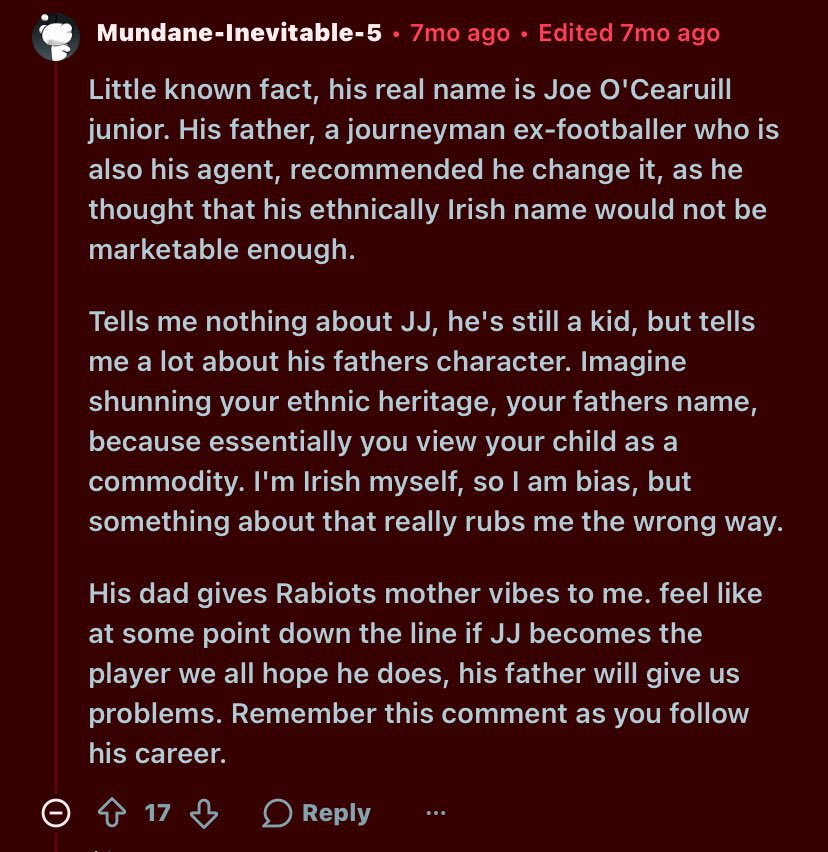
JJ Gabriel is not actually the name of the 15-year-old Manchester United “wonderkid” nicknamed “Kid Messi. His full name is Joseph Junior Andreou O’Cearuill – born to a Cypriot mum, and English dad with Irish and Trinidadian grandparents. So where did the name Gabriel come from?
Reports are that JJ Gabriel’s dad changed his sons name to “make his son more marketable”. Imagine disregarding your families heritage, that of your grandparents, your wife, just because you want to make your teenage son sound Brazilian so that he can be more marketable. All a little odd.
Yesterday, it was reported that the youngster was on the brink of leaving Manchester United. His grievance apparently that fellow youth products Shea Lacey and Harry Amass got game time in the Champions League and he did not. When I say “his grievance”, it is likely not his but his father’s.
Whilst 19-year-old’s Lacey and Amass made their Champions League debuts against Sabah, Gabriel was scoring a hattrick in the youth version of the competition against the same opponents. The UEFA Youth League is for under 19s, so a 15-year-old playing up 4 age groups should be seen as an incredible achievement. But not to the O’Cearuill’s.
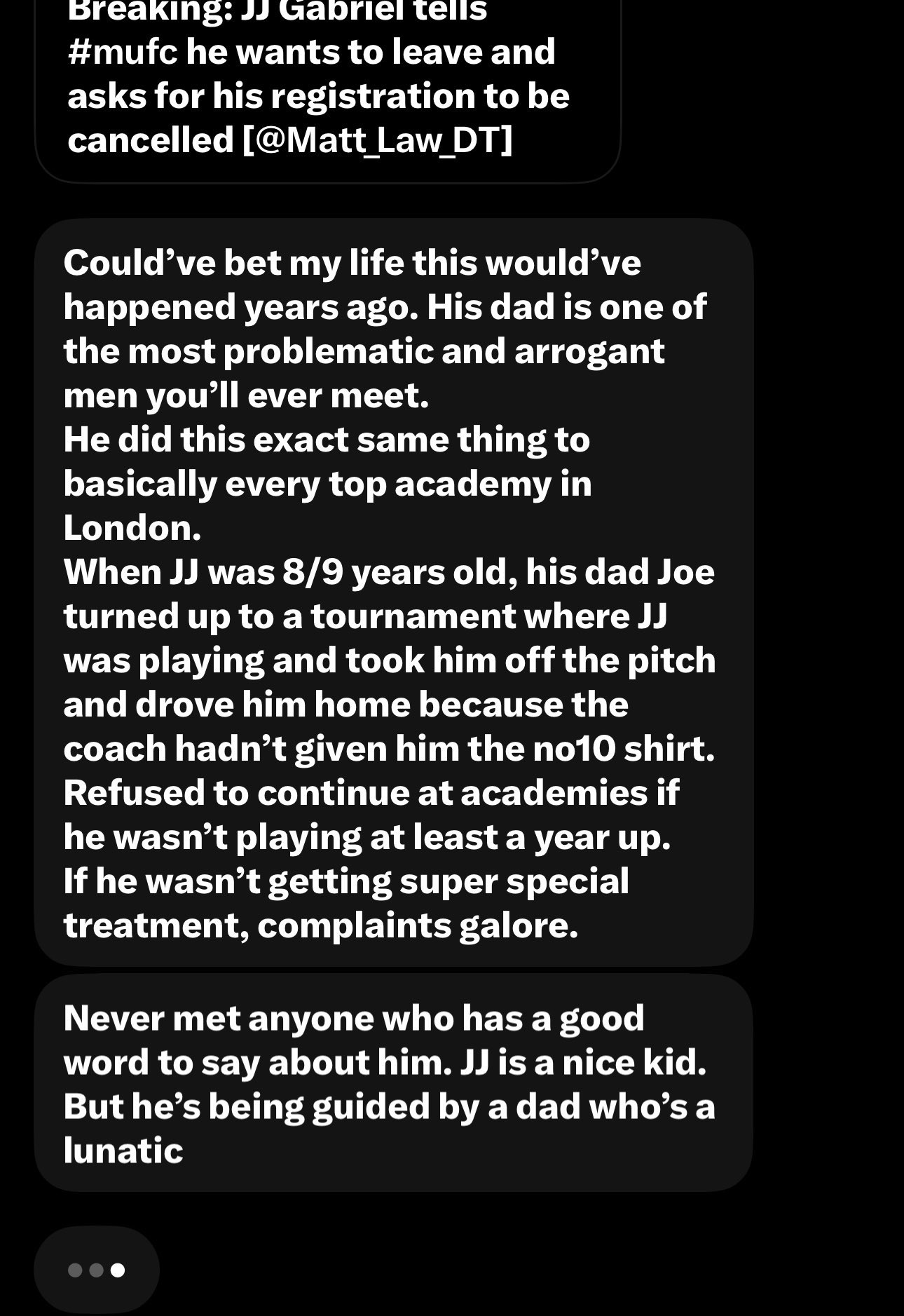
JJ Gabriel was slated to make his Manchester United debut tonight against Brighton in the League Cup. He would have become Manchester United’s youngest ever senior player. Instead, less than 48 hours before the game, the news leaked that Gabriel had sent formal notice to Manchester United that he wanted to cancel his registration with immediate effect. Following the news, social media was flooded with stories about the family.
The stories from those who have previously been involved in the young mans career continued…
And the digger fans dug, the more was found out about his dad.
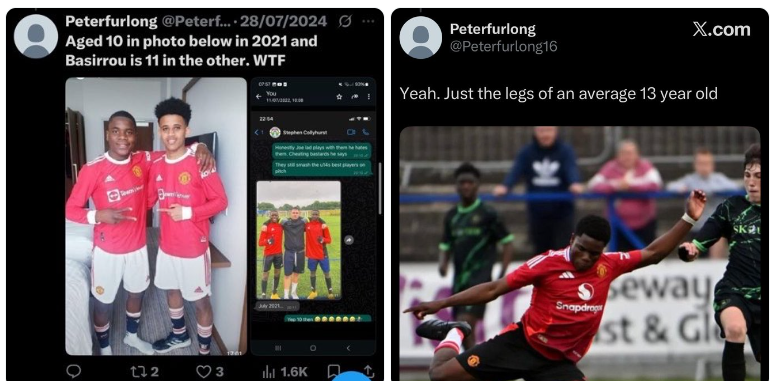
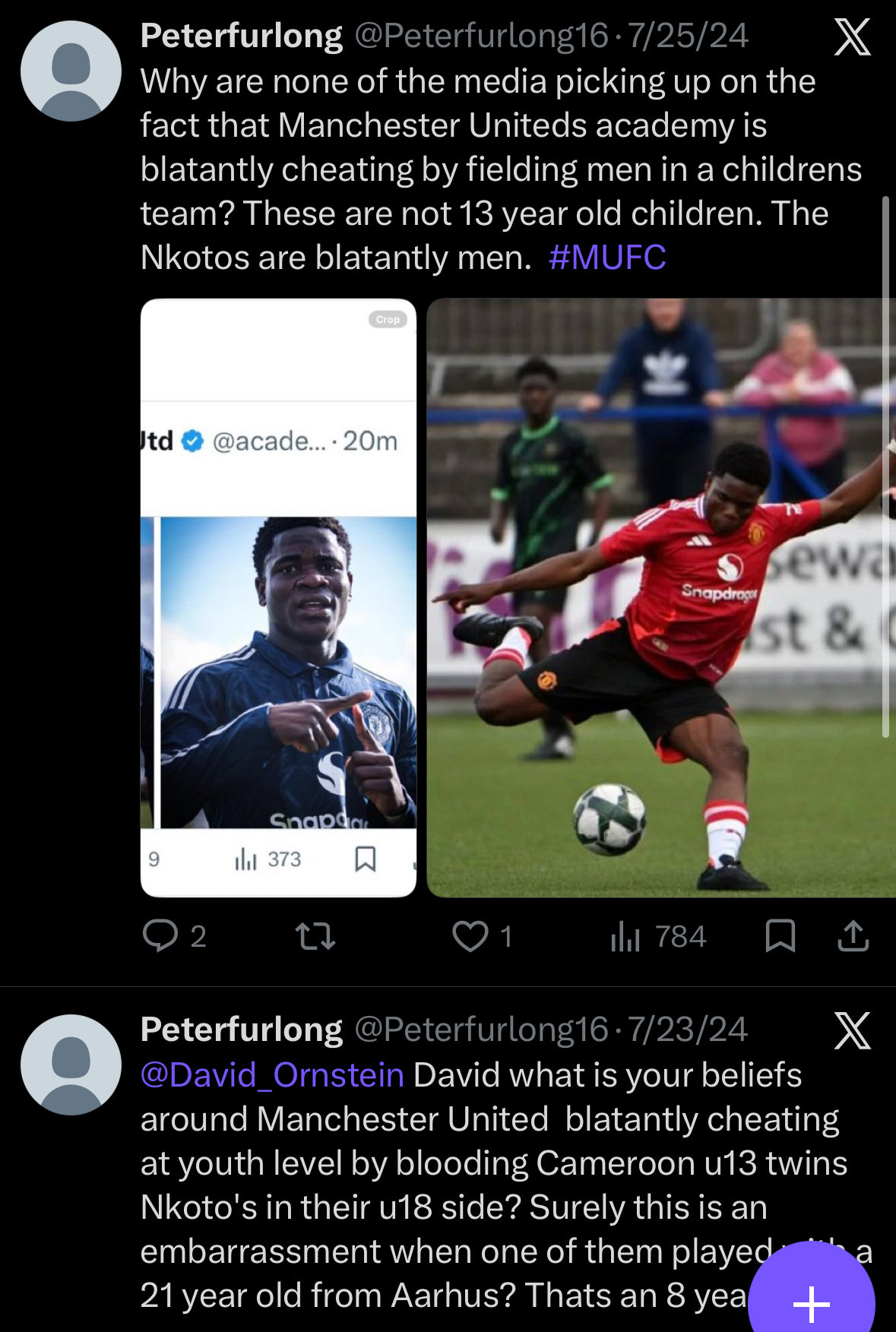
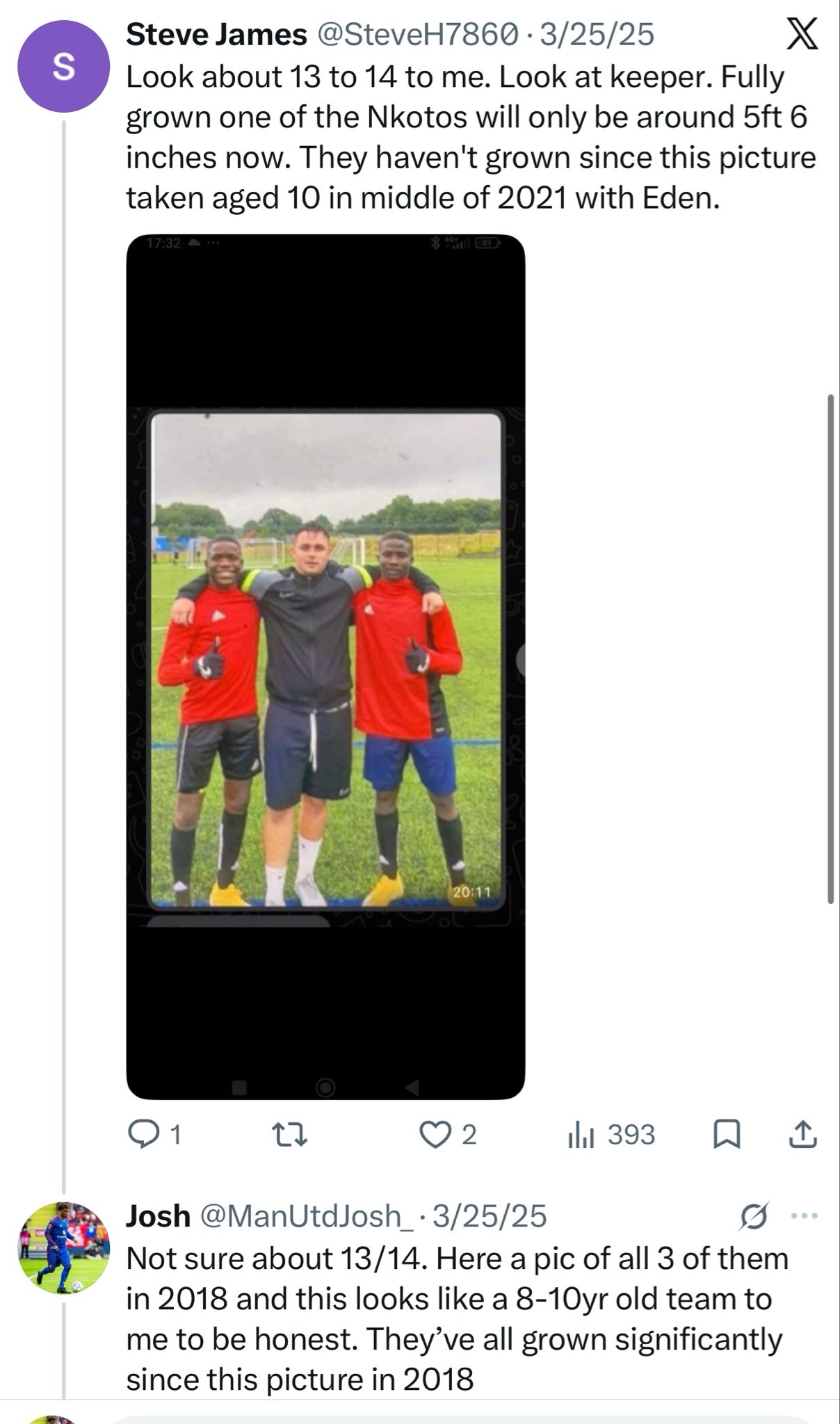
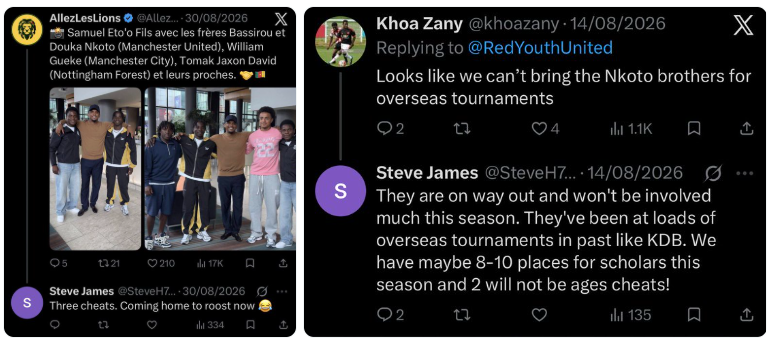
Reported “burner accounts” on X were found, which are apparently Joe O’Cearuill questioning the age of JJ Gabriel’s Manchester United academy teammates. A clear attempt to put down a pair of teammates, get them out of the picture at Manchester United, and create an easier pathway for his son.
And it was not just one alleged burner account…
All this paints a picture of a father who see’s his son as his cash cow, and is attempted to live through his talented son – a common trait in many failed footballers whose kids show a bit of talent.
Instead of letting their children flourish at their own pace, father’s pace the touchline of youth pitches up and down the country, barking orders and making demands. All because they failed as footballers and think, just because they were once in an academy, they know best.
Whilst JJ Gabriel has ruined his chance of becoming Manchester United’s youngest player tonight (or more his dad has ruined the chance), Arsenal’s youngest ever player grabbed himself a brace last night against Ipswich.
If everything coming out of Manchester about O’Cearuill is bad, everything that comes out of Brentwood about Max Dowman’s family is good. Supportive parents who keep their sons feet on the ground, ensured he did his GCSE’s, and trust the club will make the best decisions for the club. You only ever hear from Dowman’s dad, Rob, when he is shooting down rumours about his son on social media.
Last night, Arsenal finished the game with 5 teenagers on the pitch:
Myles Lewis-Skelly (19) – At Arsenal since 8 years old Max Dowman (16) – Since 8 years old Marli Salmon (17) – 10 years old Theo Julienne (18) – 13 years old Ife Ibrahim (18) – 7 years old
This summer, there have been a lot of academy movements between clubs. It is interesting that many of those players to have moved had not been with their club since pre-teen. Most had been signed between 13 and 16 from another clubs academy. And then at 16 or 17 they were being moved again by their “handlers”.
Arsenal signed a then 15-year-old Kyran Thompson in 2024 from West Ham. This summer he opted not to sign a professional deal and join Newcastle.
Mishel Nduka joined Arsenal from Charlton as a 15-year-old. Like Thompson, he stayed for 2-years, saw out his academy deal, refused to sign a professional deal and left. He is on the way Manchester City.
Someone has to do research about young player loyalty, and if players are more loyal if they start with a club at a younger age, and are not poached in their teams from elsewhere. By poaching, are we “creating the monster” and making it clear that being disloyal is OK?
It is so hard to progress from talented academy product to senior professional.
Of players who come through English Category 1 academies, roughly 30% eventually receive a professional contract somewhere in the Premier League or EFL, but only about 10% establish anything resembling a sustained professional career in the top four divisions. Only about 3% ever play in the Premier League.
To make it, you need the natural talent. You also need the work ethic, mentality and supportive parents. Many of those that fall by the wayside do so not due to their talent, but due to their own work ethic or mentality, or parents / representatives moving them from club to club and creating problems for them.
You often here “pathway” when a kid moves from one academy to the next. This is just a meaningless word.
Chido Obi-Martin went from Arsenal to Manchester United because they sold him a pathway to the first team. He has yet to really progress beyond the level he was playing at in 2023 for Arsenal and has since been given a chance to prove himself in Holland for Willem II.
When JJ Gabriel does move, it will be because of the “pathway”. But he will move to someone like Real Madrid, Barcelona or Manchester City. These are clubs with better players than Manchester United. And better young players. It will actually be harder for him to get the game time he (or his dad) thinks he should get.
Ultimately, JJ Gabriel’s dad thinks his son is better off out of Manchester United. All he really cares about is his sons profile, not his career. He wants the Nike deal, to see his kid in the shirt of Barcelona. He does not care if it affects the long term progression of his boy.
Ultimately, if you are good enough, and work hard enough, you will get the playing time, the acolades and the money.
Bukayo Saka had a £73m Nicholas Pepe ahead of him. He forced his way into the first team ahead of Arsenal’s record signing. Phil Foden broke through at Manchester City despite having some of the best attacking talent in the world ahead of him. Marcus Rashford got his chance at Manchester United at 18 based on his talent, attitude and work rate.
If the likes of JJ Gabriel and Chido Obi Martin deserved their chance, they will get it. Top clubs do not just give game time to youngsters to keep parents, or fans, happy.
I always chuckle when I see fans say “X player deserve a chance to show he is good enough”. No, they do not. They need to prove they are good enough on the training ground when training with the first team. That will show to the manager and coaches whether they are ready for first team football – not just chucking them into a run of Premier League games.
JJ Gabriel is still a child. He still has the body of a child. He is not a Wayne Rooney who had hair on his chest and was balding at 15. Manchester United are correct in taking his development slowly. And if his father thinks he knows best, then that is the reason we should stay clear.
A toxic dad overly involved in his sons career will only spell disaster further down the line.
My final thought is JJ Gabriel will sign a 2-year-deal with Barcelona. He will see very little game time. In 2-years he will be on the move again in the quest for first team football. A new 5-year deal, maybe to a French or German team, but not one of the big ones. After 1 good season, his dad will be pushing to move him to Chelsea or Manchester City. We have all seen this story before.