Former Player? No Managerial Experience? Not a problem

With Arsenal passing up the opportunity to appoint Carlo Ancelotti, seemingly in the favour of appointing managerial virgin Mikel Arteta, some fans have complained that the club should be going for a big name manager.

But the appointment of Arteta continues the clubs 100 year history of not going for a big name.

“Modern” Arsenal began after the First World War when Arsenal returned to the first division following relegation prior to the start of the war in 1913. Arsenal have remained in the top division since then. 100 years.

Leslie Knighton

When professional football resumed in 1919, Norris appointed Leslie Knighton as the club’s manager.

Knighton had spells as an assistant manager at Manchester City (1909–12) and Huddersfield Town (1912–19) before being appointed secretary-manager of Arsenal in 1919.

Arsenal was his first managerial job and he oversaw the club for six years.

Herbert Chapman

Arsenal appointed Herbert Chapman after he had won back to back titles with Huddersfield. He was the first, and arguably only, big name manager appointed to the club.

Under his management, the club was transformed from relegation threatened to league champions.

It took Chapman 5 years before he led the club to its 1st piece of silverware – the FA Cup in 1930. League titles followed in 1930/31 and 1932/33.

Arsenal went into 1933/34 looking to retain the title, and started consistently; they worked their way to the top of the league and were a comfortable four points clear following a goalless draw with Birmingham City on 30th December 1933.

Chapman died on 6th January 1934 after pneumonia set in following a scouting trip to watch Sheffield Wednesday

Chapman revolutionised not just Arsenal but English football.

George Allison

Following the sudden death of legendary Arsenal boss Herbert Chapman earlier in January 1934, Allison was appointed Chapman’s full-time successor in the summer of that year.

After his move to London in 1906, Allison became the club’s programme editor and continued his association with the team after they moved to Highbury and renamed themselves “Arsenal”. He became a member of the club’s board of directors soon after the end of the First World War; he was at first club secretary and then managing director.

Under Chapman and caretaker manager Joe Shaw, Arsenal had already won the League Championship twice in a row, and Allison made it a hat-trick, winning a third successive title in 1934/35. He also won the FA Cup in 1935-36 and the League again in 1937/38.

Arsenal were the only club he ever managed. Following the end up World War 2, allision, by now in his mid-sixties, retired from the game.

Tom Whittaker

Following a broken knee cap whilst playing for Arsenal, Tom Whittaker joined the coaching staff of the club under Herbet Chapman. In 1927 he became first team trainer, reforming the training and physiotherapy regime at the club.

Following Chapman’s death in 1934, Whittaker continued to serve under his successor, George Allison, and also became a trainer for the England national team.

After Allison’s retirement in 1947, Whittaker became the club’s new manager; under him the club won the League in 1947/48 and 1952/53 and the FA Cup in 1949/50. Arsenal would be the 1st and only club he managed.

Whittaker, while still at the helm of Arsenal, died of a heart attack at the University College Hospital, London in 1956, at the age of 58.

He would not be the only physiotherapist to step up to league title winning manager at Arsenal.

Jack Crayston

Former Arsenal player Jack Crayston was assistant manager under Tom Whittaker.

After Whittaker’s death in 1956, Crayston became caretaker manager on 24 October 1956 and permanent manager on 21 December 1956. However, his stewardship of the team was brief and unsuccessful; disillusioned, in May 1958 he resigned as Arsenal manager, and took up the reins at Doncaster Rovers a couple of months later, holding the post until his retirement from the game in 1961.

George Swindin

Another former Arsenal player, George Swindon joined Arsenal from Midland League side Peterborough in 1958. It was his 1st job in charge of a professional club.

Billy Wright

Appointed as manager of Arsenal in 1962, Billy Wright had only previously managed at a youth team level – leading England’s youth team in 1960.

Arsenal would be the only club he managed.

Bertie Mee

After leaving, the the Royal Army Medical Corps, Bertie Mee joined Arsenal in 1960 as physiotherapist.

Following the sacking of Billy Wright in 1966, the club asked Mee to become manager, a highly surprising move, perhaps even to the man himself; Mee asked for a get-out clause for him to return to physiotherapist after twelve months if it didn’t work out.

Mee would take the club to its first European trophy in 1970 and oversee the clubs first league and cup double in its history.

Arsenal would be the only club he managed

Terry Neill

Having become one of the youngest ever managers in the history of the game when taking over at Hull City as player-manager aged just 28-years-old, Terry Neill became Arsenal’s biggest name appointment when he was appointed  in 1976 to replace Bertie Mee.

Between Hull and Arsenal he managed Tottenham for two seasons having succeeded Bill Nicholson.

At the age of 34, he became the youngest Arsenal manager to date.

He led the club to a trio of FA Cup finals (1978, 1979 & 1980), winning one. He also took the club to the UEFA Cup Winners Cup Final, where they lost to Valencia on penalties.

Neill was sacked by Arsenal on 16 December 1983 and retired from the game at just 41-years-old.

Don Howe

Former player Don Howe rejoined Arsenal as head coach in 1977 under Terry Neill, having previously worked with the club under Don Howe. Between his 2 stints as a coach at Arsenal he had unsuccessful stints as manager at WBA (who he relegated) and Galatasaray.

Following Neill’s departure, Howe was originally appointed as caretaker manager before being given the job permanently in April 1984.

After just two years in the job, Howe resigned. His legacy would still be felt decades later having been the man to introduce a host of young players to the 1st team including Tony Adams, David Rocastle and Niall Quinn.

George Graham

Following the resignation of Don Howe, arsenal first offered the job to Barcelona manager Terry Venables before switching their attention to Alex Ferguson, who was then in temporary charge of Scotland whilst still Aberdeen manager – who he had taken to 3 league titles; breaking the Glasgow dominance.

It was the first time Arsenal had looked to recruit a manager at the top of the game since Herbert Chapman was appointed 60 years previously.

Having been rejected by both, Arsenal ended up with George Graham. A former player who had got Millwall promoted to the 2nd division in 1984/85.

2 league titles, Anfield 89, domestic cup double and a European trophy followed before it all came crashing down in 1995 after Graham was sacked following the discovery that he has accepted an “unsolicited gift” from a Norwegian agent (everyone was at it in those days).

In his 9 years at the club, Graham transformed Arsenal from a team drifting in mid-table to the best team in the country.

Bruce Rioch

Like Graham, Bruce Rioch had never managed in top flight football before joining Arsenal.

He had taken Bolton to the Premier League via the play-offs in the season prior to joining Arsenal. His only season at Arsenal would be overshadowed by a fall-out with Ian Wright.

Arsene Wenger

“Arsene Who?” was the headline when David Dein appointed an unknown Frenchman who had just spent a year managing in Japan to replace Bruce Rioch at Arsenal.

The Frenchman had taken Monaco to the Ligue 1 title 10 years previously. No one could have foreseen how he would change Arsenal and English football.

He bought with him a new culture.

From coaching methods to fitness, nutrition to scouting, he ripped up the rule book that English coaches had followed for decades. Where he led in sports science, statistical scouting and eye to detail, other clubs would follow.

3 league titles, 7 FA Cups, 2 cup doubles and an unbeaten season.

Other clubs soon followed Arsenal in appointing foreign managers in the hope they would replicate his success.

A manager with the longevity and success of Wenger may well never be seen again in England.

Unai Emery

Following Wenger’s departure, Arsenal went big for the 3rd time in their history by appointing serial winner Unai Emery.

Emery had taken Sevilla and PSG to 9 trophies in the 5 seasons previous to joining Arsenal. Only Pep Guardiola had won more in European football during that time.

Following a 21 game-unbeaten run, Arsenal’s form dropped off and his 1st season ended in disappointment with the club thrashed in the Europa League final.

He was sacked in November 2019 following a winless run of seven games.


Following the big name appointment of Unai Emery, Mikel Arteta will see Arsenal return to their tried and tested history of not recruiting a big name manager.
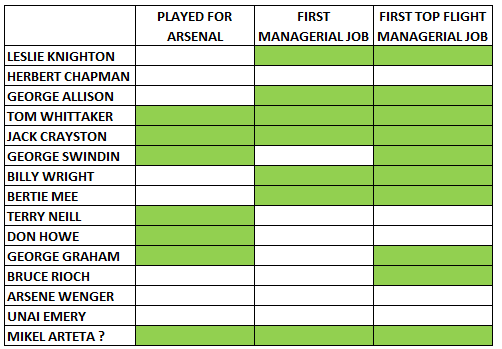
In the last 100 years, Arsenal have had 14 permanent managers:

  • 6 were former players
  • 6 had never managed before
  • 9 had never managed in the top flight
  • 2 were physiotherapists

Keenos

Arteta v Ancelotti – Arsenal pick the right man

Over the last 24 hours a lot has happened.

Firstly we had Arsenal’s senior negotiating team getting “caught” leaving Mikel Arteta’s house in the early hours, then we had the news that Carlo Ancelotti was Everton’s first choice to be new manager.

Arsenal have come in for a bit of criticism and mocking for being “caught” leaving Mikel Arteta’s house, but the situation is odd, almost stalkers.

It was 1am in the morning when the pictures were taking. Was a member of the paparazzi hiding in the bushes outside of Arteta’s house just in case someone showed up? And if so how long has he been hiding there? Or did he tail Huss Fahmy and Vinai Venkatesham from London? It all comes across as a little intrusive, a little desperate from the British media.

I guess ultimately the photographer got his picture, got his money, and will now have a good Christmas from the profits. Still, it’s odd that the British media criticise Arsenal when they promote stalker behaviour to get a story.

So Arsenal, and Everton, both had a choice.

In one corner you have Mikel Arteta. A man who has captained both clubs. Who has been involved in British football over 17 years.

Arteta became one of Pep Guardiola’s first back room staff when was appointed an assistant coach at Manchester City back in 2016.

At 37-years-old, he will be the youngest manager in the Premier League by over 4 years if appointed (Frank Lampard currently being the youngest). He will be the 5th youngest Premier League or English Football League manager.

Arteta has no managerial experience at any level, but is a trusted lieutenant for Guardiola.

Reports coming out of Manchester City are that Guardiola takes a step back on the training ground. More overseeing the session rather than running drills. Arteta has grown into the man in charge.

The importance of Arteta is detailed in Pep’s City: The Making of a Superteam. What comes through is that Arteta, is integral to the work undertaken on the training ground – and particularly with the likes of Raheem Sterling and Leroy Sane – and that he has the complete trust of Guardiola.

Having grown up through the Barcelona youth system, Arteta shares the same basic philosophy as his fellow La Masia alumni.

In an interview with the Arsenal website back in 2015, Arteta outlined what type of manager he wanted to be:

‘My philosophy will be clear. I will have everyone 120 per cent committed, that’s the first thing. If not, you don’t play for me. When it’s time to work it’s time to work, and when it’s time to have fun then I’m the first one to do it, but that commitment is vital.

Then I want the football to be expressive, entertaining. I cannot have a concept of football where everything is based on the opposition.

We have to dictate the game, we have to be the ones taking the initiative, and we have to entertain the people coming to watch us. I’m 100 per cent convinced of those things, and I think I could do it.’

Commitment. Expressive, entertaining football. Taking the initiative in games. It is everything Arsenal fans demand. It would be what some claim was The Arsenal Way.

Arteta might be young, he might be inexperienced, but he clearly has the intelligence and confidence to get to the very top.

If Arteta is virgin manager, Carlo Ancelotti is anything but. He is a man who has been around a bit, done everything there is to do.

At 60-years-old, he has won almost everything there is to win in European football, including the Intertoto Cup.

He has led his teams to 19 trophies during his 24 years of management, including 4 league titles and 3 Champions Leagues.

He has managed Juventus, AC Milan, Chelsea, PSG, Real Madrid, Bayern Munich and Napoli.

Winning the league title in 3 different countries, he has shown tactical flexibility throughout his career – from the defensive style in Italy through to playing expansive football with Real Madrid. He has the experience, success and knowhow to make a difference wherever he goes.

But is he past it?

He was sacked by Napoli with them sitting 8th in the league table.

Ancelotti’s downfall began when he dropped Lorenzo Insigne for his team’s first game against Genk. Insigne to Napoli is what Francesco Totti was to Roma or Alesandro Del Perio was to Juventus. Their talisman. One of their own. Ancelotti was sending a message to his players.

There was mutiny within the ranks. He was unable to keep players in check and had clearly lost the dressing room.

Tactical mistakes were made. 21 goals conceded despite having a defence of Kalidou Koulibaly and Kostas Manolas. Critisicims that have followed Ancelotti throughout his career– that he does not push players hard enough in training – resurfaced. And he left.

It was a similar story at Bayern Munich.

Towards the end of Ancelotti’s reign at the German giant, there were reports that senior players organised secret training sessions.

Kicker ran a story claiming that Arjen Robben, Franck Ribery, Mats Hummels, Jérôme Boateng and Thomas Müller were particularly unhappy with Ancelotti’s relaxed training sessions and had so organised ‘secret’ high-intensity sessions behind his back.

Robben reportedly complained that Ancelotti’s training methods were less strenuous than the ones his son had to do with his school team.

Whilst he may well have a trophy haul that puts him amongst the most successful in Europe, should it be more impressive?

17 years in charge of Juventus, AC Milan, Chelsea, PSG, Real Madrid and Bayern Munich saw him win just 4 league titles. Is this not a failure rather than a success?

He has managed the best teams in their league, with the biggest budgets. Coached some of the best players in the world. But has he ever achieved at any of his clubs? Has he ever improved players? Has he ever taken a club forward from where they were previously?

In 2014 Manchester United appointed Louis van Gaal as manager. A man who came with a similar reputation for success as Ancelotti.

Like Ancelotti, he was coming to the end of his career. His faults were well known. He did not revolutionise United and the nagging doubts over style of play became a bigger talking point than results.

Ancelotti’s faults are well known. How long until noises are being made at his next club that training sessions are not intense enough? How long until he loses the dressing room for the umpteenth time?

So Arsenal (and Everton) have a choice.

The experienced winner, who has not won as much as he perhaps should have, who has been sacked from his last 2 jobs in similar circumstances. Or the virgin former captain who is rated highly as a coach but comes with zero track record.

I think what swings it for me is the view of those who know a thing or two about management.

Arsene Wenger

‘He has all the qualities to do the job, yes and I think as well he is one of the favourites

‘He was a leader, and he has a good passion for the game and he knows the club well, he knows what is important at the club and he was captain of the club.’

Mauricio Pochettino

‘For me, he’s going to be one of the best coaches when he decides to be a coach. ‘He has the capacity to be one of the greatest coaches in football, for sure.

‘Yes of course, he’s going to be. ‘He’s top, a top personality, character. ‘I think he has the qualities to be one of the best.’

Pep Guardiola

‘He is an incredible human being and works a lot. I said after a few months together he would be a manager. He is already a manager – he behaves like a manager.’

The opinion of Wenger, Pochettino and Guardiola is more valuable than someone on Twitter.

Keenos

Football should follow Mesut Ozil’s lead and stop supporting sportswashing

Regardless of whether you like Mesut Ozil or not, whether you think he is a waste of space on the pitch and we should get rid, we should all be standing with him over his comments about China.

On Friday, Ozil posted a message on his criticises China’s treatment of Muslims in Xinjiang.

The treatment the Uighur Muslim minority in western China has been labelled as the ‘atrocity of the century’ with reports that up to 3 million people are being held in “modern day” concentration camps.

Leading Uighur activist Rushan Abbas described the situation back in 2018.

“[It is] not just the 3 million people in the concentration camps facing mental and physical torture, forced intense indoctrinations, forced medications, food and sleep deprivation, [but] even the people at large … living outside, are facing a complete surveillance police state.”

The United Nations and human rights groups estimate that between one million and two million people, mostly ethnic Uighur Muslims, have been detained in harsh conditions in Xinjiang as part of what Beijing calls an anti-terrorism campaign.

The first Uighur camp was built in 2014, and much of the world has turned a blind eye to what is happening. Most of the world are actually unaware of what is happening, with countries across the globe continuing to do business with China in the same way they were doing business with Germany in the late 1930s, despite the first Nazi concentration camp being built in 1933.

It has taken Ozil’s Instagram post to bring the plight of the Turkic ethnic group into the world domain.

Posting the words against the backdrop of the flag of the short-lived East Turkestan republic, an area that is now Chinese-controlled Xinjiang, he called Uighurs “warriors who resist persecution” and criticised both China’s crackdown and the silence of Muslims in response. “(In China) Qurans are burned, mosques were closed down, Islamic theological schools, madrasas were banned, religious scholars were killed one by one. Despite all this, Muslims stay quiet,”

In response to Ozil’s comments, China’s state broadcaster CCTV pulled the broadcast of Arsenal’s Premier League game against Manchester City.

Ozil has seen his China-based “M10” fan club shut down, his social media accounts blocked and almost all trace of his name removed from Chinese search engine results.

Several Chinese football fan sites have said they will stop posting news related to Ozil, according to the Shanghai-based publication The Paper. A Chinese football simulation game said it would no longer produce Özil player roles or cards.

Fans in China have labelled Ozil a “dirty ant” and posted videos of them burning his shirts.

In a comment that has since been deleted, the editor of the Global Times, Hu Xijin, accused the footballer of essentially calling for global jihad against China. Asking Özil to provide examples of his allegations, Hu wrote: “This man is full of nonsense. Does he just want to encourage global jihad, using Xinjiang as an excuse?”

Ozil has been brave standing up to what he clearly feels are human rights breaches that are currently being ignored by the global community.

China’s record on human rights is one of the worst in the world. Like many other countries with poor records, they have been attempting to use sport to improve its reputation in something that is known as sportswashing.

From the 2008 Summer Olympics in Beijing through to Qatar 2022, sportswashing is becoming more common as authorities and clubs put aside their morals and values to sell their sport to the highest bidder.

Last weekend saw the world title heavyweight clash between anthony Joshua and Andy Ruiz take place in Diriyah, Saudi Arabia.

Saudi Arabia’s relatively sudden interest in sports can be construed as a soft power tactic to help distract from the kingdom’s ongoing human rights abuses and the Yemen crisis.

The kingdom has hosted the Race of Champions (ROC) motorsport event, secured a long-term deal with the WWE that includes multiple shows a year, hosted boxing events headlined by stars like Amir Khan, hosted a PGA European Tour golf event.

Azerbaijani is another nation using sport as a distraction from what is actually happening in their country.

Despite human rights infringements, a lack of press freedom, a clear threat of terrorism and Azerbaijan being labelled as “not free”; the likes of UEFA, the IAAF and the FIA have all awarded Azerbaijan major events in recent years, including the recent Europa League final.

Back to Ozil and China, clubs across Europe have turned a blind eye to human rights issues for a long time. They chase money agreeing to play friendlies in China, Qatar, Abu Dhabi and Saudi Arabia.

Every club should now stand with Ozil over his comments. Stand with the Uighur Muslim’s, stand with those who have been detained, killed elsewhere across the globe for having a different religion, race or sexuality.

Amnesty International recently called for “clubs – the coaches, players, and backroom staff – to use their considerable influence to press for greater recognition of human rights.”

Ozil is in the right highlighting a human rights issue in China. Imagine how much more powerful the message would be if, following China’s boycott of Arsenal, the Premier League stood together as one and boycotted China.

No more selling TV rights to the country, no more holding money-spinning friendlies there. Not until they have sorted themselves out. Cleaned up their act. Stopped detaining millions for simply following another religion.

Standing together will not happen, however.

Take a look at Manchester City. Current Premier League champions.

The City Football Group, who own the club, Abu Dhabi United Group and a consortium of Chinese state-backed investment firms. Are they really going to take a stand against what is happening in nations across the globe when they are owned by those states committing the atrocities?

Until clubs and the authorities grow a pair and stop selling themselves to the highest bidder, it will be up to the likes of Mesut Ozil to bravely stand on his own and speak up for those who have no voice.

Ozil might polarise support on the pitch, but we should stand with him when it comes to speaking up against human right breaches.

I stand with Ozil.

Keenos