Tag Archives: Arsenal

Manchester City case “enters bullying stage”

Let’s get it right, Manchester City’s defence of the 115 was nothing short of a disaster.

114 of the 115 charges stuck, the Premier League labelled it a “sham”, and key witnesses and irrefutable evidence on behalf of Manchester City either did not materialise or could not be proven.

Manchester City’s sole defence of the entire situation is that it was not Abu Dhabi United Group (ADUG) that subsidised the huge sums paid to Man City by sponsors, But the Abu Dhabi Government (AD).

This line of defence directly contradicts what Etihad Airways told the US Government back in 2015.
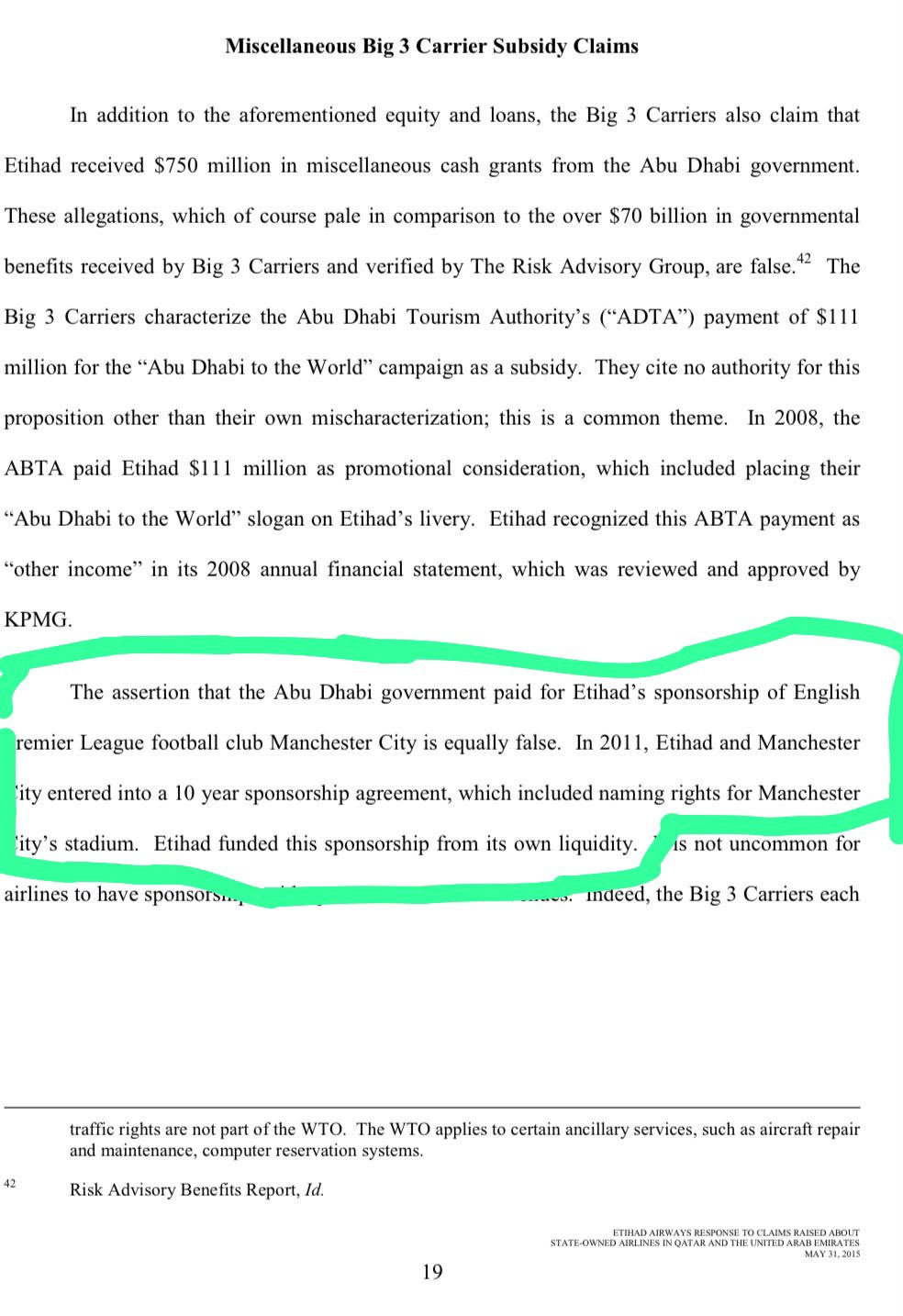
And this is exactly why the Man City case has fallen the way it has.

Whilst City may have claimed that the sponsorship money was subsidised by AD, and not ADUG, they were unable to provide any evidence. Neither AD, Etihad, or alternative organisations would have been able to provide proof of where funding comes from because it would have completely contradicted that 2015 investigation.

City fans across social media are claiming that lawyers defence is “genius” and that they are playing 4D chess. This is laughable.

You do not go into a hearing, a court case, or anything else, with the aim of losing so that you can win on appeal. It does not happen. And it is ludicrous that anyone is claiming that City lawyers were hoping to lose so that they could “expose the Premier League on appeal”. Especially when you consider the cost of those lawyers.

High up executives at Man City, ADUG and AD know exactly the predicament they are in – and there only two paths out.

Man City or Etihad Airways. The will have to choose a fighter.

The evidence needed to exhonorate Man City throws Etihad under the bus with the US Government. 

If evidence is presented to show that Etihad were funded by AD, then the US will reopen their 2015 investigation. That could have huge implications for not only one of the biggest airlines in the world, who are also AD’s flagship brand, but also for those who presented the evidence in 2015.

Not only would presenting the evidence in support of City be an existential threat to Etihad, it would likely lead to criminal proceedings for those who then lied in the evidence above.

The alternative for AD is to back Etihad, and it is Man City who are then pushed under that bus.

Without AD or Etihad being willing to corroborate Man City’s claims, the Premier League can rightly disregard Man City’s claims of where the funding came from.

The question ultimately for AD is do they want to sacrifice Man City to the Premier League to protect Etihad, or do they want to sacrifice Etihad to the US Government in an attempt to protect Man City.

And that leads us to where we are now. The bullying stage.

AD and ADUG can not keep their two flagship operations clean. One will have to fall. So in an attempt to get two favourable outcomes, they are now using political, legal and PR posturing to bully the Premier League and UK Government.

Firstly we have Etihad threatening to sue the Premier League.

The headline is that they have hired “the world’s most feared litigation law firm” in Quinn Emanuel.

Firstly, the chances that they have only just hired Quinn Emanuel are laughable. Major companies like Etihad will likely have major global law firms on retainers. We’ve all watched Suits. We all know how this works.

Secondly, I am not really sure what the basis of any case by Etihad against the Premier League could be built on.

It is an independent commission panel that heard the case, and made the judgement. Not the Premier League. The PL merely presented their case, their evidence. And when it came to evidence around where the funding came from, everything that mentioned Etihad came from Man City or ADUG emails. You can no sue someone for presenting the facts as they appear.

If Etihad are to sue anyone, it would actually be Man City, as it is them that have made the claim that their sponsors, including Etihad, were subsidised by AD. If this as an untrue statement by Man City, then that is where the lawsuit sits.

As for the posturing by the UAE, there is zero chance that they will pull investment in the UK due to the decision against Manchester City.

A move like this would have huge ramifications across the globe. It would show to the world that the UAE and the Emirati that make it believe that they are above the law in whichever county they have organisations, companies or sports teams operating. It sends out a sign to governments worldwide that they believe their organisations can operate however they want, and if they are sanctioned then government level investment will be pulled.

This position is not a position of strength.

Whilst on the short term, the UK may lose out on investment, it would not be a catastrophe. 

In the grand scheme of things, the UAE is not one of the biggest investors in the UK. The are no where near the US, India or France. The billions they claim that they will pull from the UK is only around 0.3-1.4% of the foreign investment in the UK. Although it must be said that is public money. There is also a private side, such as the millions pumped into Manchester by ADUG.

Whilst pulling investment would not be catastrophic for the UK, it would be a catastrophic decision by the UAE. 

As we briefly outlined above, why would any foreign government want to do investment deals with the UAE if the UAE show themselves as willing do drop their investment due to one of their organisations have been sanctioned? It would lead governments being less willing to make deals with UAE. And we all know those deals are massive for the UAE as they attempt to invest the email money before the income dries up.

The estimation is that oil in the UAE will dry up in 80 years. Due to this they have a global investment strategy with the aim of reducing the reliance on oil – in 1980, 55% of the UAE GDP was based on oil, that is now just 23%.

UAE need to continue investing in both themselves (tourism) and foreign countries to ensure they survive once the oil runs out. If they fail to do so, the area will just become a desert. Pulling investment in the UK would directly damage this strategy, especially if other countries decide the UAE are no longer trustworthy enough to strike big deals with.

Etihad will not sue the PL. The UAE will not pull their investment in the UK. It is just bullying and PR.

The hope is to force the hand of the PL or UK Government into coming to a settlement. The aim is to also paint Man City as victims in all of this. To continue the sportswashing of the blue side of Manchester.

And whilst the bullying will not be successful, we are seeing the PR side of the project become a success. City fans from Manchester to Lagos, and across Asia are ignoring the facts and trying to paint City and ADUG as victims. 

Abu Dhabi, and by extension the UAE, basically now have millions of online warriors who will go out to battle for them, who will defend them no matter what they do. And that is what sportswashing is all about. 

We have also seen the success of this sportswashing already in the way UK Primer Minister Andy Burnham came out swinging for Man City’s owners. He has since had his wings clips, although there could now be political ramifications followings calls to investigate the Labour leader’s relationship with the Manchester City owners.

Having triggered the appeal, it must now take place in 12 weeks. The verdict must be delivered within 30-days of the appeal ending.

Regardless of the verdict, Man City’s online warriors will continue to fight for their owners. They will paint City and ADUG as the victims. They will claim it was always the goal to take the PL to the High Court, Supeme Court, The Hague, Nuremberg, the Earth Supreme Court or Wizengamot. And that this is all part of the bigger plan to spend millions dragging the reputation of their club through the mud.

And my final point of all this is all this posturing only deals with the sponsorship related charges. 

The claim that sponsors funding came from AD, and not ADUG, does not defend the PSR breaches, nor the lack of cooperation charges. And these alone can lead to huge point deductions, life bans for the officers and executives who failed to cooperate, and even the expulsion of Manchester City.

January 2027 will be huge. 

Keenos
Arsenal should have nothing to do with “toxic” former players wonderkid son

Joe O’Cearuill is a name that no Arsenal fan would likely have remembered.

Released by Leyton Orient in 2005, and by Watford in 2006, O’Cearuill somehow found his way onto Arsenal’s books, signing professional terms with the club in July 2006.

Part of the squad for Dennis Bergkamp’s testimonial, which opened the Emirates Stadium O’Cearuill’s was an unused substitute for the Arsenal first team for a was an unused substitute for the Arsenal first team for a League Cup third round match against West Bromwich Albion in October 2006. That would be the closest he ever got to the Arsenal first team.

A loan spell at Brighton followed, and in 2007 he joined Barnet. A move to Ireland followed a year later, before he did the rounds of non-league clubs in and around London. Starting at Orient at 17, O’Cearuill would move 17 times throughout his career, never really settling at a single club. He did manage to make 2 appearances for Republic of Ireland.

O’Cearuill’s career is stereotypical of many a player. Talented enough to get into an academy, but fails to make it and ends up bouncing around non-league as a frustrated footballer who tells people he “could have made it”. Whether it is lack of talent, work ethic or a poor mentality, there is always a reason why many academy prospects end up with the careers they do. I imagine his story will come out in the next few weeks.

Whilst you might not have known the name O’Cearuill, you would probably have heard about his son – JJ Gabriel. And this is where the story really begins.

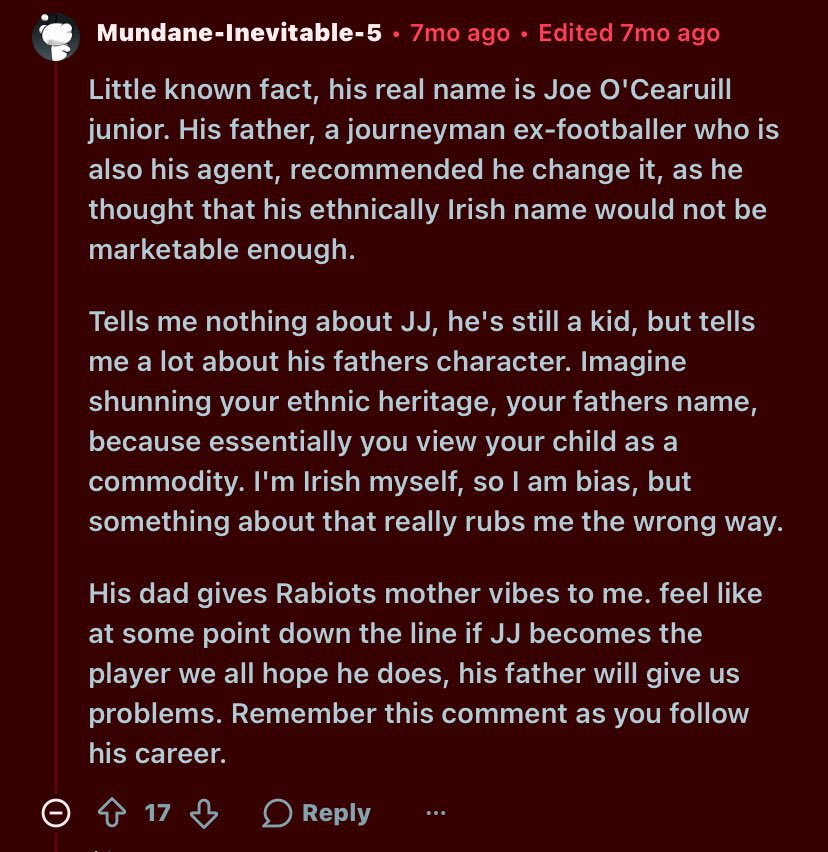
JJ Gabriel is not actually the name of the 15-year-old Manchester United “wonderkid” nicknamed “Kid Messi. His full name is Joseph Junior Andreou O’Cearuill – born to a Cypriot mum, and English dad with Irish and Trinidadian grandparents. So where did the name Gabriel come from?

Reports are that JJ Gabriel’s dad changed his sons name to “make his son more marketable”. Imagine disregarding your families heritage, that of your grandparents, your wife, just because you want to make your teenage son sound Brazilian so that he can be more marketable. All a little odd.

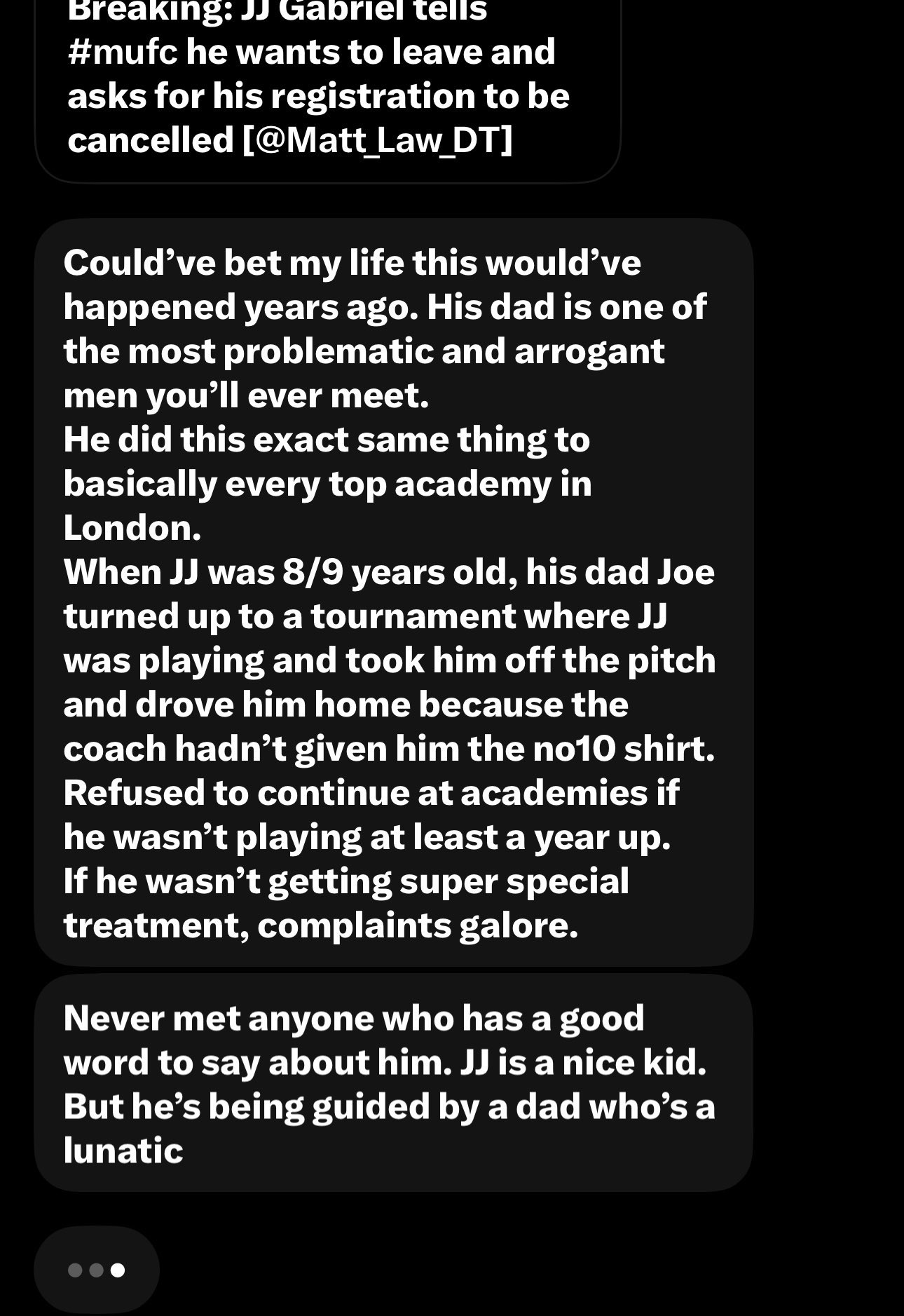
Yesterday, it was reported that the youngster was on the brink of leaving Manchester United. His grievance apparently that fellow youth products Shea Lacey and Harry Amass got game time in the Champions League and he did not. When I say “his grievance”, it is likely not his but his father’s.

Whilst 19-year-old’s Lacey and Amass made their Champions League debuts against Sabah, Gabriel was scoring a hattrick in the youth version of the competition against the same opponents. The UEFA Youth League is for under 19s, so a 15-year-old playing up 4 age groups should be seen as an incredible achievement. But not to the O’Cearuill’s.

JJ Gabriel was slated to make his Manchester United debut tonight against Brighton in the League Cup. He would have become Manchester United’s youngest ever senior player. Instead, less than 48 hours before the game, the news leaked that Gabriel had sent formal notice to Manchester United that he wanted to cancel his registration with immediate effect. Following the news, social media was flooded with stories about the family.

Previously on the books at Chelsea, Arsenal and West Ham, the family left the capital after they “burnt bridges with pretty much every academy in London“, with his dad labelled “an absolute nightmare”.

The stories from those who have previously been involved in the young mans career continued…

And the digger fans dug, the more was found out about his dad.

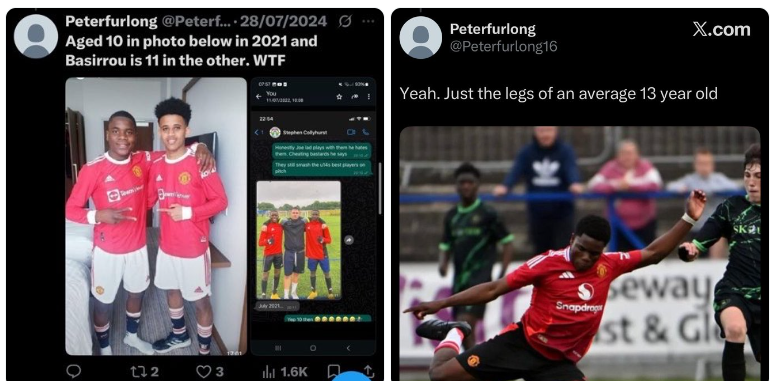
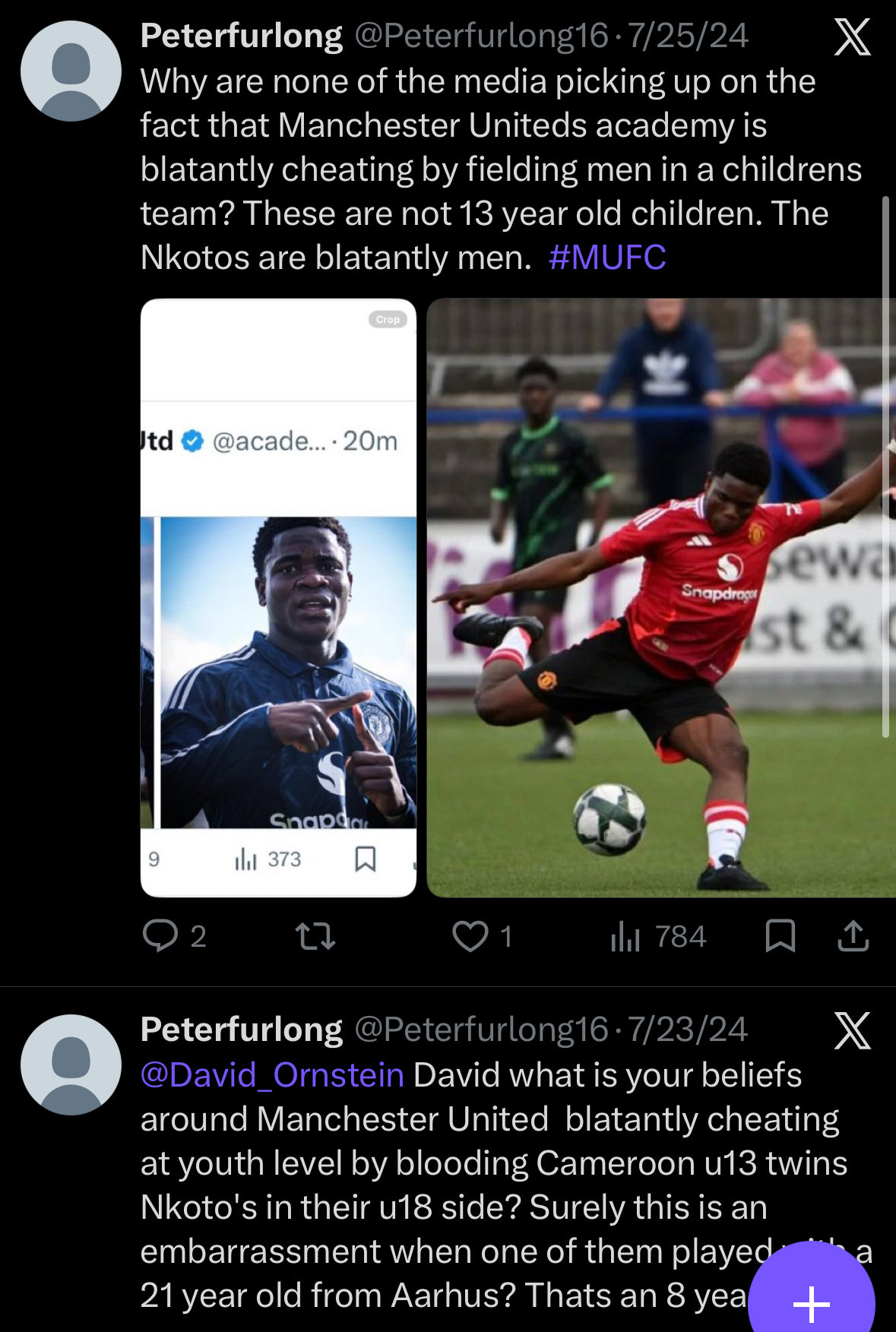
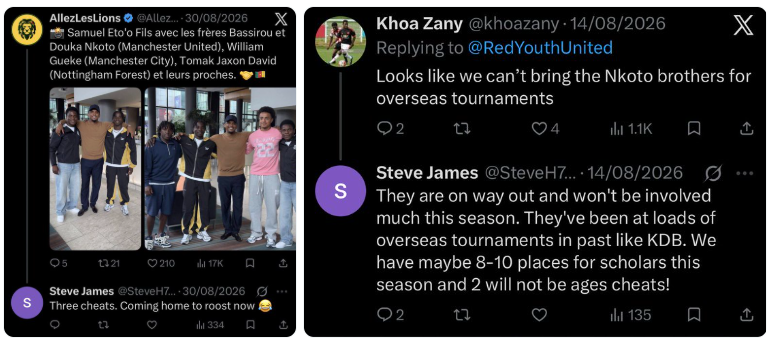
Reported “burner accounts” on X were found, which are apparently Joe O’Cearuill questioning the age of JJ Gabriel’s Manchester United academy teammates. A clear attempt to put down a pair of teammates, get them out of the picture at Manchester United, and create an easier pathway for his son.

And it was not just one alleged burner account…

All this paints a picture of a father who see’s his son as his cash cow, and is attempted to live through his talented son – a common trait in many failed footballers whose kids show a bit of talent.

Instead of letting their children flourish at their own pace, father’s pace the touchline of youth pitches up and down the country, barking orders and making demands. All because they failed as footballers and think, just because they were once in an academy, they know best.

Whilst JJ Gabriel has ruined his chance of becoming Manchester United’s youngest player tonight (or more his dad has ruined the chance), Arsenal’s youngest ever player grabbed himself a brace last night against Ipswich.

If everything coming out of Manchester about O’Cearuill is bad, everything that comes out of Brentwood about Max Dowman’s family is good. Supportive parents who keep their sons feet on the ground, ensured he did his GCSE’s, and trust the club will make the best decisions for the club. You only ever hear from Dowman’s dad, Rob, when he is shooting down rumours about his son on social media.

Last night, Arsenal finished the game with 5 teenagers on the pitch:

Myles Lewis-Skelly (19) – At Arsenal since 8 years old
Max Dowman (16) – Since 8 years old
Marli Salmon (17) – 10 years old
Theo Julienne (18) – 13 years old
Ife Ibrahim (18) – 7 years old

This summer, there have been a lot of academy movements between clubs. It is interesting that many of those players to have moved had not been with their club since pre-teen. Most had been signed between 13 and 16 from another clubs academy. And then at 16 or 17 they were being moved again by their “handlers”.

Arsenal signed a then 15-year-old Kyran Thompson in 2024 from West Ham. This summer he opted not to sign a professional deal and join Newcastle.

Mishel Nduka joined Arsenal from Charlton as a 15-year-old. Like Thompson, he stayed for 2-years, saw out his academy deal, refused to sign a professional deal and left. He is on the way Manchester City.

Someone has to do research about young player loyalty, and if players are more loyal if they start with a club at a younger age, and are not poached in their teams from elsewhere. By poaching, are we “creating the monster” and making it clear that being disloyal is OK?

It is so hard to progress from talented academy product to senior professional.

Of players who come through English Category 1 academies, roughly 30% eventually receive a professional contract somewhere in the Premier League or EFL, but only about 10% establish anything resembling a sustained professional career in the top four divisions. Only about 3% ever play in the Premier League.

To make it, you need the natural talent. You also need the work ethic, mentality and supportive parents. Many of those that fall by the wayside do so not due to their talent, but due to their own work ethic or mentality, or parents / representatives moving them from club to club and creating problems for them.

You often here “pathway” when a kid moves from one academy to the next. This is just a meaningless word.

Chido Obi-Martin went from Arsenal to Manchester United because they sold him a pathway to the first team. He has yet to really progress beyond the level he was playing at in 2023 for Arsenal and has since been given a chance to prove himself in Holland for Willem II.

When JJ Gabriel does move, it will be because of the “pathway”. But he will move to someone like Real Madrid, Barcelona or Manchester City. These are clubs with better players than Manchester United. And better young players. It will actually be harder for him to get the game time he (or his dad) thinks he should get.

Ultimately, JJ Gabriel’s dad thinks his son is better off out of Manchester United. All he really cares about is his sons profile, not his career. He wants the Nike deal, to see his kid in the shirt of Barcelona. He does not care if it affects the long term progression of his boy.

Ultimately, if you are good enough, and work hard enough, you will get the playing time, the acolades and the money.

Bukayo Saka had a £73m Nicholas Pepe ahead of him. He forced his way into the first team ahead of Arsenal’s record signing. Phil Foden broke through at Manchester City despite having some of the best attacking talent in the world ahead of him. Marcus Rashford got his chance at Manchester United at 18 based on his talent, attitude and work rate.

If the likes of JJ Gabriel and Chido Obi Martin deserved their chance, they will get it. Top clubs do not just give game time to youngsters to keep parents, or fans, happy.

I always chuckle when I see fans say “X player deserve a chance to show he is good enough”. No, they do not. They need to prove they are good enough on the training ground when training with the first team. That will show to the manager and coaches whether they are ready for first team football – not just chucking them into a run of Premier League games.

JJ Gabriel is still a child. He still has the body of a child. He is not a Wayne Rooney who had hair on his chest and was balding at 15. Manchester United are correct in taking his development slowly. And if his father thinks he knows best, then that is the reason we should stay clear.

A toxic dad overly involved in his sons career will only spell disaster further down the line.

My final thought is JJ Gabriel will sign a 2-year-deal with Barcelona. He will see very little game time. In 2-years he will be on the move again in the quest for first team football. A new 5-year deal, maybe to a French or German team, but not one of the big ones. After 1 good season, his dad will be pushing to move him to Chelsea or Manchester City. We have all seen this story before.

Keenos

Heavily rotated Arsenal swat aside Napoli

As predicted, Arsenal arrived in Naples with a heavily rotated side with 4 changes from the weekends game with Chelsea – Mikel Merino, Viktor Gyokeres, Eberechi Eze and Piero Hincapie all coming into the starting XI.

In a hostile stadium, against a Napoli team with plenty of experience and attacking quality, the changes made little difference. Mikel Arteta’s side were simply better.

The final score was only 1-0, thanks to Martin Ødegaard’s superb strike in the 75th minute, but the scoreboard was doing Napoli a considerable favour. Arsenal had chances to put this game beyond doubt long before the captain finally found the net.

And that is perhaps the most encouraging part of the evening.

This wasn’t Arsenal at full strength desperately hanging on for a famous away victory. This was a rotated Arsenal side controlling a Champions League match in Naples as though it were a routine Saturday afternoon fixture.

There was no great sense of Arsenal needing time to settle. The ball was moved around with the usual patience, Napoli were pushed backwards and the Gunners repeatedly found spaces between and around the home side’s midfield.

The only thing missing was the finish.

Arsenal created enough opportunities to have been comfortably ahead before half-time, with Mikel Merino among those unable to convert. The second half followed much the same pattern: Arsenal continued to dictate, while Napoli struggled to turn possession into anything remotely resembling sustained pressure.

For all the talk beforehand about the difficulty of playing in Naples, Arsenal made the occasion look surprisingly ordinary.

That is not an insult to Napoli. It is a compliment to Arsenal.

Perhaps the biggest takeaway is what the performance says about the squad – Arteta made significant changes, yet the structure remained.

The pressing remained. The control remained. The defensive discipline remained. Most importantly, the expectation that Arsenal would dominate the ball and territory remained. This is what squad development is supposed to look like.

You don’t build a team capable of competing for major honours simply by having eleven excellent players. You build a squad in which the standards don’t collapse when you rotate three, four or five positions.

Against Napoli, Arsenal looked like a team with depth rather than a team forced to compromise because of it. And then there was the captain.

Martin Ødegaard has started this season looking like a man determined to remind everyone exactly how good he is.

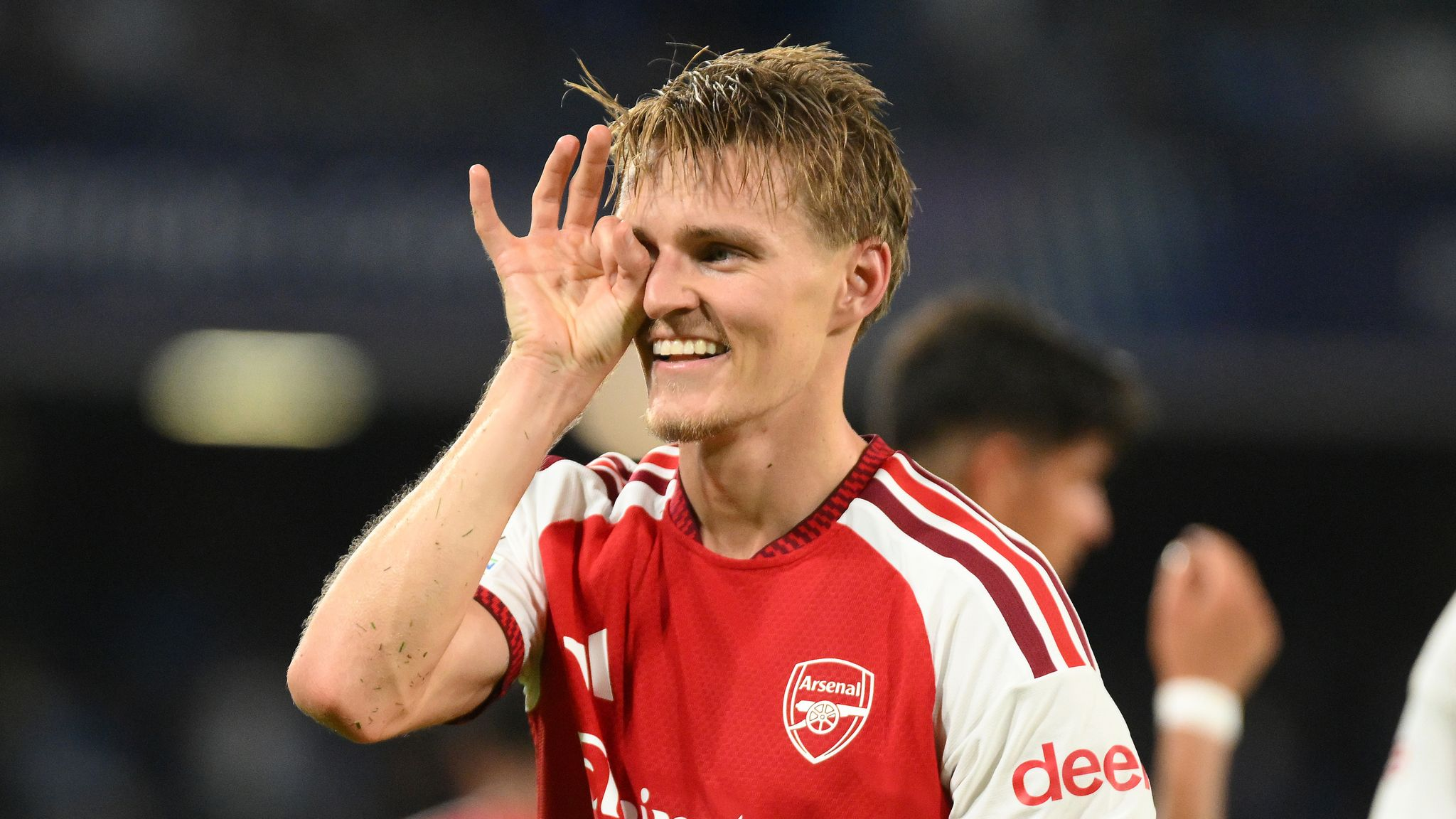
He has now scored four goals in five games, and this one was arguably the best of the lot. After Arsenal worked the ball into a dangerous position, Ødegaard found the space outside the box and produced a superb first-time strike that flew away from the goalkeeper and in off the post.

It was the sort of goal that had been threatening to arrive all evening.

The Norwegian was also central to almost everything Arsenal did well, creating six chances and completing five passes that broke Napoli’s defensive line.

There was something particularly pleasing about seeing the captain take responsibility when Arsenal needed someone to turn dominance into a result.

There will be complaints that Arsenal should have scored more. And some have complained that we will not achieve anything this season without a new striker. That is unfair. We heard the same last season and won the league.

The big misses against Napoli were by Bukayo Saka, Merino and Hincapie. Having a better striker on the pitch would not have seen these guys snap up their fairly easy chances. And these fans seem to have a mythical striker who is tall, strong, quick and can score, whilst pressing and being involved in the build up. He does not exist.

There should also be considerable credit for the other side of the equation – Napoli managed just one second-half shot. One.

Arsenal didn’t merely prevent Napoli from scoring. They largely prevented Napoli from playing. And that is the bit that should worry Arsenal’s Champions League opponents.

You can survive a team that creates one or two chances. You can hope they miss them. But when Arsenal can produce 26 shots and around 4.1 expected goals while conceding roughly 0.3 xG, and do so with a significantly altered XI, it starts to look rather more serious.

The scoreline says narrow victory.

The performance says something else entirely.

If there is one criticism, it is obvious.

Arsenal should have killed the game.

There were enough opportunities to turn this into a 2-0 or 3-0 victory, and the longer you leave an opponent alive in a Champions League away game, the more opportunity you give them to produce one moment of nonsense.

Thankfully, Napoli never found it.

And Arsenal’s ability to remain calm despite failing to convert their superiority was itself encouraging.

They didn’t panic.

They didn’t start forcing everything.

They kept playing their football.

Eventually, the goal came.

The Champions League is about surviving difficult nights, but it is also about making difficult nights look less difficult than they actually are.

Arsenal did that in Naples.

The result will go down as three points.

The performance may prove more significant.

If this is what a heavily rotated Arsenal side can produce away from home in Europe, the rest of the squad should be feeling rather confident about their chances of getting plenty of football this season.

And Arsenal’s European rivals should probably be feeling rather less confident.

DJ