
Tag Archives: Arsenal

Goal Scoring – It’s an old mans game

Yesterday I discussed about how being the wrong side of 30 does not suddenly stop Pierre-Emerick Aubameyang by being a top class striker.

A look around the top scorers of Europe tells a story of the “old men of football” outperforming the youngsters:
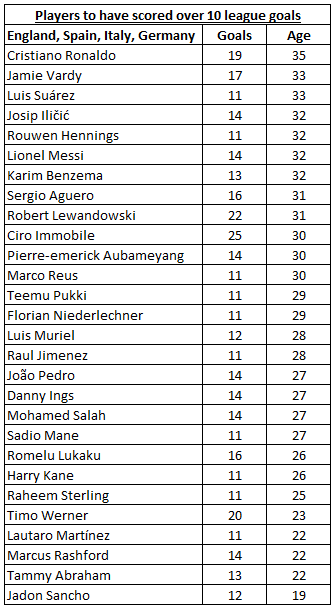
The top two in England – 33-yeard-old Jamie Vardy and the eternal Sergio Aguero – are both older than Aubameyang – with the Arsenal striker 3rd on the list.

Over in Italy, Ciro Immobile tops the list – he turns 30 at the end of this month. Cristiano Ronaldo at 35 is 2nd, with Romelu Lukaku 3rd. At 26-years old he is one of the youngest on the long list.

La Liga is topped by Lionel Messi (32), Karim Benzema (32) and Luis Suarez (33). no other played has scored over 10 goals.

Germany bucks the trend; with 2 of the 3 top scorers being under 30 – although 31-year-old Robert Lewandowski still tops the charts. He is backed up by Timo Werner (23) and Jadon Sancho (19).

Of the 28 players to have scored over 10 goals in Europe’s top 4 leagues (Premier League, La Liga, Serie A & Bundesliga), 12 are over 30 and just 5 under 24-years-old.

If Arsenal do decide to let Aubameyang (and Alexandre Lacazette) leave this summer, they have to be looking at bringing in a proven goal scorer. Not take a risk on someone from Portugal, Holland or France. The above list would be the starting point.

You would want the Aubameyang replacement to be no older than 27 years-old. That way Arsenal get least at 3 seasons out of him before we are in the same situation as we are now.

16 players are over 27-years old, leaving us just 12 players.

Mo Salah, Sadio Mane, Harry Kane, Raheem Sterling, Marcus Rashford and Tammy Abraham are all playing for Premier League rivals. We can draw a line through them.

You can also remove Jadon Sancho as he is not a striker – I would not be upset to see him on our left wing next season.

Joao Pedro and Danny Ings are in the same sort of boat as each other. Having a good season, but are either Arsenal quality? No.

Romelu Lukaku only joined Inter Milan in the summer so he is unlikely to leave.

That leaves Lautaro Martinez and Timo Werner.

Werner is the stand out name on the list. Just 23-years-old, he already has 100 senior goals. He has been linked to Chelsea and Liverpool already. If he comes on the market, any top side after a striker will be after him.

If Arsenal do decide to cash in on Aubameyang and Lacazette, Werner must be top of the list. But I imagine Chelsea and Manchester United are thinking the same for next summer.

As for Martinez, I know nothing about him.

The reality is there is not a lot of quality proven goal scorers in world football that have youth on their side.

One option would be to look outside the top 4 leagues, and instead focus on Holland, France and Portugal:
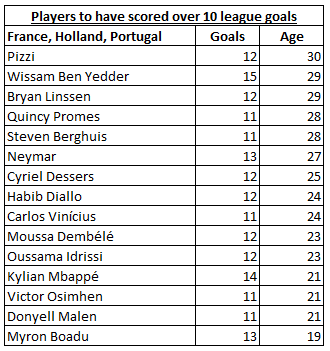
The obvious one of Kylian Mbappe aside, there is also not much outside of the top 4 leagues.

Would you rather Aubameyang up top or Cyriel Dessers, Habib Diallo or Victor Osiemhan?

Moussa Dembele is the next best after Mbappe, but is he really up to Aubameyang’s level yet? Surely a better option would be to keep Aubameyang and sign Dembele as a replacement for Lacazette.

Likewise Myron Boadu is clearly a talent, but like with Gabriel Martinelli he is young and it will be a risk to have him as first choice.

I would rather keep a 31-year-old Aubameyang, backed up by Martinelli, than spend big on someone who is not really good enough.

Football is changing. Goal scoring is no longer a young mans game.

Keenos

Age ain’t nothing but a number for Aubameyang

But Aubameyang is 31 at the end of the season was the response why I proposed on Twitter that we should be looking to tie him down to a new deal, even if it means increasing his weekly wage.

Arsenal fans (and perhaps football fans in general) have been conditioned over the years that passing through 30-years-old is something that is bad. That suddenly you go down hill rapidly. That you are done. That you should not get a contract beyond one year.

Arsene Wenger had the philosophy that players over 30 should only get a one year extension. But this theory is built on 1990s players who had not looked after themselves from a young age. These days players know a lot more about diet, fitness and drinking.

It is true that tying up money in someone at their peak is a danger. If they are at their peak they will soon by over the hill and going down the other side.

When a player is at his peak is when they usually command their highest wages in their career. But it is also when they are most likely to begin declining.

Andriy Shevchenko is the most obvious example of this.

Shevchenko left Milan for Chelsea for £30.8 million a month before his 30th birthday. He was one of the hottest strikers in Europe. 127 league goals in 226 games. He became the most expensive player in English football, and one of the highest paid.

He scored just 9 league goals in the 2 seasons he was at Chelsea before being loaned back to AC Milan.

But then you have the story of Cristiano Ronaldo.

Ronaldo signed a four-year contract with Italian club Juventus after completing a €100 million transfer. He was already 33.

In the one and a half seasons that have followed, he has scored 50 goals in just 70 games across all competitions. Ronaldo has shown that age is nothing but a number.

When it comes to a players age and how long a contract you offer them, it is perhaps better to look deeper than their birth certificate.

Look at how many games he has on the clock, how often he picks up minor injuries, how many major injuries he has had throughout his career, and how naturally fit he is. It is also important to establish whether he has any long term injuries that he has been managing.

Aubameyang has played 488 games in his career. It is a huge chunk. But he was not a teen sensation who was playing week in, week out since he was 17 or 18. He had only played 39 games prior to his 20th birthday.

After this season he will have had 12 full seasons under his belt. Wayne Rooney and Nicolas Anelka were both 29-years-old when they completed their 12th full season.

Rooney played a further 3 seasons for Manchester United; Anelka 3 seasons for Chelsea.

Both did tail off in their final season, but that is why you offer Aubameyang something along the lines of a 2 year deal with an option to extend to 3 years.

Injuries also play a big part in what age a player begins to decline.

Someone who has had a big year-long injury will usually begin their decline earlier. Especially as a big injury can led to the rest of their career being blighted by further break downs. Think Abou Diaby.

Likewise a player plagued by multiple minor injuries will often give up earlier. Michael Owen or any number of player plagued by hamstring injuries. Gareth Bale springs to mind.

Throughout Aubameyang’s career, he has not suffered too many injuries – neither long term or short term.

A players natural fitness is also very important.

The human body naturally slows down as you age. Your metabolism slows. It is harder to keep those pounds off. But it affects people less who are “naturally fit”.

Compare again to Wayne Rooney. He was not a natural athlete and had to work hard to keep fit. Every pre-season was a slog. Every return from any sort of break he had to lose a couple of kilos. Eden Hazard has similar problems.

You can tell by Aubameyang’s body size and make up, he is a natural athlete. He does not need to work hard to stay in shape.

Finally the underlining injury issues. Think Thierry Henry. His back issue.

He was managing a back problem for a while, and eventually it caught up to him. As far as we know, Aubameyang does not have an underlining issue.

So here we have Aubameyang, about to turn 31-years-old, but his “body age” could be that of a 28 or 29-year-old. The sports scientists at Arsenal will know the score.

Ian Wright scored 30 goals in 41 games when he was 33.

Do not write off a player just because they are the wrong side of 30.

Keenos

Match Report: Burnley 0 – 0 Arsenal

Burnley (0) 0 Arsenal (0) 0
Premier League
Turf Moor, 52-56 Harry Potts Way, Burnley BB10 4BX
Sunday, 2nd February 2020. Kick-off time: 2.00pm

(4-3-3) Bernd Leno; Hector Bellerin, Shkodran Mustafi, David Luiz, Bukayo Saka; Mattéo Guendouzi, Granit Xhaka, Mesut Özil; Gabriel Martinelli, Alexandre Lacazette, Pierre-Emerick Aubameyang.
Substitutes: Sokratis Papastathopoulos, Dani Ceballos, Lucas Torreira, Nicolas Pépé, Emiliano Martínez, Joe Willock, Eddie Nketiah.
Yellow Cards: Mesut Özil, Granit Xhaka, Lucas Torreira
Arsenal Possession Percentage: 58%
Referee: Chris Kavanagh
Attendance: 21,048

A cold Lancashire afternoon that sees our chaps play in front a full house at Turf Moor. Is there a better way to spend a Sunday afternoon in February? Great to see Pierre-Emerick Aubameyang back after serving a three match suspension, and one of three strikers in an exciting 4-3-3 formation which shows Mikel Arteta’s intent to play attacking football in order to gain maximum points from today’s must-win match for us.

We started the match confidently, pushing the ball around in midfield and finding gaps in the Burnley defence. Indeed, not only did we have the best of the early chances, but were desperately unlucky not to open the scoring after Alexandre Lacazette’s header went narrowly wide. Undoubtedly, the best chance for Arsenal to score came when Pierre-Emerick Aubameyang was put through from an excellent David Luiz pass, and from about ten yards from the goal he directed it wide of the mark. Put it down to match rustiness this time. The home side started to come back into the game, and twice in as many minutes, Bernd Leno did well to prevent them from scoring, firstly from a Jay Rodriguez long-range shot, and secondly, a cheeky shot directly from a corner which saw our goalkeeper tip it over the bar. In the main, these attempts were totally against the run of play, as we were by far the dominant side here at Turf Moor in the early stages of the game. Unfortunately, young Bukayo Saka was having mobility issues due to an earlier injury and looked as if he had difficulty moving around as quickly as he had previously; because of this, the home side sensed a weakness and probed our defence through the left side of the pitch. By now we struggled to keep possession as the home side started to assert themselves at our expense in all areas. This match was now getting dogged and tough for both sides with no quarter taken nor given, with hard tackles going in everywhere. Poor marking by our defenders allowed Burnley to come close to scoring on several occasions before the break, and when Mesut Özil received a yellow card from referee Chris Kavanagh just before half-time, it was more out of frustration than anything else more malicious.

The start of the second half mirrored the end of the first; Burnley looking more organised and showing desire to come forward and open the scoring in earnest, with more and more dangerous balls flying into Bernd Leno’s goal from both wings. Granit Xhaka was booked for an obvious foul, and the resulting free-kick saw Burnley squander yet another chance from close range. A few minutes later, Lucas Torreira (who replaced the injured Bukayo Saka at half time) received our third yellow card of the day after a pointless foul on Charlie Taylor, and by now things were starting to look very iffy for us. Mesut Özil was substituted by Joe Willock after sixty-three minutes, and the more we tried to advance and change the pattern of play, the worse it became. However, with a quarter of an hour of the match left, Hector Bellerin was unlucky not to score when he cut inside the Burnley defence on the right and blasted it over the bar, and Pierre-Emerick Aubameyang’s header went just the other side of Nick Pope’s post. After Jay Rodriguez’s shot came off the inside of Bernd Leno’s bar and down and out, we regrouped and came forward again. Alexandre Lacazette was unlucky not to score from close range; this was the last attempt that he had today, as minutes later Eddie Nketiah took his place for the remainder of the match. Despite a late chance by Gabriel Martinelli which was easily saved by Nick Pope, a draw was the final result. It could have been a lot worse, quite frankly.

Sloppy, inconsistent and lacklustre. And that was just the defence. Firstly, the positives; a clean sheet and we didn’t lose. The negatives; poor shooting, indecisive movements in midfield, non-existent game management. Why Lucas Torreira didn’t start the match is a mystery, but at least he played half of it. Shkodran Mustafi was excellent, as was Hector Bellerin; everyone else were basically pedestrian. Perhaps when the players come back from their winter break, they will be refreshed and raring to go; they had better be, as out Premiership position needs to be moving in the upwardly direction rather quickly, starting with a victory against The Magpies at home in a fortnight. We’ll see. Remember everyone, keep the faith, get behind the team and the manager, as this season is going to be crucial for our future success in all competitions. Stick with the winners. Our next match: Newcastle United at The Emirates on Sunday, 16th January at 4.30pm (Premier League). Be there, if you can. Victoria Concordia Crescit.

Steve

Too Dearly Loved To Be Forgotten: Arsenal v Racing Club de Paris 1930-1962 by Steve Ingless (Rangemore Publications, ISBN 978-1-5272-0135-4) is now available on Amazon.