
Tag Archives: Mikel Arteta

Arteta’s Arsenal becoming harder to break down

Under Unai Emery, one of the most concerning statistics coming out of every game was how many attempts we were conceding against opponents.

Whether it was 18 at home to Burnley, 24 against Wolves or 31 against Watford. It was simple too easy for opposing sides to get a shot off against us.

Sides found it very easy to carve through our midfield and defence to see the whites of the keepers eyes. Only Bernd Leno’s brilliance saved us from conceding more in many games this season. Too many shots conceded was a huge part of Emery’s downfall.

In just a handful of games, Mikel Arteta has addressed the situation.
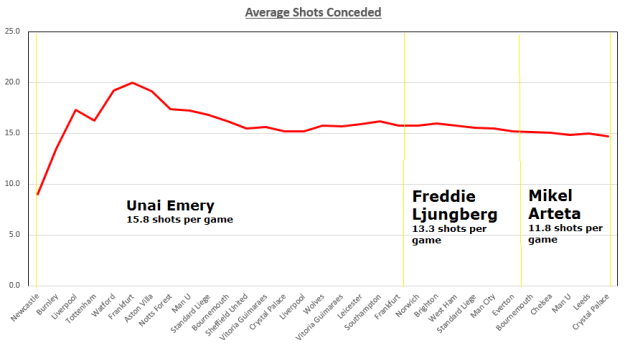
Against Crystal Palace, Arsenal faced just 6 shots. That was our lowest in the Premier League this season and just 1 more than our lowest in all competitions (we conceded just 5 shots against Nottingham Forest in the League Cup).

Whilst it was frustrating to come back from South London with a draw, there was plenty to be optimistic about, especially in the way our players battled for the ball.

Arteta has the team defending from the front.

He has also got Granit Xhaka and Lucas Torreira battling for every ball in the middle again. No longer are we seeing opposing midfielders run away from Arsenal players. They chase them down, win the ball back. Gone is the lazy running and half-hearted covering,

We have also seen Sokratis and David Luiz step up their game at the back. Now moving towards the ball and engaging with the attackers rather than standing off.

The fact is, the less shots you concede, you reduce the chances opponents have of scoring. When you let you opponents have 31 shots at goal, like Arsenal did against Watford, there is always a high chance 1 or 2 will go in.

In the Premier League under Unai Emery, Arsenal were showing relegation form when it came to chances conceded to opponents. In just 4 games Arteta has turned that around and we are now showing top 4 form.

Whilst Arteta wants to be playing free flowing, attacking football, he knew his first job was to come in and fix Arsenal’s leaky defence. Key to that was to reduce how many chances we concede to opponents.

Arteta’s Arsenal concede 40% less shots than Emery’s. A huge improvement.

With 2 clean sheets in the first 5 games under Arteta, Arsenal’s defence is moving in the right direction – Emery’s Arsenal had kept just 5 clean sheets in all competitions; 3 of which were in the cups.

The rest of this season is going to be about rebuilding the structure of the team. Getting us tactically proficient and raising fitness levels. Once Arteta has sorted out that aspect of the game he can then encourage the players to be more extravagant in attack.

Arsenal are becoming harder to score against. There is still some way to go but we are now moving in the right direction.

Keenos

Time for Arteta to trust in Pepe

Labelled as one of the most exciting talents in Europe following 22 goals in Ligue 1 for Lille last season, Arsenal stunned the world of football when they signed the Ivory Cost winger for a club record fee of £72million back in August.

Back in April, we discussed how he could be the new Eden Hazard, who joined Chelsea from Lille, but also warned that Gervinho came to the Premier League at a similar age and reputation.

All 3 players came to the Premier League  in their early 20s with very similar scoring records over the previous 2 seasons for Lille. Hazard scored 34 goals in all competitions, Gervinho 36 and Pepe 37.

Hazard and Gervinho had very different Premier League careers. One was one of the finest players to grace the league in the last decade, the other was a flop.

Half-way through his 1st season, Pepe has been closer to Gervinho than he has Hazard. Some have gone to label him a huge flop already following his huge price tag and justified the opinion of some that he was a penalty stat padder (9 of his 22 league goals came from the spot last year).

Misses against Liverpool and Sheffield bought back memories of Gervinho’s wastefulness. The Ghost of Bradford had returned.

Despite the misses, it did not feel like we were watching the incarnation of Gervinho

Gervinho was very technically poor. You would not catch him bending shots into the top corner or scoring free kicks. He could not pass, could not cross, could not shoot. He was a physicaly player. Quick, strong with a burst of acceleration that got him into space and made himself chances.

Highlight reels of Pepe at Lille had already shown his ability in dead ball situations, with numerous goals from open play from the outside of the box. This was a guy who was clearly technical sound.

From day 1 at Arsenal he was taking corners. He must have been showing something on the training ground to be our 1st choice set piece taker.

Against Vitoria de Guimaraes he showed he did have magic in his boots with two stunning free kicks. Both unsaveable no matter who was in goal.

But he was still struggling from open play. And successive managers from Unai Emery, Freddie Ljungberg and Mikel Arteta left him on the bench. He had fallen behind both Bukayo Saka and Riess Nelson.

He looked lightweight on the pitch, despite his 6-foot frame. Knocked off the ball to easy, he tired quickly and contributed little defensively.

Reports began to surface that he was not doing what was required in training.

Following being dropped to the bench against Norwich, Ljungberg told reporters “Pepe is a very good player, but I looked at what we did in training and what I see every day. And that is how I judge it.”

Pepe made his 9th start of the season against West Ham in the middle of December where he bent one perfectly in the top corner from just inside the box, reminding everyone that he has technical ability to go with his pace.

Against Manchester City he played a full 90minutes but looked laboured in what was his worst performance for Arsenal.

He failed to get off the bench in interim-manager Ljungberg’s last game in charge, and played just 12 minutes in Arteta’s first two games. The new manager deciding to start Nelson in both games and bring on Joe Willock before him.

Against Manchester United he put in a Man of the Match performance in Arsenal’s best result of the season, scoring with a first time finish.

Pepe was substituted off after 61 minutes and there are some clear conditioning issues there, but he is also clearly a big talent.

A lot will now come down to Pepe’s own mentality.

Does he buy into Arteta’s philosophy of demanding “120 per cent” commitment from every player? Is he going to follow Pierre-Emerick Aubameyang’s lead and start putting in a big defensive shift alongside his attacking prowess?

Despite having a slow start to his Arsenal career, Pepe has still has 5 goals and 5 assists in 1,245 minutes of football. That is a goal or assist every 124 minutes. That is a better contribution per minute that what Eden Hazard achieved in his first season (147 minutes) and the same as what Sadio Mane did in his first season at Liverpool.

What Pepe now needs is more game time. That will allow him to contribute more. Score more. Assist more.

With 17 league games as well as FA Cup and Europa League still to come, Pepe should be targeting to double what he has done so far.

20 goals and assists in his first season in English football will be a solid return and something that he can build on.

What Arteta now needs to do is trust in his record signing, play him. And Pepe needs to repay that by performing both on the pitch and at London Colney.

Pepe can become a huge player for Arsenal in the future. It is down to him to apply himself.

Keenos

2 weeks under Mikel Arteta – What has actually changed?

Structure

The biggest criticism of Unai Emery’s Arsenal was the lack of structure.

He chopped and changed the formation so often that it was clear that he did not know how he wanted the team to play. And this translated onto the pitch as players did not know what their job was.

Our game lacked structure. Where we playing counter attacking football? Possession based football? High pressing football? A lack of cohesiveness led to gaps between defence and midfield, midfield and attack. We could not defend. We could not score goals.

Just a couple of games in and it is clear what Mikel Arteta is doing.

It starts with the formation. 4231. And then carries through to style of play.

Arteta clearly wants the team compact in defence with the team pressing as one. Not much space between the forward line and defence, it squeezes the oppositions around the half way line.

It takes energy and high fitness levels; something which will be addressed over time as players adapt to what Arteta wants.

Once Arteta has sorted out the defensive structure of the side, he can then move onto the way we attack.

Desire to win the ball back

Under Unai Emery it was too easy to get to Arsenal’s back 4 and get a shot on target. When we conceded as many shots on target as we did, it would only be a matter of time until one flew in.

The biggest problem is we did not defend as a team. There was not a desire to win the ball back from the forwards through to the defence.

Manchester City and Liverpool are successful due to their ability to win the ball back. The opponents can not score if they can not get out of their own half. Win the ball in the opponent’s half and you are already half way to goal.

From Mesut Ozil, Pierre-Emerick Aubameyang and Alexandre Lacazette up top through to the midfield and defence, every Arsenal player is now putting in 100% commitment to win the ball back.

A key change has been the return of Lucas Torreira in the middle of the park.

Getting Ozil ticking

It is only a couple of games in and we know Mesut Ozil can turn his form on and off like a tap, but in the last 2 games against Chelsea and Manchester United Ozil has performed well.

Ozil is clearly an emotional player and needs a manager who will put an arm around him, tell him that he loves him and that everything will be OK.

His big drop in form came off the back of heavy criticism playing for Germany, much of it with an undertone of racism.

At the same time he went from having a manager who spoke his language and cared for him in Arsene Wenger to Unai Emery, who comes across as a very cold manager.

A big criticism of Emery at PSG was the way he treated his star players. He struggled with Neymar’s ego (but who doesn’t?) and quickly lost the dressing room. Emotional intelligence is clearly not Emery’s strong point.

Arteta has clearly learnt from the likes of Wenger and Pep Guardiola as to how to deal with players. And it is working for Ozil. For now.

Players feel wanted

It is not only Ozil who feels wanted, but it is clear the entire squad have also bought into Arteta.

Man management is as equally as important as good coaching. The No. 1 reason people quit their jobs is a bad boss or immediate supervisor. In football it is not easy to quit, so players tend to down tools, their performance drops.

To be a success players and management need to be working in unison.

After every game, Jurgen Klopp and Pep Guardiola make a point of going onto the pitch and shaking every players hand as they come off. An arm around the shoulder of a player disappointed with his performance. A high five with a player who has done well. It makes players feel wanted.

If you want to be a success, players need to buy into what you are trying to do as a manager. They will only do this if they have bought into you as a person.

The way Arteta has got the likes of Ainsley Maitland-Niles playing well in such a short period of time shows that the players like him. They believe in him.

The way Arteta spoke about Granit Xhaka after the Manchester United game sums it up. He has made the Swiss man feel wanted again. On the verge of leaving, Arteta rates him, thinks he is a key player, and has made his feelings clear on the matter.

Gone are the newspaper rumours that senior players were unhappy with Arteta’s appointment, everyone is pulling as one.


We should not go OTT over Mikel Arteta. The Emirates crowd had a similar positive bounce following Unai Emery taking over from Arsene Wenger. But the signs are good,